




By Jessica Chevalier
The U.S. ceramic tile industry has faced sustained headwinds for more than five years, and 2025 proved no exception. Compared to other flooring categories, ceramic is uniquely exposed-its weight, energy-intensive production, high transportation costs and skilled installation requirements compound market pressures. While ceramic is a highly desirable product with a broad range of applications and the most durable flooring available, manufacturers and importers alike continue to navigate an uphill battle in an increasingly volatile environment.
In response to pressures-particularly the costs and complications of importing-many companies have invested in U.S. production with hopes of streamlining operations, but the path hasn’t been easy. “U.S. producers have been stuck in the same macro square footage for years,” says Hector Narvaez, executive vice president of sales, marketing and operations at Iris Group North America. “We have had factories here for 15 or 20 years now, and it’s not like everyone is doubling capacity. We are all still fighting to use our installed capacity.”
2025 IN REVIEW
“If you’re looking back at 2024 and 2025, the commercial segment was growing fastest,” says Scott Maslowski, executive vice president of sales service centers and operations at Dal-Tile. “If you look forward, we think residential remodel will be the fastest-growing segment, and then new residential and commercial will kick back in later at the end of 2026 or into 2027.”
The interviewees with whom we spoke largely concluded that 2025 was a flat year overall for U.S. ceramic producers. “Some were up; some were down,” surmises Rodolfo Panisi, CEO of Florim USA.
In 2025, commercial ceramic sales were buoyed by continued innovation in large-format products, prized for minimizing grout lines and creating a sleek, seamless look. At the same time, the growing availability of porcelain slabs allows designers to achieve the visual impact of high-end materials-like natural marble-at a more affordable price. Many commercial sectors use ceramic both as a feature material and a durable workhorse. That said, high interest rates limited some commercial activity, while rising costs for energy and materials restrained broader growth.
In the residential market, turnover on both sides-new home construction and residential remodel-was tamped down by high interest rates, elevated home prices and low consumer sentiment, which, combined, kept many locked into their current housing. With sales between 627,000 and 738,000 monthly, the new home market saw moderate activity. However, on the existing-home side, 2024 and 2025 marked the lowest levels of sales since 1995.
These factors had a significant impact not only on ceramic sales overall but on what types of products were the best performers. “Consumers who were remodeling had cash on hand, and that was definitely the middle to high end, especially in residential,” says Panisi.
ONGOING HEADWINDS
With 12 factories operating on U.S. soil, totaling an estimated billion square feet of utilization, according to tile industry analyst Joe Lundgren, domestic producers cannot meet total market demand, making imports essential. Most U.S. manufacturers focus on making what Lundgren describes as “chocolate and vanilla” products-core styles that satisfy broad demand. High production costs largely prevent domestic producers from competing at the low end, while the more specialized, design-forward products are left to imports from countries such as Italy and Spain.
The low end of the market has been under pressure for years due to product dumping-first from China and, more recently, from India-often supported by government subsidies that disadvantage domestic suppliers. While U.S. anti-dumping and countervailing duties have cut off these supplies, they have not eliminated the market disruption they create.
Tariffs levied by the U.S. government have also created uncertainty for ceramic importers, with many U.S. players dependent on importing both supplementary products and machinery. “The economic pressure of the tariffs and supply disruption around the world has made it challenging to maneuver and determine where you’re going to buy product and at what price, which has created a lot of just chaos in the marketplace,” says Maslowski. “I would say this, by far, was probably the leading driver in the in the overall industry where 70% of product is imported.”
“2025 was a very interesting year for the ceramic tile industry,” says Jacky Huang, CEO of American Wonder Porcelain. “The industry moved from globalization in the last ten to 15 years to more regionalization because of tariffs, volatility and inventory risks, and this forced everyone to rethink supply chains.”
Federico Pifferi, CEO of Atlas Concorde USA, notes “Tariffs, freight volatility and geopolitical risk have made sourcing and planning more complex. As a result, the conversation has shifted from lowest cost to reliability, transparency and risk management.”
Ultimately, the U.S. ceramic market remains fragmented, notes Torcivia, and strategic acquisitions and private-equity interest indicate continued consolidation.
Lundgren believes that, by year’s end, the U.S. ceramic market may no longer have 12 active factories. “We have excess capacity and expensive capacity, especially in older plants,” he explains. “If they are high cost and running at 85% capacity, it’s even higher cost. Something has to give.”
And, of course, there is the labor crisis, which Larry Browder, executive vice president of Crossville Studios/residential direct, points out was impactful even “in tight market conditions with high interest rates.”
THE INSTALLATION LABOR SHORTAGE
While the industry has been sounding the alarm bell for years, qualified installation labor remains a critical problem for the ceramic industry.
Although the problem does not rear its head as obviously in a flat market, it will become more obvious when demand escalates. Keep in mind that installation of a ceramic tile floor also is lengthier than installation of other types of flooring, which also means that laborers are tied down to a single job for longer.
The solution is two-fold: recruit and train new installers while also easing the process for installing tile-neither of which is simple. “We all have a responsibility to help grow the labor force, continue to bring more qualified laborers up through the ranks and help people understand that this is a good industry where you can make a good living,” says Maslowski.
Of course, it’s not only the ceramic industry but all of the construction that is struggling with a shortage of labor, which means competition for hands is fierce, with the trades, flooring or otherwise, offering the best pay and opportunity likely winning out.
RAW MATERIALS
Over the last few years, raw material cost increases have not been limited to the ingredients in tile. The overall cost of doing business has risen, due to surges in everything from energy to cardboard.
“For the presses we have brought in from Italy, the steel and metal tariffs have made spare parts and updates much more expensive than planned,” says Narvaez. “Getting visas for the contractors who we bring in to service the machines has become more expensive. So, it’s easy to say that raw material prices have gone up, but so much more than that has too. We are trying to do whatever we can to contain costs.”
Adds Pifferi, “Today, energy, logistics and labor weigh more on total cost than raw inputs, while trade policy and tariffs add uncertainty, especially on imports.”
Manufacturers are coping with these challenges in a multitude of ways. “We’ve all had to get a little more creative on finding raw materials based on the tariffs on certain countries,” says Maslowski.
A few years ago, Florim shifted all its raw material sourcing to the U.S., and this has helped ward off some challenges with import costs and uncertainty.
Another approach to minimizing raw material costs can be altering formulations. “We are constantly hunting for materials that maintain consistent quality but help us keep costs at a reasonable level,” says Huang. “Some manufacturers, once they come up with a good formula, stick with it, but the experience and knowledge that we have of raw materials provides us the luxury of altering our raw materials.”
Crossville’s Scott Jones, director of product management, points out that refining production can also be helpful. “The key to dealing with raw material cost increases is becoming more efficient and creating less waste,” he says. “Less waste is good for the environment and also to fend off the impact of those cost increases. The less waste, the less raw materials and energy used.”
CONTINUED INNOVATION
Despite the many challenges, U.S. producers have upped their game. “One way the U.S. market has changed-and I think I can speak for my peers here-is that we all continue to invest and make better goods,” says Narvaez. Iris has delved into its 4D technology, which applies color not just to the surface of the slab but injects it throughout the body.
“Even with market softness, the U.S. ceramic tile industry has focused on design innovation, technology and supporting domestic manufacturing,” says Tressa Samdal, senior director of marketing and product management for Panariagroup’s U.S. brands, which include Florida Tile. “Large-format porcelain and wall applications are gaining momentum, while customer expectations for reliability, service and sustainability continue to rise.”
Indeed, nearly every manufacturer interviewed reported investment to increase its capabilities around larger formats and better finishes and aesthetics.
One area where some have focused innovation efforts is around installation. For years, manufacturers have worked to find new ways of installing tile that simplify and shorten the process, which could help make the product more DIY friendly and ease pressure on the installation community. The market has seen several systems come and go with little impact-often because of the cost associated with them, notes Lundgren. Samdal points to Panariagroup USA’s dry-fix system, which is mortar-free with tiles secured using mechanical fasteners, as a solution with a lot of possibility. In addition, Iris’ Attract utilizes magnetism to create a semi-permanent installation.
All told, says Maslowski, “the U.S. is a great place to manufacture product. Some people panic, thinking competition is a bad thing, but when you have good competition, it raises the bar of your product. And then if you do it well, it raises your brand name. So, all in all, I believe that the investments have been a good thing to solidify the importance of ceramic tile in the U.S. marketplace.”
INCREASING CERAMIC SALES
With little growth in the market, every manufacturer’s hope for expansion rests on taking share. “Everyone I speak to is talking about taking share from the competitor, so, for manufacturers, it’s important to have a plan to do that as well as to block those who are trying to take share from you,” says Lundgren.
The U.S. market has never consumed as much ceramic tile as many European nations, and analysts have long pondered how U.S. suppliers might push consumption toward the rates of those counties. But today, some instead emphasize that the U.S. market is different from Europe, and, therefore, must be served differently. Instead, through catering to the unique desires of the U.S. market, ceramic may expand its reach.
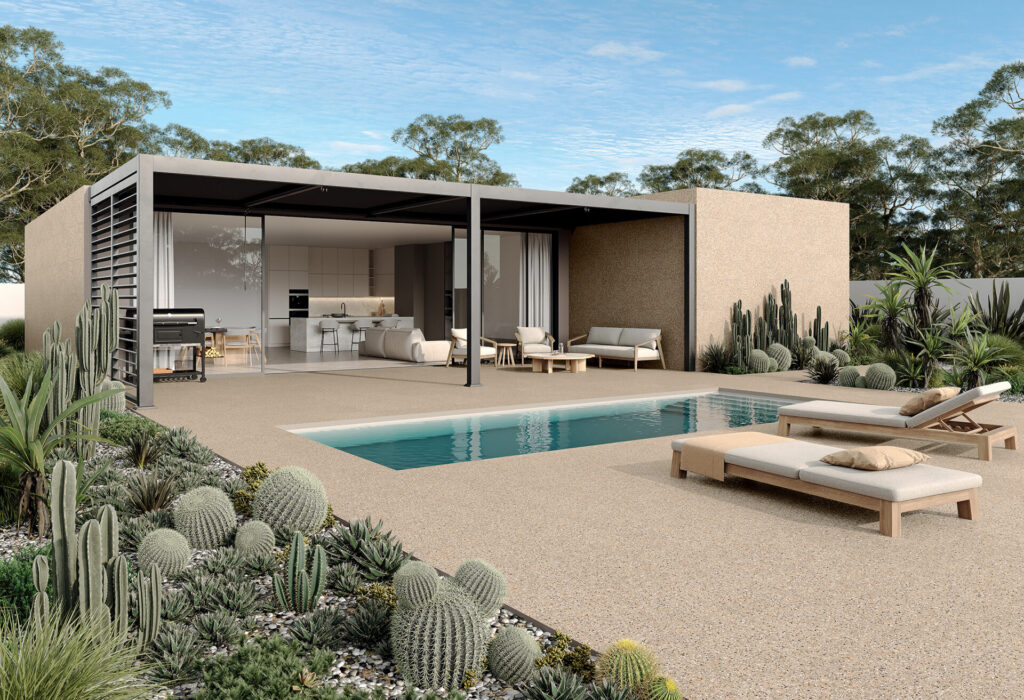
We see this happening now with materials such as 2cm pavers and collections that feature corresponding indoor and outdoor products. Outdoor living is a significant trend in the U.S. market, so adding tile products that serve this market increases consumption.
Similarly, while saturation has been slowed by limitations around labor, thin porcelain slabs have offered a fashion-forward take on surfacing while also being sustainable, easy to maintain and more affordable than the natural materials they often mimic, providing a new solution for specifiers.
“Increasing consumption relies on education, inspiration and accessibility,” says Paulo Pereira, vice president of MSI. “Demonstrating tile’s durability, design versatility and long-term value, while simplifying the selection and installation process, helps drive broader adoption.”
In addition, in a market obsessed with water-resistant floors, it’s important to remember-and promote-that a ceramic installation is truly waterproof.
FORMATS & FACADES
Tile formats continue to grow. “While 12”×24” remains the most popular format, 24”×48” has clearly emerged as the aspirational next step,” says Samdal. And some note that even larger tiles-such as 40”x48”-are becoming standard. Large formats offer fewer grout lines for a more seamless look and, of course, fewer of the problems that grout can present, such as discoloration and erosion due to its porous nature.
At the same time, smaller tiles are also finding a niche.
On the design end, the digital technology that has been altering the aesthetic opportunities in tile production for more than a decade continues to be applied in new ways to improve the aesthetics of the material, often in creating more realistic copies of natural materials. And, combined with evolutions in finishing to create texture, it offers ever-more-realistic facsimiles.
Another innovation to the surface of ceramic is Crossville’s FeatherSoft Finish, which yields a soft-to-the-touch feel. In addition, the coefficient of friction on FeatherSoft’s unpolished finish jumps when the product is wet.
CONSUMERS GRAPPLE WITH INFLATION
Interviewees agree that, on the residential side, homeowners remodeling right now are those with more discretionary income. These individuals have the money to get what they want and, for the most part, they do. “In the mid-to-high end of the market, we’re not seeing meaningful trade-down behavior in either residential remodel or commercial segments,” says Samdal. “There is a segment of consumers who remain relatively inflation-resistant and are prioritizing quality, longevity and performance over fast fashion.”
That said, the market is seeing increased interest in entry-level pressed porcelain, as customers look for thoughtful value without sacrificing design integrity or durability.
“Consumers are very price sensitive, though they are not necessarily trading down,” says Browder. “Consumers are looking for value.”
“While economic pressures continue to impact the housing and remodeling markets, demand for tile remains steady across residential and commercial segments at all price points,” says Jim Parello, president of Emser Tile. “We continue to see pressure in the ‘middle.’ Customers are wanting the mid-priced designs for the opening level price points, which is helping to create opportunities for innovation. What has changed and continues to change is that customers are more cautious, timelines are more fluid and suppliers, including contractors, are expected to help offset rising costs to keep projects moving.”
“New home residential is probably where you’re seeing the most price pressure right now as the builders are trying to get cost out of building a house,” says Maslowski. With flooring installed at the end of the building process, there is often increased price pressure as builders-exhausted from having paid higher prices for nearly every material and service throughout the building process-hope to make up cost by saving some bucks on flooring.
The story is similar in the commercial market. Increased costs throughout the building process come home to roost at the end. Browder explains, “If a builder started a 30-story high-rise three years ago, by the time they ordered windows and other materials, they found that the cost suddenly exceeded the budget, and by the time they get to finishes, they are above budget, so they are trading down, but not to $0.69/foot tile. This is happening at every level.”
“In commercial projects, specifications are generally being maintained, with value engineering focused more on timelines and logistics than on performance tradeoffs,” says Pifferi.
In all three segments, buyers are seeking value. “Value has a variety of definitions, and the overwhelming story for our commercial team was you have to be able to convey value to customers,” says Tom Kettering, AHF Products’ vice president of commercial sales. “Were we, at times, asked to find something less expensive? Yes, everyone is dealing with that, but we remind everyone that value doesn’t necessarily mean low price. It also means service, quality, how we stand behind products. We had three large projects in K-12, where they used our higher or highest price category products.”
Panisi points out that today’s customers-regardless of the segment-are searching for something different, and offering a differentiated selection is one way that manufacturers can turn the conversation away from price toward other topics.
THE SUPPLIERS
Last year, Atlas Concorde USA sharpened its portfolio around high-growth formats like 24”×48” products, outdoor 2cm pavers and a new stone program, while improving availability and lead times with U.S. production and tighter supply planning. It also increased capacity through ongoing factory investments and a more resilient U.S. and E.U. footprint, which helps it mitigate freight and energy volatility and serve project timelines more reliably.
Atlas Concorde USA is a part of the Italian Gruppo Concorde. This year, the company is celebrating a decade of business as a U.S. producer.
AHF Products’ Crossville characterizes 2025 as a year of investment and growth in a challenging market, a back-to-basics approach. “With all the market dynamics shifting, it was very important to stay close to the customer and make sure their projects hit expectations,” says Kettering. The company invested in new products, grew its residential and commercial sales teams, and introduced new carbon-neutral and FeatherSoft offerings. In addition, it invested in its inventory to ensure its best-selling quick-ship products were well-stocked.
Regarding its commercial sales team, the company now goes to market as a single-solutions provider with AHF’s other hard surface flooring options, which essentially doubled its size and provided momentum going into the second half of 2025. The company expects to grow its commercial team by another 10% in 2026.
Crossville, which manufacturers its products in Crossville, Tennessee, reports that it has the largest tile press in the Western hemisphere. The company’s offering includes slabs, which have grown continually thinner, to make better use of materials and energy.
In Q4 2025, Crossville hired merchandising and marketing expert Emily Mateo as director of merchandising and showroom sales to evaluate its Crossville Studios’ customer-facing experience.
Regarding his outlook for the coming year, Kettering reports, “I have been in the industry for 40 years and have never been more excited about what we are doing and what the next two years will look like. Scott [Browder]’s product team has given us good selection, and the quality of the people on our team is high. We are seeing some great wins in education, both K-12 and higher education, and in the healthcare segment, as well. Hospitality is a challenge because the process is more complicated, but we are seeing good traction there too, and expect nice growth.”
Mohawk-owned Dal-Tile, the parent brand of Daltile, Marazzi and American Olean, produces 80% of its U.S.-sold products in the U.S. The company continues to pursue innovation via investment in its manufacturing plants, through which it has achieved greater flexibility in what it can produce in each. The company notes that it is especially pleased with this achievement given the general unpredictability of business currently.
Dal-Tile’s products go to market a variety of ways: through its company-owned sales service centers, independent distribution and home centers, and its porcelain slab, quartz and natural stone sell through the big boxes as well as through fabricators. The company has over 100 showrooms around the country.
Dal-Tile, which serves both residential and commercial customers, reports that its porcelain slab business is very active, and the market for these products continues to grow significantly each year, both residentially and commercially.
One of Emser’s more significant advancements in 2025 was its digital transformation across Emser.com and EbyEmser.com, along with its fully integrated Emser Online B2B platform, which gives customers 24/7 access to product information, pricing, inventory, ordering, payment and shipment tracking. For dealers, distributors and builders, the platform removes friction from day-to-day operations and helps ensure they have the information they need to manage their business effectively.
Emser, a Los Angeles-based marketer and producer of tile products, has teams across the U.S. dedicated to segments and regions, including hospitality, dealer/trade, builder and multi-family home. Overall, Emser works closely with all its partners, including builders, custom homebuilders, remodelers, fabricators, contractors, retailers, mass merchants, kitchen and bath dealers, buy groups, pool retailers, designers and architects.
2025 marked one of the most significant periods of investment and growth in Florida Tile and Panariagroup USA’s history. The company invested heavily in dry-fix technology, advanced finishing capabilities and elevated design. As a result, 2026 will be its largest product launch year in nearly a decade, with more than 14 collections launching or expanding across both businesses.
Florida Tile and Panariagroup USA serve a diversified mix of residential remodel, builder, commercial and multifamily markets. The company believes diversification is essential to maintaining steady growth, particularly in turbulent economic cycles, and it allows the company to respond quickly as demand shifts across segments. The majority of its porcelain is manufactured in Lawrenceburg, Kentucky, while it sources porcelain, 2cm pavers and gauged porcelain panels from its European sister companies, which produce in Italy and Portugal.
The company sells primarily through distribution and its privately held branch network, both of which support dealers, architects and designers, builders, and contractors. It also has big-box and private-label programs, which are differentiated from its core catalog offerings.
Florim, part of Italy’s Florim Ceramica S.P.A., has U.S. operations in Clarksville, Tennessee. The company had a busy year in 2025, investing in its rebranding to the Milestone name for its U.S. distributor business. The company targets both residential and commercial customers.
In addition, Florim achieved B Corp certification for its U.S. operations. Its Italian arm earned this certification in 2021. B Corp considers not only the sustainability and transparency of the manufacturing process and resulting product, but also the company’s impact on employees, the local community and the environment. As Panisi puts it, “It is a 360-degree view of how our company is using business to do good things. That, for us, is a big achievement.”
Since 2021, the company has been investing in raising the level of technology at its factory. Today, it has two Continua systems to create formats up to 48”x 110” in varied thicknesses.
Over the last four years or so, Florim has been catering to the independent distributor by investing in higher-end product produced in the U.S., similar to what it had been sourcing from Italy.
Ceramic importer MSI continued to invest in design, merchandising, inventory depth and customer support last year, and also released new products, including its Elbe porcelain collection.
A key area of growth for MSI is its TileTouch Surface Technology, which utilizes textured finishing techniques to create dimensional and tactile surfaces that elevate both design and performance. MSI currently offers three TileTouch collections.
MSI caters to the needs of a diverse customer base across residential, commercial and mixed-use applications. The company has more than 50 distribution centers across the U.S. and sources its products from a variety of producers.
The company offers gauged porcelain panels through its Porcelain Stile program, which includes a variety of colors, finishes and select thickness options.
In 2025, Stonepeak, the U.S. arm of the Italy’s Iris Ceramica, continued the implementation of its new go-to-market strategy, which it rolled out in early 2024. The new strategy included changes to its branding and structure. “Our customers embracing these changes is what gave us the positives, the winds in 2025. We are putting the customer first and streamlining our approach to market,” says Narvaez.
Stonepeak serves both the commercial and residential markets with a fairly even split between the two. The company’s range of products focuses on better goods. Stonepeak has U.S. offices in Chicago with a factory in Crossville, Tennessee, and the firm supplements its U.S. production with imports from its factories in Italy and Germany. It goes to market through large distribution partners.
Stonepeak values innovation in product production. Its slab production includes what the company calls 4D technology, where the decorative pigmentation isn’t applied only to the surface of the product but is dropped into the entire slab, meaning that a cut end, for instance, would show color variation as a natural piece of marble would. The company’s slabs are available in formats up to 5’x10’ and thickness from 6mm to 20mm.
In addition, Stonepeak offers Attract technology for tile installation using magnetism, which ultimately results in a semi-permanent installation that can be removed at the end of its desired life without the need for the same degree of demolition.
Wonder Porcelain’s parent company, Marco Polo, went public in China last year, resulting in the largest-ever IPO in the home improvement space in China, according to the firm. In addition, 2025 marked Wonder’s ten-year anniversary. Jacky Huang, CEO of Wonder, is the son of the founder of Marco Polo.
Due to the antidumping duties on Chinese tile, Wonder cannot supplement its domestic product portfolio with product made in its Chinese operations, like those producers with headquarters in Europe can; therefore, the company has onshored some operations, including adding a mosaic line that it cuts in-house.
Wonder targets the medium to medium-high price range in the residential and light commercial markets. The company has become more focused on commercial business as a way to navigate the uncertainty of the market. Wonder goes to market through distribution.



Join Our Newsletter
Get the latest flooring industry news delivered weekly.