Focus of Leadership: Ken Walma love the mechanics of business – March 2026
Interview by Kemp Harr
Ken Walma joined the flooring industry as president of Mohawk’s North America business in November 2024, having most recently served as CEO for Big Ass Fans.
While he started his adult life studying mechanical engineering at the University of South Carolina, Walma realized that the mechanics he liked best were the mechanics of business, so he pursued opportunities in operations, soon joining Lutron, a manufacturer of lighting and shade control systems for residential and commercial applications. Lutron led him to Cooper Industries, which was acquired by Eaton, and then to Madison Air.
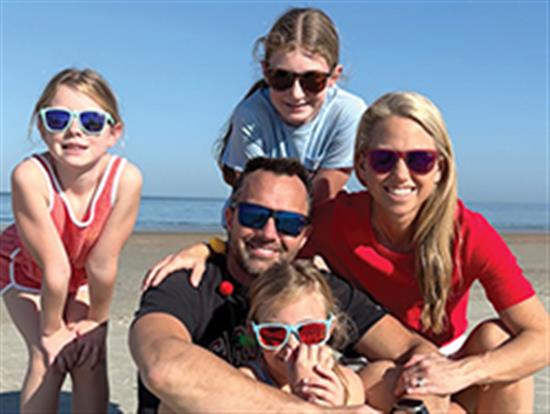
Today, Walma lives in Marietta, Georgia with his wife, Sara, who works in orthopedics, and their three daughters.
Q: Where did you grow up, and what are your fondest memories of childhood?
A: I grew up in three places: Washington, D.C.; Chicago; and Delaware. I have fond memories of all three places, but D.C. and its surrounding areas in northern Virginia are rich with history, stunning architecture and a sense of majesty. In addition, the area experiences all four seasons with hot summers, beautiful long falls, snowy winters and a truly colorful spring-creating a great backdrop for childhood. Lastly, being a boating family, we cherished the many waterways and wonderful seafood around D.C.
Q: You went to the University of South Carolina and leaned toward engineering, right?
A: Yes. I was one of those kids who, at two years old, was taking things apart. I grew up with interest in how things worked.
When I turned 16, there was a car sitting in our driveway that hadn’t run for a year. My father called a junkyard and asked, “How much will you give me for a 1974 Toyota Celica that doesn’t run?” They offered him $350, so he came to me and said, “I’ll sell you that car for $351.”
If I wanted to drive, I had to fix it. I opened the hood, tried to turn the key and heard something click. I figured out what had clicked, took it off, went to Pep Boys and said, “What is this? I need one of these.” They gave me one. I put it back in. The car started. That unlocked a passion for automobiles. From that point until I graduated college, I bought and sold 21 cars and two motorcycles. I paid my way through college by working as a bartender and fixing and selling cars.
Because I was great at math and physics, a high school counselor told me, “You’re an engineer. Go do that.” South Carolina had an up-and-coming mechanical engineering program. I also walked on the football team. The combination of those two and the palm trees were why I chose South Carolina.
Q: What did you do after you graduated?
A: My now-wife, who I met when I was bartending, was a year younger than I was, so I wanted to stick around South Carolina until she graduated. I worked at a nuclear fuel rod assembly plant building robots. I interviewed with Honda and Bridgestone, and then something struck me: I didn’t want to do engineering anymore. But I was fascinated with business and how businesses worked.
I joined Lutron. They put me in a rotational program. I got to sample all the different pieces of the business. Once I understood how business worked, that was the machine I chose to work on.
Q: You hit a home run at Lutron in the early part of your career. Tell us about that.
A: I was fortunate to be the right person at the right time. Lutron had invented the dimmer and was tremendously strong in residential environments, but it had not yet made progress as a mainstream lighting and energy automation solution for large commercial office buildings in the early 2000s. Every customer I met was eager for us to expand into that space. At the age of 23, I had the opportunity to pitch the owner of Lutron an idea over dinner, and a couple weeks later, he gave me a team of about 20 people to make it happen. A few years later, we launched, and it became the most successful initiative the company had ever had. The answer had been right in front of us; I just helped bring it all together.
After Lutron, I went to Cooper Industries, which hired me to build a controls and automation business-from $3 million to $100 million. That was 2007 and my first general manager role.
Q: How did lighting lead to Big Ass Fans?
A: I spent 15 years at Eaton after Cooper was acquired. I ran lighting, power, missile parts, emergency lighting-lots of different businesses. Eventually, my division was sold to Signify. Two weeks after the acquisition, Covid happened. We shut the business down and still delivered synergy plans.
I was ready for something different. I met private equity firms and became fascinated with how fast they move. A recruiter pitched Big Ass Fans. It had been acquired by private equity, was direct-to-consumer and a strong brand. I loved it.
We grew the business from $300 million to $400 million and added over $500 million in enterprise value. We drove more than 30% top-line growth and more than 30% bottom-line growth. Customers loved us, and employees loved working there. We were growing like crazy.
Eventually, the strategy changed, and I got the itch to go back to something with more scale.
Q: What was an "aha" moment in your career that helped you learn what to focus on to create more success in business?
A: I have had many such moments. The one that stands out most was when I became deeply focused on emotional intelligence and self-awareness as a leader. This shift in perspective transformed my approach from making things happen to enabling them to happen by empowering others. It was a pivotal change that greatly enhanced my effectiveness in business.
Q: A lot of this is getting the right people in the right seats, isn’t it?
A: Yes, but, most of the time, the people are already there. You just have to unlock their potential. Usually, the real problem is a lack of vision and strategy. When people understand how their role fits, the workforce feels new.
Q: You’ll be 48 on your next birthday, and you’re running Mohawk’s North American business. How did you make that happen?
A: It’s a line from a movie but for me, “It’s not the years; it’s the mileage.” It’s about the experiences and the journey. I could go into detail about all the different businesses I’ve led and the acquisitions and divestitures I’ve been involved in, but at the end of the day, it comes down to knowing my passions and understanding how I can create value. I’ve always sought to position myself with companies where I can help them succeed.
Q: What are the parallels and differences between the lighting/fan business and the flooring business?
A: As you can imagine, there are both similarities and differences. In the lighting business, the parallels are particularly strong because lighting has a tremendous impact on the visual aspects of a space-both in how it illuminates the area and in the aesthetic design of the light fixture.
Pre-LED lighting, lighting was one of the largest consumers of electricity. I was fortunate to be part of the industry’s transformation through control systems and advanced technology, which significantly reduced energy consumption. The lighting industry is a channel business, selling through resellers. There are two or three big companies that dominate the market, followed by a couple hundred smaller players. During my time in lighting, I also observed a shift in manufacturing, with production moving from the U.S. to Asia and Mexico, much like what happened in hard surface flooring.
The fan industry shares some similarities, but Big Ass Fans operated in its own space. It had a high percentage of direct-to-consumer sales and distinct product positioning, which provided a unique experience. The biggest difference I’ve noticed in flooring is the strong partnership with retailers and customers. Additionally, the industry has a significant opportunity to better substantiate its value.
Q: What are a few of the biggest challenges the flooring industry needs to solve?
A: I read a study last year that reported $640 billion was spent on home renovations in 2024. It listed the top three renovations that brought people the most joy and the top three that provided the best returns when selling their homes. Flooring didn’t make either list. While we do compete with other flooring companies, the real challenge lies in capturing the attention of homeowners and building owners from other industries that have already won their hearts and wallets. We need to emphasize the value of the experiences we can enhance, given our footprint in the home.
Q: Who were your mentors and what did they teach you?
A: I believe you can learn something from everyone. I don’t see myself as an expert in anything. There’s always someone who knows more, and I just need to find them and leverage their experience.
Q: What character traits do you look for when you are adding to your team?
A: Over the years, and outside of their specific technical competencies, I have found that individuals who are purpose-driven, transparent, capable of humility and with strong self-discipline are the best ingredients for leadership teams that take a business to the next level. Additionally, I am a fan of leadership profiling techniques like Discovery Insights and Myers-Briggs, which help me build a team with a diversity of thought and approach, ensuring we are continually challenging each other.
Q: How do you balance everything that is going on in your career with family and work?
A: I try not to think of it as a balance where one has to counter the other. This is my craft, and I love what I do-empowering teams to unlock profitable growth. I am purposeful with both my work and family time, and each complements the other. While there are certainly sacrifices and I don’t always get to do everything I’d like, my family understands we are very blessed to be able to enjoy different experiences together because of the work my wife and I do. This is also reflected in the culture of the companies I have worked for, especially Mohawk, which has a strong family-first mentality.
Q: What do you and your wife do for fun when you are not focused on work?
A: My wife and I both have a passion for creating new experiences with our family. We love all things water-boating, beach days, lake outings-and enjoy being outdoors and staying fit. We are also donors and volunteers at a marine science center. With a young family, I often find myself working as a chauffeur for gymnastics and soccer events.
Q: What advice do you give your three daughters about what it takes to be successful and happy?
A: Our message to our daughters is to find the biggest problem they love solving. If they love what they do, they won’t have to worry because there will always be people willing to pay them to do it.