


Designer Forum: How flooring shapes the patient journey at St. Mary’s Medical Center – Dec 2025
By Jill Wheeler
In 2023, the largest hospital in northern Minnesota opened its doors to the city of Duluth, casting its shadow over the banks of Lake Superior, the largest of the Great Lakes. Designed by architecture, engineering and interior design firm EwingCole, Essentia Health’s St. Mary’s Medical Center set out to transform healthcare delivery in the region. The team envisioned a hospital environment that is comfortable, welcoming and efficient for patients, visitors and staff.
Spanning nearly 900,000 square feet, St. Mary’s Medical Center redefines the scale of healthcare design in the Upper Midwest. With a footprint equivalent to two football fields, the new hospital presented EwingCole with a central challenge: how to make a complex environment intuitive and navigable for every visitor. The answer, in part, was found beneath the design team’s feet.
Flooring became a vital instrument of wayfinding and storytelling, linking the hospital’s architectural clarity to its overarching theme of natural and cultural landscapes. Across public corridors, gathering spaces and patient care zones, each flooring material reinforces a sense of place while quietly directing movement through a campus designed to calm, comfort and connect.
TERRAZZO AS TERRAIN
The West Link is the main corridor on the sixth floor of the hospital, stretching from Superior Street to 2nd Street, connecting visitors to both the inpatient and outpatient sections of the building. It offers views of the city and lake and houses key amenities such as a pharmacy, chapel and conference center. From the main entrance lobby, known as the Winter Garden, to the Dining Commons at the opposite end of the building, epoxy matrix terrazzo establishes a luminous and durable foundation for circulation.
Specified in two custom tones-bright white and warm grey-the terrazzo creates a visual rhythm while distinguishing key programmatic zones. Its aggregate-a blend of white marble chips, recycled clear glass and mother-of-pearl-catches the light in subtle patterns that echo the shimmer of Lake Superior just beyond the site.
Finished with a 200-grit water-based urethane for slip resistance and longevity, the terrazzo’s seamless surface helps orient visitors without the need for overt signage. Corridors open into touchdown areas, or spaces for pause and orientation, where the tonal contrast naturally signals shifts in function.
For EwingCole, the flooring’s material integrity and understated elegance made it an ideal solution for a facility designed to serve thousands daily, marrying aesthetic with performance.
CULTURAL LAYERS BENEATH THE SURFACE
Nowhere is the hospital’s narrative more visible than in the public dining area, or Dining Commons, where the design pays homage to the Ojibwe people, whose ancestral lands encompass the region. Warm wood textures and seating zones echo Ojibwe history and connection to nature. The cafeteria’s terrazzo floors ripple with metal inlays inspired by the waves of Lake Superior. At the same time, a custom glass-tile mosaic wall from Stone Source references Ojibwe textiles in a palette of ten vibrant hues. Together, these materials transform a functional gathering place into a cultural touchstone and an environment that invites calm and reflection as much as nourishment.
SPACES OF STILLNESS AND REFLECTION
The hospital’s chapel embodies quiet simplicity. Clad in natural wood from floor to ceiling, the sanctuary’s 7” engineered white oak flooring by Resawn Timber Company grounds the space in warmth and texture. Its 4mm veneer and matte polyurethane finish ensure durability in a high-traffic, contemplative setting.
A FOREST FOR HEALING
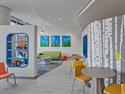
The patient tower consists of nine floors of private inpatient rooms with stunning views of the Duluth hillside or Lake Superior. Each floor has its own aesthetic theme, which helps orient patients, their families and staff and provides a de-institutionalized, calming atmosphere. On the pediatric floor, inspiration comes from the birch forests of northern Minnesota.
Destination seating areas feature Tarkett’s Allee modular carpet in Surf Teal, evoking sunlight filtering through a forest canopy. Surrounding zones transition seamlessly into Tarkett’s Acczent resilient sheet flooring in a warm wood tone that is durable, easy to maintain and softly reflective of natural textures. The combination creates a landscape where young patients and families can find comfort in familiarity, where play and rest coexist in gentle harmony.
FUNCTIONAL FLOW IN CARE SPACES
Within the NICU, flooring becomes a subtle boundary between clinical precision and family comfort. Acczent sheet flooring, chosen for its cleanability and cohesion, defines patient care zones, while adjacent family spaces shift to Acczent Tissé sheet in a warm grey tone. An integral cove base ensures seamless maintenance, reducing infection risks and supporting staff efficiency.
GROUNDED IN NATURE, GUIDED BY DESIGN
St. Mary’s aesthetic ethos was to reflect and celebrate the natural and manmade elements of its community. Across every level of the hospital, flooring serves as both path and palette, directing flow, distinguishing spaces and embedding a sense of place into the architecture. From the shimmer of terrazzo to the softness of resilient surfaces, each material selection supports the hospital’s central promise: to connect healing with harmony. By using flooring not only as a finish but as a language, EwingCole transformed a vast, complex facility into a series of human-scaled experiences.
THE AUTHOR
Jill Wheeler, regional director of interior design at EwingCole, leads the firm’s interior design discipline with a focus on staff development and design excellence. An architect and interior designer by training, she champions a holistic, multidisciplinary approach that integrates architecture, interiors, brand and furnishings to create cohesive user experiences. Her recent work centers on workplace transformation, creating environments that enhance performance and support employees. Wheeler holds a bachelor of architecture from Virginia Tech and a master of architecture from Columbia University, is a LEED AP BD+C, NCIDQ certified, and is a member of the AIA.



Join Our Newsletter
Get the latest flooring industry news delivered weekly.