




Winning the Stay-in-Place Consumer: Reaching today’s homeowner is an active pursuit – July 2026
By Jessica Chevalier
When home sales are slow, as they have been for the past four years, floorcovering retailers become increasingly dependent on homeowners choosing to improve their current residences rather than move to a new one.
“Right now, the main driver for flooring sales is people realizing that buying a new home is not worth it and instead deciding to stay and remodel,” says Todd Duffy, CEO of Molyneaux Home, which has eight locations in the Pittsburgh, Pennsylvania area.
Ryan Rogers, CEO of Texas-based Yates Flooring Center, notes that, in 2022, Yates’ business was 45% residential remodel and 38% builder/new construction. This year, residential remodel accounts for 55% of business—and has been for 12 months rolling—while new construction makes up only 25%. (In both cases, the remaining percentage of business is commercial.) Yates operates locations in Lubbock, Midland and Amarillo.
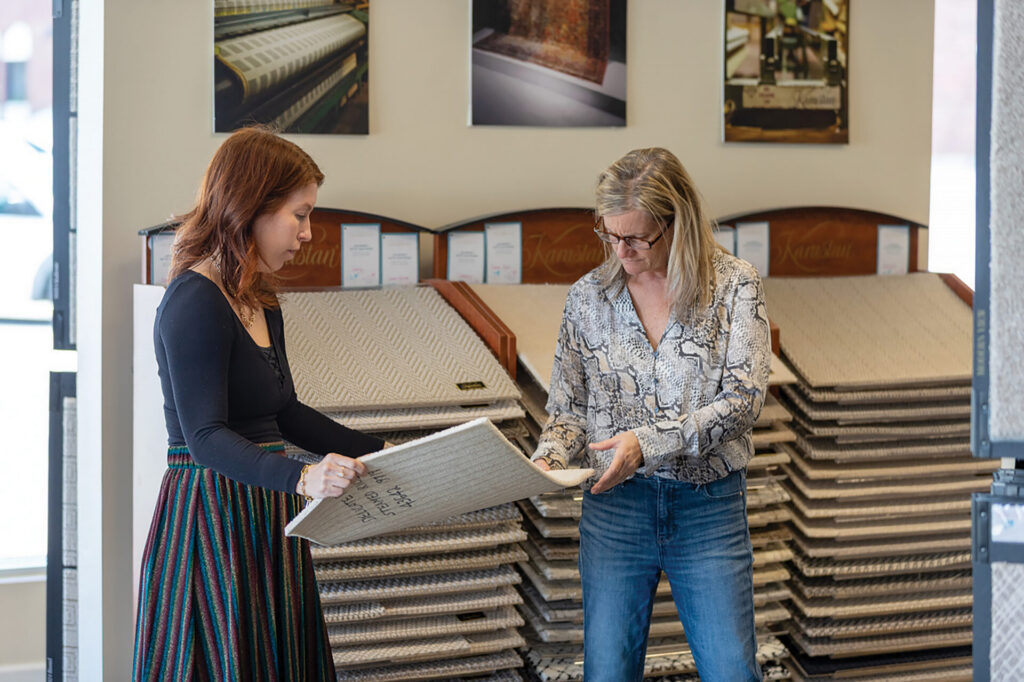
As retailers become more dependent on discretionary remodeling projects rather than housing turnover, attracting homeowners requires a more proactive approach, one making the argument that a flooring upgrade will improve their living experience. “You have to keep your foot on the gas and get your name out there,” says Duffy. “You can’t just expect people to come to you without encouragement because in this environment, they won’t.”
THE RENOVATION CYCLE
The pandemic disrupted the typical renovation cycle, and the years since have been somewhat unusual. Once American homeowners got the hang of managing quarantine and safety protocols, many opted to update the spaces in which they were cloistered, and that pushed up some renovations that would have happened later, which then created a trough. As the world began to reopen, consumers were eager to get out of their houses and stretch their wings with travel and took a break from investing in home improvement, and, at the same time, economic conditions—including higher interest rates, inflation, elevated material costs and uncertainty—made renovation less affordable.
Harvard’s Joint Center for Housing Studies estimates that homeowner improvements and repairs began rising dramatically at the start of 2022, ultimately reaching a 26.6% year-over-year increase in Q4 2022. Numbers descended thereafter, dipping into negative territory a year later (Q4 2023), down 1% year over year, and remaining negative until Q1 2025, when it was flat and began to chalk up low single-digit growth again through 2025, projected to have continued in 2026.
As remodeling activity normalized, retailers found that the current market increasingly consists of two distinct groups. “There is a large group of consumers who are flourishing, with a ton of home equity, and they’re opting to stay put until interest rates come down. And these are the folks that are spending on home renovations,” says Fred Black, chief operating officer for USA Flooring. “These shoppers have the luxury of keeping up with current design trends.” USA Flooring has locations in Raleigh (2), Durham, Fayetteville, Wilmington and Winston-Salem, North Carolina with mobile showrooms in Pinehurst and Charlotte.
The other group of homeowners lacks the advantages of assets or equity. These homeowners may have big dreams for their home and recognize the need for flooring replacement but lack the resources to invest in a large way at present and are more likely to delay projects, prioritize necessities over aesthetics or seek lower-cost solutions.
“At the end of the day, if you compare the environment today to the boom in 2021 and 2022, homeowners are less impulsive now,” says Black. “They want clarity of their options and reasons to move forward. As retailers, we have to establish confidence more than in the past when they were more impulsive. Today, they are moving slower, doing more homework and investing in products that will solve a problem and last longer.”
ACTIVE APPROACH
The selling and buying of homes has historically generated the majority of flooring remodeling activity, as sellers spruce up their properties for sale and buyers look to make new homes their own, meaning this business is triggered by an event outside of the flooring retailer’s control.
However, because homeowners can live on an ugly flooring indefinitely, the trigger of a purchase for homeowners who are staying put is different—not about upgrading to something attractive to catch the eye of a buyer but about making improvements for their own pleasure. “In general, move-related customers often have urgency, while stay-in-place customers often have deeper emotional investment,” says Black.
The retailer’s outreach should help create that motivation, encouraging homeowners to explore flooring options, visit a showroom and envision how a new floor could improve their daily living experience. The challenge is persuading them to invest in a project that is discretionary—replacing a floor they can continue living with, even if it no longer reflects their tastes or needs.
The challenge of motivating discretionary purchases is compounded by the split between the higher end of the market and those more constrained by economic conditions. The bulk of Americans have found their earnings handcuffed by inflation, with uncertainty and world events hampering sentiment. Some of the consumers that fall into this group are in wait-and-see mode, setting aside any extra dollars for future challenges. Spurring a sale among these consumers is harder but not impossible, say interviewees, if you reach them where they are.
“We don’t blame the economy for our performance,” says Steve Walbolt, president of MDG Flooring America and Monarch Carpet One, with stores in Medina, North Olmsted, Akron and Brunswick, Ohio. “If a lead walks in, they probably have some legitimacy in looking. There is not a lot of tire-kicking right now, so it’s our job to identify their pain points and needs and wants and really be a consultant along the way. You need to have a solid team member working with them and a good project manager, as well.”
He continues, “I hear some of our sales staff say, ‘The customer never called me back.’ A lot of closing a sale is process procedure, but you also have to have a team culture that really cares about the person and their project.”
For Atlanta Flooring & Design Centers, “residential market refurbishment has been the most sluggish business segment,” reports CEO Donny Phillips. “The residential market, which is more sensitive to news cycles, really suffered last year and through the first quarter of this year.” Phillips’ business has retail locations in Duluth, Warner Robins and Suwanee, Georgia; Chattanooga, Tennessee; and Greenville, South Carolina.
“The modern customer is still very price conscious when they enter any store,” says Phillips, “but if our sales team does a good job explaining features and benefits and that a better floor can give you more years, then we can upgrade that sale. In reality, it does help the customer to have a longer-lasting floor. It’s a better purchase for them, and, sometimes, a better sale for us.”
TIMING IS KEY
Rogers reports that the bulk of homeowners buying right now are doing so because their current floor has uglied out. “With rates where they are, they are staying in their home and might want something more in style, something new and refreshed to live on,” he says.
Walbolt has noticed consumers begin to consider renovations when they take a look at their home’s tired flooring and assess whether they could use their equity or savings for updates. “They start online and look at our reviews, and that drives them in,” he says. “Oftentimes, the consumer is doing more research on the front end rather than just popping in the store like they used to.”
Retailers say that generating interest is only half the battle. Once a homeowner begins exploring flooring options, speed of response and consistent follow-up become critical to closing the sale.
Duffy has noticed one unique factor in the current market. “People are still spending money, despite the economic environment, but they want everything fast,” he says. “We have had lots of cancellations and have been trying to figure out why. We are shortening the timeline for designers to visit the home because we have to get a potential customer a quote quickly. We see demand for faster turnaround times.”
Walbolt agrees, noting, “Time is of the essence. If you have customers who are calling in and asking for a quote, you are already on the verge of losing them.”
In Black’s market, the story varies a little, though timing remains key. “We are not seeing cancellations, but hesitation,” says Black. “More searching, more phasing, but overall, the desire to improve the home is there.”
To keep prospective customers engaged during that decision-making process, some retailers are investing in new follow-up systems. USA Flooring has implemented SMS automation as follow-up to sending a quote, a program it built in-house.
“When we email a quote to a customer, it triggers SMS automation for additional touchpoints, versus a manual system where RSAs have to call on the quotes repeatedly,” says Black. “The SMS automation makes touchpoints at day two, day six and day ten after sending a quote. Tracking our close percentage, we know that our conversion rate on quotes overall is 38%, and then on the SMS automation texts, the rate on day two is 30%, on day six is 10%, and on day ten is 9%.”
The system has improved close percentages and offers a hand to harried RSAs, who might otherwise get busy with other customers and fall short with after-quote follow-ups.
THE NITTY GRITTY
For the average consumer, budget remains a key talking point. “Not everyone, but the majority are saying, ‘This is what I have to spend. What should I look at?’” says Rogers.
The retailer reports seeing a good number of consumers embarking on large-scale renovations—not a single room—which he believes is unusual in comparison to the larger U.S. market. He attributes this to the mindset of buyers in his Texas markets, who often take a conservative approach to spending and would rather pay in full for a large purchase than finance it.
Budget constraints also influence how sales teams structure their conversations with potential customers. In Walbolt’s area, customers more frequently come in seeking products for a single room. “When we are in our finding phase, we can uncover their true needs by asking good questions,” he says. “Some just do a room, but once you show the bigger picture, you can sometimes close a sale on the whole floor.”
Walbolt believes that offering kitchen and bath renovation helps in this regard. “We have a few KIBA Studios, and that has helped dramatically,” he says. “If someone comes in for kitchen and bath, they need flooring, and vice versa. It gives them a realistic way of knocking out a whole project at once rather than piecemealing with different companies.”
As budget remains the starting point for most purchases, retailers are increasingly using financing options to expand what customers feel is financially possible. Financing can play a large role in making a purchase possible for customers who do not have the equity or savings to pay outright. Duffy notes that Molyneaux’s financing program is “a huge advantage for us.” The retailer has seen an increase in the use of financing when the company runs financing specials.
Walbolt does not believe that stating that a company offers financing is enough. Instead, RSAs should outline the terms and details to provide the consumer a true understanding of what the program can afford them—not only payment flexibility but also the opportunity to purchase a better product that will last longer and perform better.
Rogers reports that, in his area, many consumers have the mindset of saving until they have the money to buy something, so financing isn’t as popular an option as it is in other locations. That said, Rogers reports that he would love to see an increase in the use of financing from his customers.
LABOR PLAYS A ROLE
Labor availability and installation quality shape consumer confidence in flooring purchases, as homeowners weigh both cost and the risk of potential failures. Black’s family currently has a friend’s daughter staying with them as she completes a summer internship at a law firm in Raleigh. She told Black that, by call volume, flooring is one of the top complaints the law firm is contacted about.
Wagner Meters estimates “moisture-related flooring failures continue to cost contractors, businesses and homeowners a staggering $2.4 billion per year in remediation and repairs”—and that does not include poor workmanship, product failure or other problems, like the widely publicized Lumber Liquidator laminate formaldehyde scandal, which generated concerns about the health of those living atop the flooring.
There is no way to estimate how many homeowners have been negatively impacted by these sorts of issues, nor how many people they have told about their experiences, but it’s safe to say that some percentage of Americans has been harmed or significantly inconvenienced—financially or mentally or even physically—by flooring failures, and this likely impacts their eagerness to embark on additional projects.
“So many homeowners have heard horror stories from their neighbors or read bad reviews online, and that scares the consumer,” says Black.
Some of these failures are the result of poor workmanship. Black continues, “There is absolutely a labor issue, which slows down the homeowner’s willingness to move forward with projects. According to manufacturers I’ve spoken with, the industry is flat to down 5%. If we are having a hard time right now with keeping up with installation requirements, what will it be like when interest rates come down and pent-up demand starts moving? We don’t realize how bad the situation is with the lack of quality labor because demand isn’t very high. When we see our next boom, it’s going to be very apparent that there is a big problem.”
In an effort to assist with finding solutions to this crisis, Black serves on the board of the Floor Covering Education Foundation and believes that the organization’s program to partner with community colleges to teach flooring installation is a path forward. “I have six community colleges in North Carolina working to launch the program, and that will build a pipeline into our market,” he says.
MANUFACTURER LEADS
In prior years, one of the benefits retailers received from partnering with manufacturers was receiving consumer leads brought in by manufacturer websites. However, only one of the retailers interviewed reports receiving leads directly from manufacturers, though some did believe that consumers may identify their operation through manufacturer “locate a dealer” features.
“Direct-from-manufacturer leads are few and far between, but when they do come in, they generally bear fruit,” Rogers says.
Walbolt reports that, pre-Covid, his company may have received a lead from a manufacturer once a month, but that has now dwindled to nothing.
One interviewee said that leads gathered through a manufacturer site are most often channeled to the local retailer that has the most significant partnership with a particular brand or product line. For instance, a lead for Mohawk’s RevWood or Shaw’s Coretec would be channeled to the local dealer with the largest representation of that line in the area.
USA Flooring does receive leads from manufacturers—particularly Mohawk, Shaw and Daltile—but Black has determined through investigation on manufacturer sites that the “find a dealer” features can be as problematic as they are helpful. Blacks asserts that oftentimes, these lists are not maintained with frequency by the manufacturer. At times, he has searched zip codes where his stores are located and found that USA Flooring is not listed. While updating these lists may be a low priority for manufacturers, it feels significant to dealers that have invested in forming partnerships with these manufacturers and promoting their products.
The leads that USA Flooring does receive from manufacturers vary in quality. Black notes, “The close percentage is much different with some manufacturers because of how they run campaigns and retarget initiatives to stay in front of the customer. The leads higher in the funnel and those retargeted perform much better. The best manufacturer leads are ones where the customer has already shown intent, researched the local dealer and identified a certain product.”
He continues, “The way manufacturers have their programs designed, the higher you are in the loyalty program, the higher the percentage of co-op you get. We are a diamond level with Shaw Flooring Network, so we get 100% co-op on campaigns we are running. That’s still their dollars; they are just letting us use some of their dollars because the campaigns are more effective if I run them. For example, if a manufacturer runs a campaign nationwide to drive leads to their website for them to find me, that would be a broad-stroke campaign, but if they give me those same dollars and let me run them, my campaigns will look much different.”
STRATEGIC OUTREACH: YATES
Over the last three years, Yates has targeted its advertising toward remodel market consumers. “TV is still king in our area of West Texas,” reports Rogers. “We spend the majority of our advertising/outreach budget through professionally made television commercials. We do partake in socials/radio/billboard advertising avenues, but currently we are spending much less in these sectors compared to TV.”
Last month, Yates opened a new, 80,000-square-foot location in Lubbock. The company reports it made the investment in the new space because walk-in customers remain a vital part of its business.
As the company has been situated within its community for 51 years, it has a strong name in the area, and its community involvement efforts are substantial and consistent, regardless of the economic climate.
STRATEGIC OUTREACH: MOLYNEAUX
Molyneaux, a 96-year-old company, targets a mid- to high-end customer with its flooring and sells primarily private-labeled product. “We thrive on offering service,” says Duffy. “We aren’t known for being the cheapest but the best.”
Duffy believes that Molyneaux’s diversified offerings are a boon in challenging times, “We offer not just flooring, but painting, which is something that a lot of flooring customers will consider doing themselves and a great opportunity to upsell,” he notes. “We will say, ‘You can add it to your financing for $40 a month.’ That really helps.”
Molyneaux focuses its spending and effort on digital advertising, also participating in community events such as home shows, where it will hang a banner to keep the brand top-of-mind among consumers.
Further, Molyneaux knows that often a sale begets a sale—but sometimes later. “When a customer buys hard surface, they might feel financially strapped after making the purchase, but typically, after they live on the floor, they want a rug, so we send an email two weeks later with a sale on area rugs,” says Duffy.
Another avenue Molyneaux utilizes is nurturing relationships with restoration companies, which recommend the retailer when a customer needs to replace flooring due to a disaster.
Like Yates, Molyneaux participates in local home-centered events, like the Pittsburgh Home and Garden show and Ross Township’s Community Days, where it might host contests, such as a free room of carpet give-away, requiring that hopefuls sign up using their email, which allows the company to build its email list and thereby reach customers directly.
STRATEGIC OUTREACH: ATLANTA FLOORING DESIGN CENTERS
A little over a year ago, Atlanta Flooring Design Centers hired an additional employee to focus on social media. “Due to the fact that we have two outlets and three retail locations, he has concentrated on getting our name out in those markets,” explains Phillips. “That has helped. We still believe that advertising in Atlanta is difficult.”
He continues, “It’s hard to motivate people to come in the store. The key is to catch them when they are interested in flooring and online doing research. We have to be available digitally in whatever place is geographically desirable to their location. I would like to say we have silver bullets, but we are searching for the right approach each week.”
The 41-year-old company leans into its role within the community—outside of buying and selling. “We promote our involvement in of the communities we serve,” says Phillips. “We really believe in that. You can’t just take; you have to give back. That’s part of our core values.”
That involvement varies from branch to branch, led by the employees’ interests and passions. If a teammates’ child is involved in sports, Atlanta Flooring Design Centers may sponsor their team, but the company is also committed to the betterment of the community through charity work. This spring, as it has for the last five years, the Suwanee team participated in a promotion to build beds, so that no local child sleeps on the floor. “We had 50 people from the Suwanee complex involved. We try to build 40 to 50 beds a year,” says Phillips.
Several years ago, the company instituted volunteer-time-off policies for teammates who want to use their time to support a cause close to their hearts.
STRATEGIC OUTREACH: MDG FLOORING & MONARCH CARPET ONE
Walbolt believes business is finally returning to normalcy, following the Covid business boom. “During Covid, sales were coming in left and right, but a lot of trade processes got really messed up,” he says. “Sometimes my team says they feel like business today is moving backwards, but I tell them, ‘This isn’t backwards. We’re returning to normalcy. We need to make sure we don’t take the customer for granted and assume every sale will close. We have to be a solution.’”
He continues, “We aren’t perfect by any means. It is absolutely tougher to close sales now, but, in my opinion, that will make us better stewards for the customer, not just salespeople but partners for the long run. The key is building processes behind this. If all your customers get a different experience, it is chaos. Serving a customer should be rinse and repeat. It’s about training, training, training.”
Walbolt doesn’t make significant changes to his outreach with changes in the economic climate but does tweak his team’s approach slightly. He explains, “When consumers hear about tariffs on the news, they bring that up to us, and educating them can provide an opportunity for us to say, ‘We don’t know when a price increase will come. But history indicates that it most likely will, and that could make your project 10% higher.’ Educating them on the ‘what if’ of that can close the project.”
Walbolt uses multiple channels to advertise his business. “Community involvement is huge,” he says. “It gives us more credibility and awareness in community.” In addition, the business buys ads on streaming TV, participates heavily in social media, uses search engine optimization and does some print advertising.
STRATEGIC OUTREACH: USA FLOORING
“One of the hot topics right now is generative engine optimization (GEO), which is different than SEO,” says Black. “AI is going to be how the consumer searches things like, ‘Where should I buy my flooring in Raleigh?’ and that is new. Once Google figures out how they will monetize it and charge us for AI searches. That will be the next big thing.”
In preparation for that, retailers can work now to establish themselves as experts in their market, “not trying to sell the consumer online but be recognized for their expertise, like through YouTube, publishing content that helps earn the consumer’s confidence,” say Black.
USA Flooring’s pro program is another key strategy for the firm. “A lot of the larger box stores have pro programs and are doing well because that caters to the consumer who is staying in place and has hired a contractor,” explains Black. “In cases where consumers are doing multiple projects to beautify the homes, they are more likely to hire pros, and the retailers who are working with these pros will get a larger percentage of the pie of the stay-in-place consumer.” Key to serving the pro is stocking inventory, so that pros can get what they need when they need it. “They don’t have the luxury of long lead times,” says Black.
USA Flooring has been in business for 53 years.



Join Our Newsletter
Get the latest flooring industry news delivered weekly.