




Production Spotlight: An inside look at AHF Products’ Cartersville facility and the next phase of domestically produced LVT – April 2026
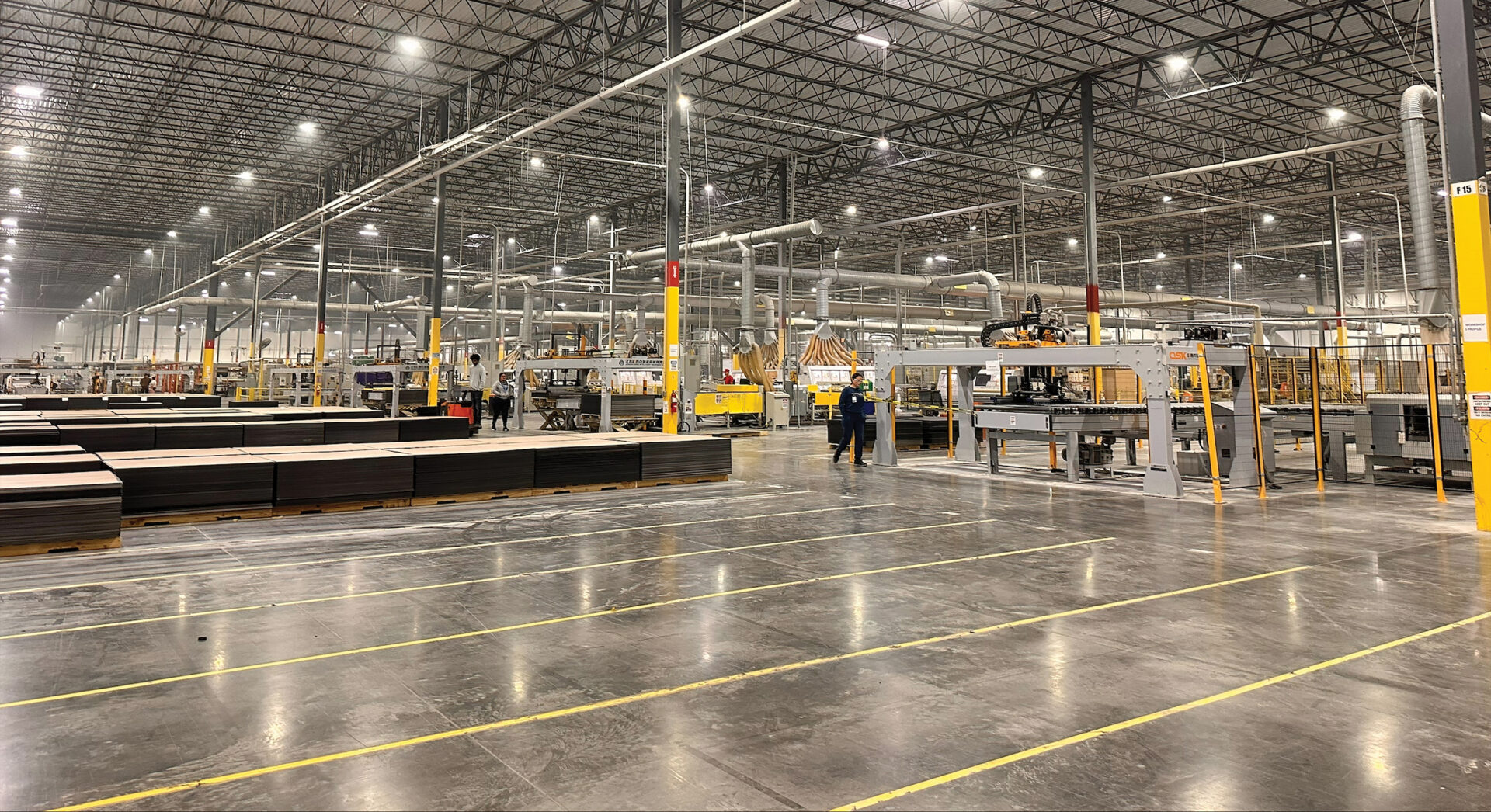
AHF Products acquired this 328,000-square-foot facility in Cartersville, Georgia, in late 2025.
By Meg Scarbrough
In the evolving conversation around domestic manufacturing, AHF Products’ recently acquired facility in Cartersville, Georgia represents a different kind of investment—one rooted not in legacy, but in acceleration.
Acquired in November 2025 and brought back online in early 2026, the plant is designed to support AHF’s expansion into rigid core flooring, a category that now dominates residential demand. For a company originally anchored in hardwood, the move signals both a portfolio shift and a strategic response to changing consumer behavior.
“This acquisition of this factory was totally strategic for our residential business, because today’s consumers are all buying from the rigid core category,” says Catherine del Vecchio, vice president of marketing for AHF. “We didn’t really have the right assortment to bring to the market to really be impactful again. But with this acquisition, we finally have the right products.”
The Cartersville facility—spanning roughly 328,000 square feet—now completes AHF’s domestic hard-surface manufacturing footprint, adding rigid core capacity to a portfolio that already includes hardwood, resilient and porcelain tile.
PROCESS, SIMPLICITY AND CONTROL
Walking the production floor, it’s clear that each step of the manufacturing process is streamlined—extrusion, coating and finishing, and profiling—organized in a linear flow designed for efficiency and throughput.
“Simplicity is what we try to drive here,” says John Sommers, who serves as executive vice president and general manager and has a long history in the flooring business. “The lines don’t need to be overly complicated.”
But that simplicity is largely visual. Beneath it is a tightly controlled system where complexity is embedded in formulation, timing and process discipline rather than machinery.
At full capacity, the plant is equipped with 16 dual-screw extrusion lines, multiple mixing stations, and four UV coating lines, with annual capacity exceeding 200 million square feet.
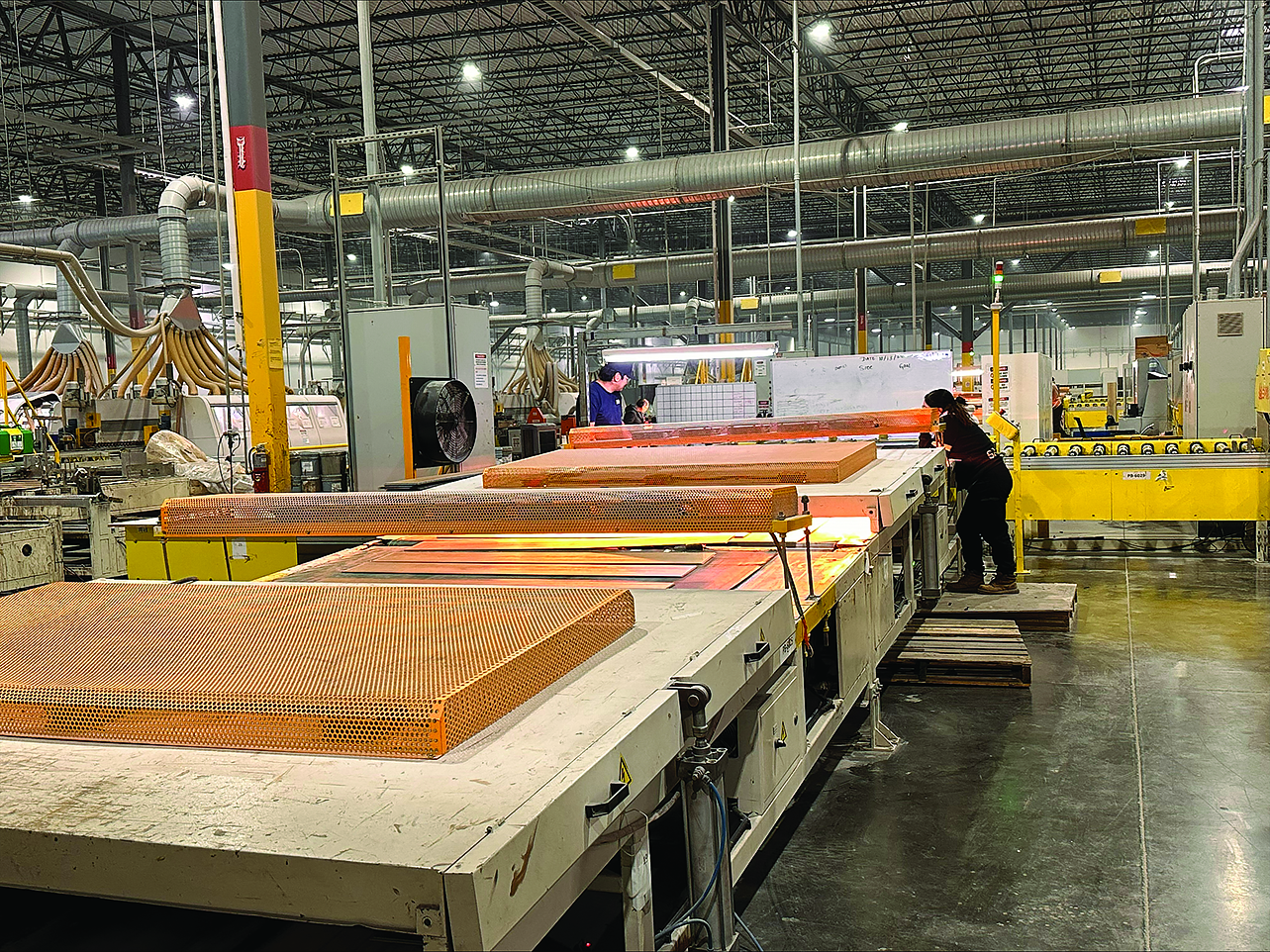
At the front end, raw materials are blended and fed into Asian fabricated extruders, where the core structure is formed. Decorative films and wearlayers are applied before boards enter a critical stabilization phase. Depending on product thickness, these slabs may rest for eight to 14 hours before moving forward.
“Once it comes off the line, it has to cool down, it has to settle down,” Sommers explains. “If you process it too fast, you’re going to have problems.”
That emphasis on timing carries through to finishing. Boards are cleaned, coated—often with multiple UV-cured layers—and paired with attached underlayment before moving into profiling, where locking systems are milled with extreme precision.
“You can’t cut that profile all in one fell swoop,” Sommers notes. “You’ve got to do a section at a time.”
QUALITY, DATA AND TRACEABILITY
If the process is simple in structure, it is rigorous in execution. By the time a finished plank is boxed, it has undergone as many as ten inspection points.
Operators pull samples every 15 minutes and conduct full-box checks every hour, logging results digitally and tying them to specific lines, shifts and production times.
“We check constantly—every step, every stage,” Sommers says.
Each board is lot controlled, allowing the team to trace performance questions back to the exact moment of production. “We know when it was made, what line it was made on, what shift it was done,” Sommers notes.
That level of visibility supports both quality assurance and field performance. “We don’t want a rubber band on it,” he adds. “It goes out and stays out—we don’t want it to come back.”
HDPC PERFORMANCE DIFFERENTIATION
At the center of the product strategy is AHF’s proprietary High Density Polymer Core (HDPC), an enhanced SPC that the company positions as a key differentiator in a crowded rigid core market.
The formulation emphasizes density and stability, reducing susceptibility to temperature swings and indentation—two of the most common failure points in the category.
“It comes down to the product stability,” Sommers explains. “A better-quality product that is more resistant to dents, more resistant to temperature fluctuations.”
According to AHF, the material maintains dimensional stability across a wide temperature range—from below freezing to extreme heat—helping prevent issues like movement, cupping and joint failure.
That performance story is particularly relevant in builder and multifamily environments, where installation failures can quickly erode margins.
“There have been a lot of inferior products that have come into the marketplace that have failed,” Sommers notes. “There’s no callbacks; it’s just the ease of installation, knowing you’re not going to have a problem.”
FROM ACQUISITION TO OPERATION
Perhaps the most striking aspect of the Cartersville facility is the speed at which it has been brought online. Within roughly 120 days of acquisition, AHF has restructured operations, integrated systems and begun ramping production.
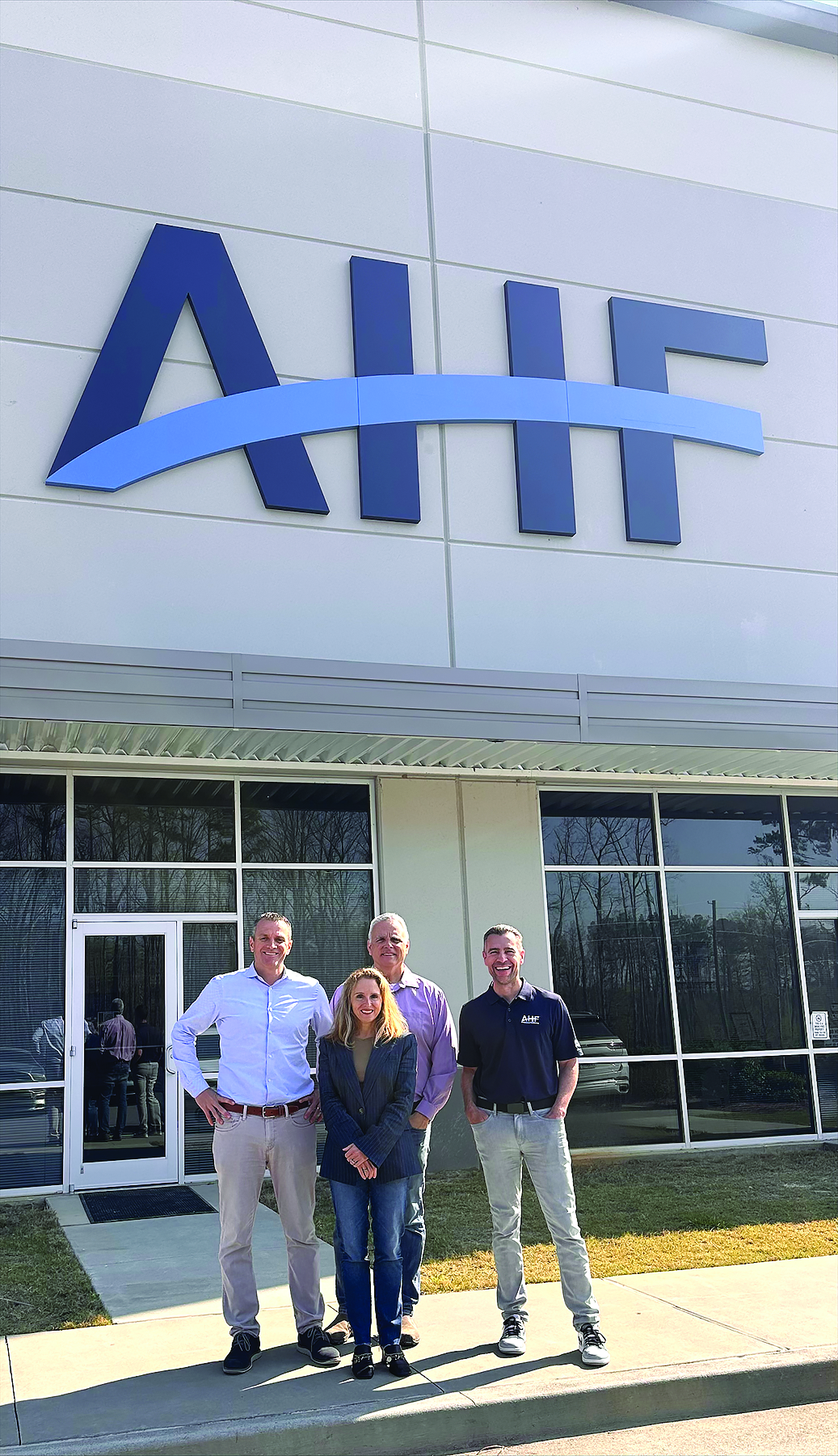
and CEO Brent Emore.
That process included a full workforce reset, ERP integration and a cultural shift toward AHF’s operational standards—particularly around safety and accountability.
“We actually took the plant down for ten days post-acquisition and conducted a complete re-vetting and screening of the entire workforce,” says CEO Brent Emore.
Today, the facility employs roughly 150 people, with a majority transitioning from the previous ownership.
“We’ve already done a survey…and they feel safer, it’s a better environment,” Sommers adds. “They feel that they’ve got the right management team.”
New systems—like tablet-based production tracking—have replaced more informal processes.
“What they were doing was logging in their quality issues and then sending it by text chat,” Sommers explains. “Now we’ve got tablets on the floor and they can quickly scan, plug the number in, and it gets transmitted to the lab.”
DOMESTIC ADVANTAGE AND MARKET POSITION
Beyond manufacturing, the Cartersville facility plays a central role in AHF’s broader strategy. It supports the relaunch of the Armstrong Flooring brand in resilient flooring, with a new assortment of approximately 60 SKUs designed around performance tiers and elevated visuals.
“There’s a lot of energy bringing Armstrong back,” del Vecchio says. “It’s such a legacy brand…the most trusted brand in flooring.”
The domestic footprint also addresses a growing priority for customers navigating ongoing supply chain volatility.
“In this environment, domestic manufacturing matters,” Emore explains. “There’s tariff volatility, diesel prices, all that noise.”
Located in North Georgia, the facility also provides proximity to key customer bases, enabling faster delivery and more responsive inventory management.
“We’ve got two major customers 40 miles down the road,” Emore adds. “There’s a lot that comes with being right here.”
A PLATFORM FOR WHAT COMES NEXT
While the broader residential market remains challenged—pressured by interest rates, inflation and cautious consumer spending—AHF’s strategy is built around readiness.
“When consumer demand for flooring starts its resurgence, you’ve got to be ready,” Emore says. “We don’t want to be talking about extruder number six still being out of service.”
In that sense, Cartersville is less about the present moment and more about positioning for the next cycle: a facility built to scale quickly, support multiple channels and deliver consistent performance.
What appears, at first glance, to be a simple manufacturing operation reveals itself as something more deliberate—a system built on control, speed and repeatability.
And in a market defined by uncertainty, that combination may be the real differentiator.



Join Our Newsletter
Get the latest flooring industry news delivered weekly.