


Owning More of the Project: How flooring retailers are rethinking diversification in a changing market – June 2026
By Meg Scarbrough
Customers aren’t just walking into flooring stores looking for floors anymore. Increasingly, they arrive carrying larger renovation plans with them—new cabinets, countertop samples, bathroom remodel ideas or entire-home projects that stretch well beyond floorcovering. And for many retailers, that shift has prompted a question: if customers are already planning broader projects, should retailers equip themselves to capture more of that business?
In a slower housing market shaped by affordability pressures, elevated interest rates and limited inventory, retailers are rethinking diversification, not simply in terms of adding categories, but as a strategy to capture more of the customer journey. Rather than chasing growth through volume alone, many are looking for ways to own a greater share of projects already entering their stores.
For some, that means kitchen and bath. Others are expanding into commercial work or complementary services. But while the categories may vary, the goal increasingly sounds the same: create deeper customer relationships, simplify the buying process and build resilience in an uneven market.
BEYOND FLOORING
At Independent Carpet One Floor & Home in Michigan, owner Cathy Buchanan says the company’s move into kitchen and bath stemmed from a realization that customers were already signaling where opportunities existed.
“People were coming into our store with a cabinet under their arm or a granite countertop, and all they wanted from us was a floor,” Buchanan says. “We were missing that cabinet business. Why not make this a one-stop shop and capture the whole project?”
The retailer had experimented with diversification efforts before. Through programs offered within its network, the company tested closet systems and, later, window treatments. Neither effort gained traction long term. Rubbermaid closet organizers failed to generate meaningful demand, while window treatments encountered challenges tied to the disruption of Covid, turnover among support personnel and limited training resources.
Buchanan does not frame those experiences as failures. “You have to try,” she says.
Instead, she views those attempts as part of a broader process of understanding what fit her business and customer base.
Kitchen and bath felt different. Before committing, Buchanan spent time watching peers across the country who had already adopted CCA Global’s Kiba Studios showroom concepts. Rather than immediately jumping in, she visited stores, asked questions and used existing operators as sounding boards.
When the retailer ultimately moved forward, the process
involved more than simply inserting displays into an existing showroom.
The company removed numerous displays, redesigned merchandising and carved out significant space for a dedicated kitchen and bath department.
The move reflected a broader realization many retailers appear to be making: diversification is increasingly becoming about creating a one-stop-shop experience. Customers may initially enter with flooring in mind. But once broader remodeling conversations begin, opportunities expand. And retailers want those conversations to stay under their own roof.
The same dynamic emerged at Contract Furnishings Mart.
Garrett Anderson, director of marketing, says the company’s move into countertops and cabinetry was driven less by pursuing new categories and more by understanding existing customer behavior.
“We’re great at flooring, but these customers that we had relationships with still had to go somewhere else to complete these spaces,” Anderson says.
The question became straightforward: How could the retailer simplify the process and keep customers engaged through more of the project lifecycle?
Countertops entered the mix roughly 25 years ago and have grown into a substantial portion of the business. Cabinetry followed later and has continued to evolve.
Like Buchanan, Anderson says expansion was rooted in solving customer pain points rather than chasing trends.
“What’s your project? Tell us about it. How can we help serve you?” he says, describing the company’s approach.
EXPERTISE BEFORE EXPANSION
One of the strongest themes across interviews was that diversification often succeeds—or fails—based on staffing. Adding categories may be easy. Building expertise around those categories is significantly harder.
Buchanan offers perhaps the most direct advice: “If you do not have a kitchen and bath designer, don’t do it.”
She describes kitchen and bath as essentially “a business within our business.”
Flooring consultants may be experts in floorcovering recommendations, installation considerations and project needs, but that expertise does not automatically translate to cabinetry design, space planning or kitchen workflows. Attempting to simply assign those responsibilities to existing sales teams creates risk.
Contract Furnishings Mart, which operates 20 locations across Oregon, Washington and Arizona, encountered similar lessons.
While cabinetry had existed within the company for years, Anderson says meaningful growth accelerated only after the company added dedicated leadership focused specifically on cabinetry operations.
That addition brought structure, processes and direction. Leadership with cabinetry-specific experience also helped establish stronger systems and consistency.
The distinction matters because many diversification efforts appear deceptively simple from the outside. Cabinets may sit beside flooring displays in a showroom. Countertops may physically complement floorcovering projects. Operationally, however, they often require different skillsets, project management processes, design tools and customer expectations.
Retailers are increasingly learning that adjacent categories do not necessarily mean adjacent expertise.
SYSTEMS MATTER
Diversification can also create operational complexity. As businesses grow broader, they frequently become harder to manage. New products introduce new workflows. Expanded services create additional customer interactions. New categories often require more training and coordination.
Anderson says Contract Furnishings Mart has focused on creating internal systems to support that complexity. The company developed its own cabinetry platform, which centralizes designs, communication and pricing functionality. The goal, Anderson says, is reducing friction and allowing employees to spend more time working directly with customers.
The retailer has also invested heavily in structured onboarding and training systems. New hires move through guided training programs, online lessons and phased learning approaches designed to create consistency.
“We have to take the time to really focus on training,” Anderson says.
Those investments may not always be visible to customers walking through a showroom, but they appear central to making diversification work. Expansion, in many cases, becomes less about adding products and more about building infrastructure.
LESS CAN BE MORE
Diversification can also create another challenge: too many choices. Historically, many flooring retailers measured showroom strength by display count. More products meant broader selection. But Buchanan says that approach can create confusion.
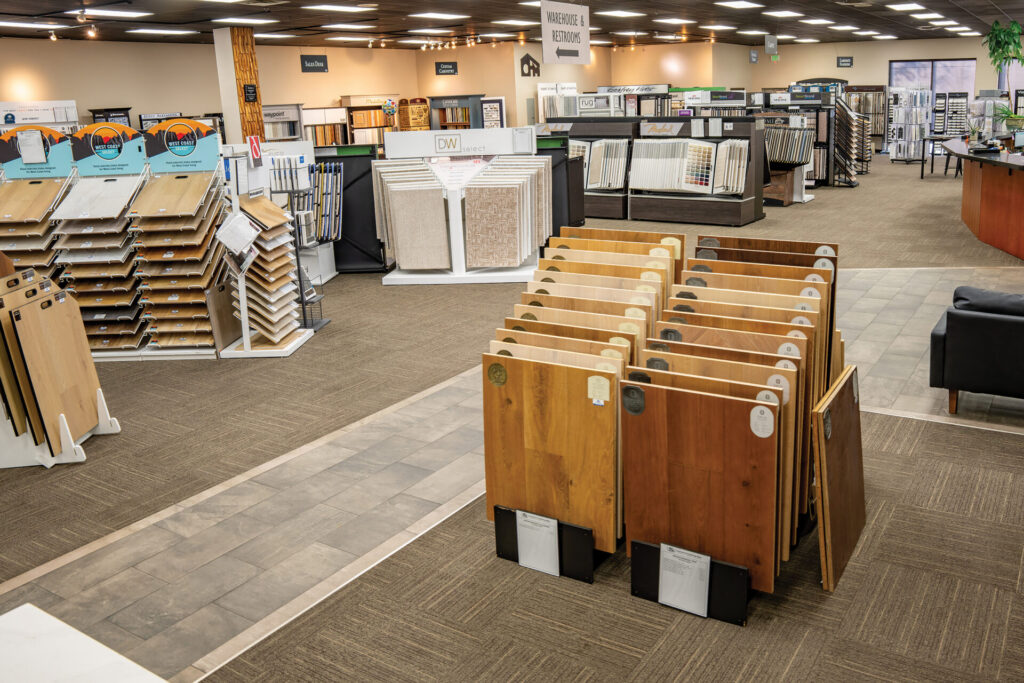
Independent Carpet One ultimately removed large numbers of flooring sample displays while redesigning its showroom. Buchanan also questioned the value of endlessly adding similar products simply because suppliers introduce them. “We don’t need to confuse the consumer,” Buchanan says. Instead, she describes a more curated philosophy. “What we have on our floor is what we would trust to put into our own home.”
That mindset mirrors broader changes occurring throughout retail. More consumers are seeking guidance as much as selection. They often want confidence that products have been vetted rather than simply presented.
For retailers, diversification may not necessarily mean expanding endlessly.
Sometimes it means becoming more selective.
BUILDING RESILIENCE
Diversification can also help smooth market cycles. Contract Furnishings Mart serves a broad mix of residential remodel customers rather than relying heavily on a single segment.
That customer diversity creates flexibility.
When new construction slows, remodeling activity may continue. Property management work may offset softness elsewhere. Renovation trends may emerge from changing housing patterns.
Anderson describes the strategy simply: “Our business is based on high volume, not putting all of our eggs in any one basket.”
The current market environment may reinforce that thinking. Consumers who remain in existing homes often redirect spending toward improvements rather than relocation. Anderson points to the “golden handcuffs” phenomenon, where homeowners with favorable mortgage rates remain in place longer.
Buchanan sees similar behavior among her customers. Rather than moving, homeowners increasingly choose renovation. “Why should we move?” she says, describing current customer thinking.
For retailers, that shift may create new opportunities—not only for flooring sales but for broader project involvement.
The result is a changing definition of diversification itself. Once viewed primarily as a strategy for adding revenue streams, diversification is now tied to creating deeper relationships, stronger customer experiences and greater participation in the home improvement process. And while cabinets, countertops and kitchen and bath showrooms may represent the most visible examples, retailers interviewed for this story suggested the broader lesson goes beyond any single category.
Success increasingly depends on understanding where customers are headed before they get there. That means listening closely to recurring requests, recognizing pain points and being willing to evolve rather than remaining tied to old assumptions about what a flooring retailer should look like.
For some businesses, that evolution may involve kitchen and bath. For others, it may mean commercial work, expanded services or simply refining existing offerings. There is no universal playbook.
The larger takeaway may be that diversification is becoming less about expanding for expansion’s sake and more about strengthening a retailer’s role in the project itself. As Buchanan puts it, the opportunity ultimately comes back to the home and the people living in it.
“Your home is your domain,” she says. “If we’re able to make it beautiful with flooring and kitchens and countertops and cabinetry and everything like that, then that’s who we are.”
For flooring retailers navigating a difficult market, owning more of the project may ultimately start with understanding a simple reality: customers are already telling them where growth opportunities exist—if they are willing to listen.
LESSONS FROM RETAILERS ON DIVERSIFICATION
Before adding a new category, consider these tips:
1. Follow the customer, not the trend
Both retailers point to the same realization: customers were already showing them where opportunities existed. Pay attention to recurring requests, adjacent products shoppers bring into the store or services they repeatedly ask for. Expansion works best when it solves an existing customer need—not when it chases the latest industry buzz.
2. Don’t confuse “adjacent” with “easy”
Cabinets sit next to flooring in a showroom, but that doesn’t mean they run like a flooring business. Kitchen and bath, countertops and other adjacent categories often require different sales processes, design tools, timelines and expertise.
3. Hire specialists early
Hire a bath designer, says Independent Carpet One’s Cathy Buchanan. Successful diversification often depends less on adding product and more on adding expertise.
4. Build systems before scaling
New categories create complexity. Training, onboarding, pricing tools, project management systems and communication processes become increasingly important as businesses expand.
5. Test before committing
Talk to peers. Visit showrooms. Ask what worked—and what didn’t. Buchanan waited and watched other retailers before moving into kitchen and bath, using their experiences to shape her own decisions.
6. Small adjustments matter
Not every experiment needs to be a massive launch. Contract Furnishings Mart described many changes as ongoing refinements rather than dramatic shifts. Minor tweaks often reveal what customers actually want.
7. Curate rather than clutter
More displays do not necessarily equal better selection. Too many choices can overwhelm shoppers. Focus on products your team believes in and can confidently stand behind.
8. Expect a learning curve
New categories rarely become overnight successes. Retailers say kitchen and bath expansion can take years to fully mature. Long-term commitment matters.
9. Keep your staff involved
Diversification can’t live solely in ownership meetings. Teams need to understand the reason behind changes and feel invested in new initiatives.
10. Be willing to pivot
Not every idea works. Closet systems, window treatments and other efforts may stall. That doesn’t mean the strategy failed. Sometimes the lesson is simply approaching it in a new way.
As retailers continue searching for growth in a slower market, the lesson may be less about diversifying for diversification’s sake and more about knowing when expansion truly supports the customer—and when it doesn’t.



Join Our Newsletter
Get the latest flooring industry news delivered weekly.