



Homebuilder Report: Market remains challenged, though players see cause for optimism – April 2026
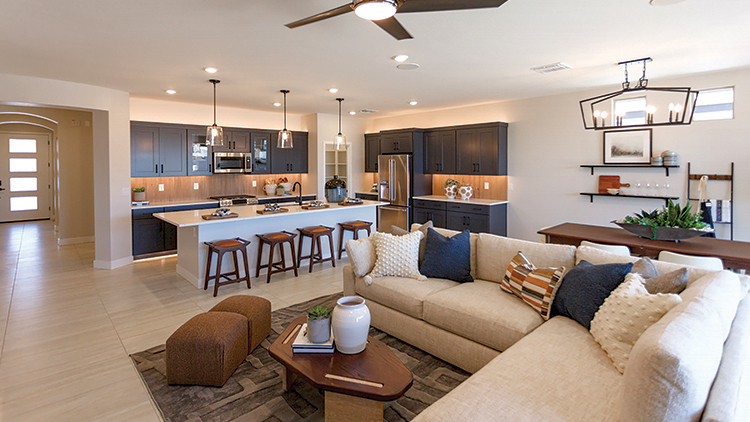
All photos courtesy of Fulton Homes.
By Jessica Chevalier
The general economics of the U.S. have not yet swung back in favor of homebuilders, flooring dealers serving the channel, or for that matter, Americans seeking a newly constructed home, so industry players faced a sub-par market in 2025, much like they did in 2024, and expectations around 2026 remain tempered.
It’s a peculiar situation for a nation literally short of millions of homes. Dennis Webb, vice president of Fulton Homes and author of From Blue Suits to Green Homes—Retail Principles in Homebuilding, reports that the combination of higher interest rates and poor affordability are the major factors tamping down builder market activity. “When interest rates were 3%, housing costs could go up substantially, and people could still afford a home,” he says. “But when prices and interest rates both went up, it was a double whammy. That has affected the whole business and ignited a race to the bottom, where builders are trying to build the cheapest possible house, but those homes are still expensive.”
By the numbers, in 2025, 1,497,800 housing units were completed (multifamily units and single-family homes), a 7.9% decrease from the 1,626,900 units completed in 2024, according to the U.S. Census Bureau.
Webb notes that recent world events—including the U.S.’ attack on Iran and the ensuing turmoil in the stock market—are also having a wet-blanket effect on consumer confidence around large purchases. “Consumer confidence is not in great shape,” he says. “These are troubling times, and consumer confidence is rocked by uncertainty.”
Wes Weger, FEI Group’s director of Home Solutions, points to another factor causing consumers to hold tight to their purse strings: the on-again, off-again, ruled-illegal, reinstated nature of the tariffs.
And, unfortunately, overall single-family starts in 2026 are still underperforming compared to the same time last year. Since flooring is one of the last items installed in a home, these weak start figures will translate into orders approximately four months later. As a result, roughly half of 2026 demand has already been determined.
While a broad combination of factors has hobbled the homebuilder market at present, Webb doesn’t believe it would take significant change to generate movement—a 5.5% interest rate may be enough.
In addition, he highlights another reason for optimism around homebuilding, “People still have a ton of equity in their homes with pricing going up as much as it has,” he says. “It can be a relatively easy move for someone with a $500,000 to $600,000 house to go up to a $700,000 or $800,000 house, but, right now, they are hesitant due to interest rates. If those decline, they may think ‘Maybe I can swing it’ as they can take out a 50% or 60% loan due to their equity and have the opportunity to buy a nicer home in a nicer area. That’s the bright spot.”
And Weger notes to the general desire for homeownership remains intact. “We are cautiously optimistic,” he says. “Demand exists, especially among the young Millennials and those forming families. I read that many renters—if conditions are right—want to become homeowners. If interest rates stabilize, even without dramatic drops, we should see some improvement.”
In addition, many builders are focused on selling existing and aged inventory and have pulled back on new starts. This had a negative impact on flooring sales in the first half of 2026.
BETTER BUSINESS
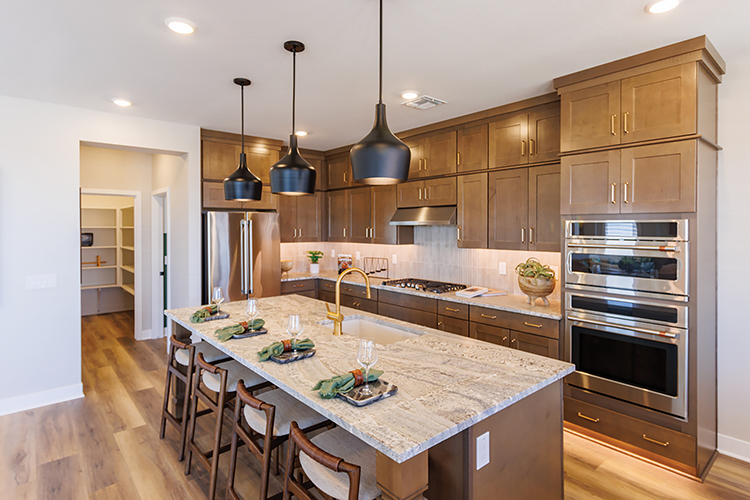
Privately owned Fulton Homes takes a different approach from many developers, building highly energy-efficient homes that utilize healthy materials and prioritize good air quality. The company seeks to build quality properties and satisfy customers who return to Fulton for subsequent home purchases.
In an effort to manage the challenges of the current market and serve a good stock price to their investors, many large, public builders have eliminated homebuyer options, meaning that they no longer operate design centers, instead selecting all finishes in-house, including flooring, and selling the properties as-is. Fulton, on the other hand, believes that buyers still value choice. The company caters to first and second step-up buyers predominantly.
The high road isn’t always the easy one. In fact, as mergers continue in the homebuilder landscape, and big builders continue to get bigger. Webb reports that Fulton is now the only large private builder in the Phoenix area.
Also, Webb notes that home sizes overall are getting a little smaller in an effort to address affordability.
RIPE FOR IMPROVEMENTS
Webb notes that the U.S. homebuilder industry hasn’t evolved much with the years. “We build homes today much the same way that we did 100 years ago,” he says. “But today, we’ve made houses unaffordable. We have screwed up our own industry. Then, because we’ve made it difficult for people to build a house, we invented build-to-rent, which is terrible for the industry.”

In efforts to modernize homebuilding operations, Fulton utilizes advanced technologies across its operations with one system communicating to the others to streamline the process. These operations extend from customer-facing to the back end.

Webb asserts that another poor practice in the homebuilding industry is utilizing purchasing professionals to make decisions around finishes rather than using merchandisers. Purchasing professionals aren’t concerned about meeting homebuyers’ needs or desires with regard to finishes but are instead focused on financials, says Webb, adding, “They don’t understand what the buyer wants. They are trained to cut costs. The flooring industry goes gaga over rebates, but that won’t drive business. Steady growth will drive business; increased sales will drive business but not cutting costs. No one has ever cut costs to prosperity.”

Further, Webb believes that the common way of judging homes according to price per square foot is flawed. “There is a lot that the conversation doesn’t cover,” he explains. “Our homes have a HERS (Home Energy Rating System) score of 37, which means our house will be $300 per month less to run than a code-built house down the street. That’s $3,600 year. In addition, one house may have $100,000 in options, while the one next door has $40,000. We should be discussing value per square foot as opposed to dollars.
SUPPORTING BUILDER PARTNERS
Webb has a few suggestions for how the flooring industry can be better partners to homebuilders.
First, he encourages manufacturers and importers to stay abreast of environmental issues and continue pushing the box on sustainability.
Second, he suggests that flooring providers better manage product discontinuation. “The flooring industry has a problem with discontinuing products,” he explains. “Often, two days before an install, we will be told that the flooring is discontinued, which means the buyer has to come in and reselect.”
These reselections are a major frustration for the buyer, who likely selected a full and cohesive palette of finishes six months earlier. Webb asserts that often, by the time they are notified of the discontinuation, the cabinets are already installed, so the buyer doesn’t have the option of starting selections from scratch.
“Manufacturers don’t have the mechanisms to track selected discontinuations, and they are really disappointing customers,” says Webb. “The industry has to get better at letting people know about discontinuations earlier. There are ways to do it. We use the Envision program. Manufacturers have the opportunity to send a message through the system that says, ‘This product is discontinued’ and give the buyer an option to switch it for another or just discontinue it from the product offering, but manufacturers don’t use it.”
If manufacturers made homebuilders aware of their discontinued products ASAP, Fulton could notify the customer subsequently and take necessary action before the last minute.
FLOORING DEALER PERSPECTIVE
2025 was a year of uncertainty and, for both builders and the flooring dealers supporting them, and, according to Weger, “Builders, suppliers and dealers all had to be chameleons. Those who took a disciplined approach to their cycles and incentives were rewarded, but the volume wasn’t what we see in ultra-low-interest-rate years.”
Weger asserts that last year, large, publicly traded national builders performed better than their competition due to the fact that high interest rates as well as high costs for land hurt smaller custom builders.
For FEI members, the entry-level home market was strongest, particularly in those markets where population growth and job migration create demand, including the Southeast, parts of Texas and Arizona. “The West showed some increase,” says Weger. “The Midwest was pretty stable.”
Other sources report that while the entry-level market is the largest, it was not the strongest in 2025. However, while it is most impacted by affordability challenges, it is expected to continue gaining share.
The active-adult single-family segment—comprising of older adults who are downsizing after their children have grown—is one that is currently performing well, though it faces challenges, such as longer closing timelines.
Last year, flooring contractors serving the builder market felt pressure from margin compression and pricing. In addition, the fact that home sizes shrank and dollars spent per home declined didn’t bode well for those flooring dealers supporting the market and hoping for upgrades.
However, FEI members indicate that those who had solid relationships with regional builders maintained steady backlogs, says Weger.
WHAT FLOORING DEALERS NEED FROM MANUFACTURERS
Flooring dealers rely on their manufacturer partners to supply them with the product they need in order to complete their work. In that effort, “Reliability in inventory is huge,” says Weger. “And realistic lead times are important. I think more than anything, flooring dealers want consistency on support and logistics. This is more important than flashy launches.”

Weger also notes the visualization offerings are an important tool for flooring dealers, so manufacturers should prioritize offering these. “That’s something they can sell with, and builders can too,” he notes.

Lastly, continuing to innovate around easing installation and shortening installation is important to enable the flooring dealer community to increase its profitability and deal with ever-tightening timelines.
DEALER CHALLENGES
Affordability pressures are the biggest challenge flooring dealers face, followed by interest rates, the volatility of interest rates and labor shortages, says Weger. “Dealers are getting a double whammy, squeezed by labor shortages and builders requesting price reductions and rebuilds while suppliers are increasing prices on products,” he explains.
As for labor issues, immigration enforcement is having a real effect. Says Weger, “Members say they are losing some of their crews. Workers aren’t showing up because they are scared, and that’s slowing projects.”
On the builder side, Weger points out that regulation red tape increases the cost of homes significantly, further crunching budgets. In fact, according to studies by the National Association of Home Builders, government regulations imposed at all levels (federal, state, and local) account for 23.8% to 24.3% of the final price of a new single-family home.
Many builders have utilized incentives, such as rate buys, to convert hesitant buyers. And Weger notes that this is necessary in the present market. “Unfortunately, from our side, it has put a hurt on dealers,” he says. “When margins are cut for builders, they have to find that money, so they cut the flooring dealer’s margins. It’s a race to the bottom—using base-grade products due to affordability. Flooring dealers make points with upgrades, and when there are none, there is no money to make.”
Even with most national builders buying down interest rates and discounting homes, these actions have not significantly improved home sales.
SPACE & MATERIAL STORY
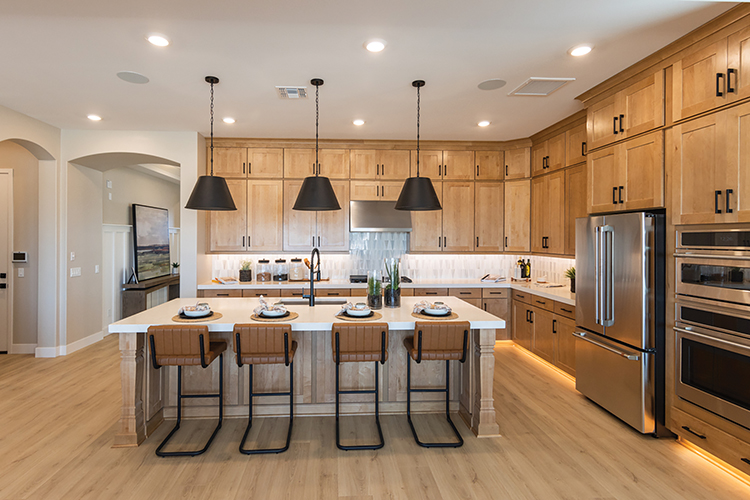
In terms of what spaces drive consumer interest, the kitchen remains the big deal, says Webb. A space that can function as a home office is also desirable. And outdoor spaces remain very important in markets like Phoenix, where Fulton operates, and these generally include a space with pavers in the backyard.
Both flooring and cabinets have gone “au naturel,” often with matte finishes. “Flooring is almost all wood looks here and pretty much the whole country is that way,” says Webb. Those wood looks can be hardwood, LVT, porcelain or “wood composite,” which is what Fulton calls laminate. In fact, if a customer asks if Fulton carries laminate, the builder says, “No, we have wood composite,” believing that the word laminate carries such a stain.
Among FEI members, water-resistant laminates have been making a strong comeback the last couple of years, reports Weger. “Laminate isn’t plastic, and the problem with LVT is often that you don’t know what you are getting—there have been some performance issues.”
At the higher end, homebuyers like wide-plank engineered hardwood in white oak or a white oak look, and installation patterns like herringbone and chevron are desirable. On the porcelain side, large format is preferred.
In many cases, according to Webb, the homebuyer prefers that the same flooring be carried throughout the kitchen and great room for continuity, rather than having, for instance, porcelain underfoot in the kitchen and LVT in the living space.
“More than anything, low maintenance is something people want—products that are durable and easy to clean,” says Weger. “The manufacturers will sell you to death on waterproof performance, and it does resonate with buyers. Scratch-resistance is big because of kids and pets. Also, people want to know that there’s a warranty.”
Weger believes statements around air quality and product sustainability resonate more with higher-end buyers, but that is dependent on all the other factors, including price and aesthetic, meeting their criteria.
Fulton continues to see a decline in the desire for soft surface—even in respite spaces. “It’s not unusual for customers to say that they want no carpet due to asthma or other health issues,” says Webb. “We are seeing more desire for hard surface.”
Because Fulton promotes the indoor air quality of its homes, its customers may be more tuned into this. All of its homes are Indoor AirPlus certified, an Environmental Protection Agency standard. This means that flooring products used within the homes need to be Greenguard certified and must not off-gas. Fulton touts these flooring features as part of its sales process. And Webb notes that a percentage of buyers are proactively concerned with sustainability factors around flooring, while many are agnostic.
Weger’s members see carpet’s share loss leveling off, with use primarily in bedrooms and secondary living spaces. Often, according to Weger, a base-grade product is utilized.

Join Our Newsletter
Get the latest flooring industry news delivered weekly.