




Hardwood Report 2026: Manufacturers found success in flexing in a chaotic year – April 2026
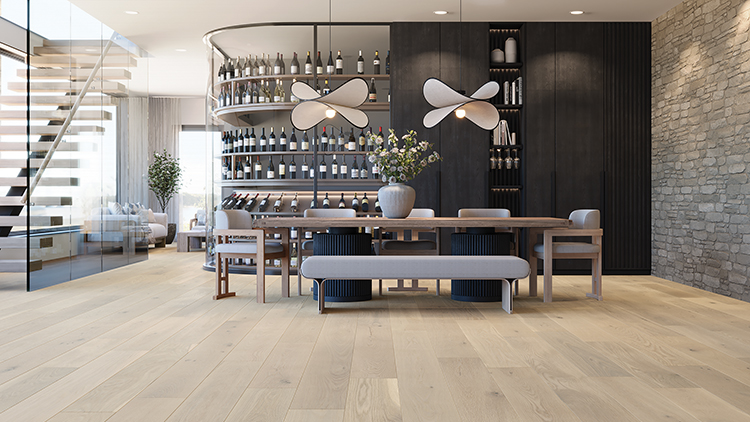
Mirage’s Bluum collection of white oak in Camellia.
By Jessica Chevalier
Chaos is how Dan Natkin, CEO of Essex Finishing, describes 2025 for the hardwood business. “Last year started out fairly normal, albeit much slower than post-Covid uptick, then the news about tariffs hit. It was mania to beat the tariffs, and then the tariffs were enacted.”
While hardwood was not alone in being impacted by tariffs—indeed, some flooring categories had more exposure—this follows years of pressure on the category by lookalikes in LVT, laminate and ceramic. “The category is about 40% smaller in volume than it was in 2016,” Natkin notes.
However, despite last year’s bedlam, according to Market Insights’ early estimates, the U.S. hardwood industry expanded 0.9% to $2.065 billion in 2025, a positive outcome compared to 2024’s 13.4% decline from post-Covid highs.
Hardwood flooring imports rose 15.7% in 2025, according to U.S. International Trade Commission data, likely due in part to importers stockpiling product prior to the application of the tariffs. Exports declined 2.2%. Market Insights estimates that U.S. hardwood flooring production declined by 15%.
Engineered hardwood continues to take share from solid, now accounting for 68% of the market, notes Market Insights, a trend that is driven by the fact that it is easier to install over slab, which is very important in certain parts of the U.S.; its lower cost of production; and increased imports, which are more often engineered.
“Product-wise, it’s a very polarized market,” says Sean Brennan, president of Kährs–Americas. “Many consumers are seeking the best they can get for the price that they have. We also have requests for custom. It’s the middle area that is hurting.”
TURMOIL & TARIFFS
While tariffs caused turmoil in hardwood flooring sales last year, they weren’t the only factor generating upheaval. Broad economic uncertainty in the U.S. market meant that those without significant means held tight to their purse strings—including around home purchases, which often generate remodel activity that includes new flooring, both before and after sales. Interest rates significantly higher than what buyers experienced amid and immediately after Covid didn’t help, and high home costs further bound up the market.
“Many members have almost taken a sit-and-wait approach,” says Stephanie Owen, president and CEO of the National Wood Flooring Association.
Brennan explains, “We had to think twice about everything. Do we bring the product in now? Do we wait? Do we focus on more affordable products or stay with premium? It made all our considerations short-term rather than long-term.”
For Mohawk, which imports its entire hardwood portfolio, the factors driving these considerations changed frequently. “For most of 2025, we were trying to figure out what was going on with tariffs,” explains David Moore, vice president of product management–wood and laminate for Mohawk. “As an imported business, we were definitely subject to the tariffs and figuring out how to deal with that from a supply-chain perspective. Rates changed frequently, and the tariffed countries changed. There was lots of uncertainly in the market, and it was hard to build a long-term plan because we just had to pivot daily.”
And it wasn’t just policy throwing a wrench in manufacturers’ plans and operations. “The first four months of 2025 got off to a good start, and we were outpacing 2024,” says Pat Oakley, president of Mullican. “The second half of 2025 was pretty weak and never really saw any strengthening, then throw in the bad weather, which had a huge impact on the first months of 2026. We lost days of production at various plants because of weather.”
Ultimately, the most significant impediment remains the market lookalikes. “The category has been under siege from LVT for ten years, which hasn’t allowed it to grow with the market, causing it to lose share,” says Milton Goodwin, vice president of AHF Products.
Looking at 2026, Danielle Lancianese, director of hardwood and laminate for Shaw, remains cautious. “Concerning the market overall, we are entering 2026 with less optimism than 2025 because of the changes with tariffs that are impacting hardwood and will slow momentum,” she says. “We started to see some relief with interest rates going down but not enough to see things turn back on in the builder channel specifically.”
“We had hoped interest rates would come down and trigger a buyers’ market for real estate and remodel, but we haven’t seen that,” adds Brennan. “Inflationary pressures have trickled into lots of things. Supply cost has gone up in packaging for samples, pallets and other materials.”
THE UPSIDES
Hardwood had a win last year, however, the consumers spending were higher-end buyers who favor authentic materials like hardwood.
Another boon for the category is that, as LVT products have now been in the market for over a decade, some consumers have now lived on a generation of luxury vinyl and may, for one reason or another, be ready for an upgrade. “There is a general LVT fatigue,” Moore contends.
“We do see consumers coming back to the category, as they want real wood in their home,” adds Lancianese.
“The beauty of hardwood is that manufacturers are collaborating with nature,” elaborates Marie-Joël Bossé, brand and product manager for Mirage. “While a printed floor comes out exactly as intended, wood products react differently to techniques such as staining, steaming and fuming for outcomes that are unique. It develops real character. Hardwood patina is genuine: grain depth, natural variation and aging are part of the appeal. Lookalikes try to imitate that, but they don’t evolve the same way.”
MEETING CONSUMERS WHERE THEY ARE
The hardwood industry holds tight to the idea that hardwood is the flooring that American homeowners aspire to have. Of course, it’s also the case that many Americans aspire to drive luxury vehicles but buckle themselves daily into Hondas, Fords and Kias—the point being that the chasm between aspiration and reality can be significant, and, in hardwood’s case, that chasm has been filled by wood lookalikes.
That said, today’s hardwood advocates are considering how they might better share hardwood’s story. “Our challenge as an industry is to make sure that we are telling hardwood’s story, rather than only highlighting the negatives of other categories,” says Goodwin. “Aspirational products like ours come with a higher price, but we sell the only forever flooring. If you spend a little more, over the long haul, it will be less expensive, and there until the house falls down.”
It’s true that in a world full of plastic, many yearn for the authenticity of something that came from nature, and Brennan believes there is a meaningful story to tell around what hardwood doesn’t contain—plasticizers, petroleum, VOCs.
Lancianese notes that today’s consumers don’t want the same cookie-cutter home their neighbor has but seek to insert their personality into their space. She says, “Today’s consumers don’t simply want the products that the manufacturers push. They build Pinterest and mood boards for their homes, and we have to innovate to supply that consumer. LVT is an easier sell, so hardwood has to story-tell to create emotion and pull consumers back to the real product.” She also notes that the industry should be meeting customers where they are, for instance using Pinterest and influencers to get the hardwood story into consumer awareness.
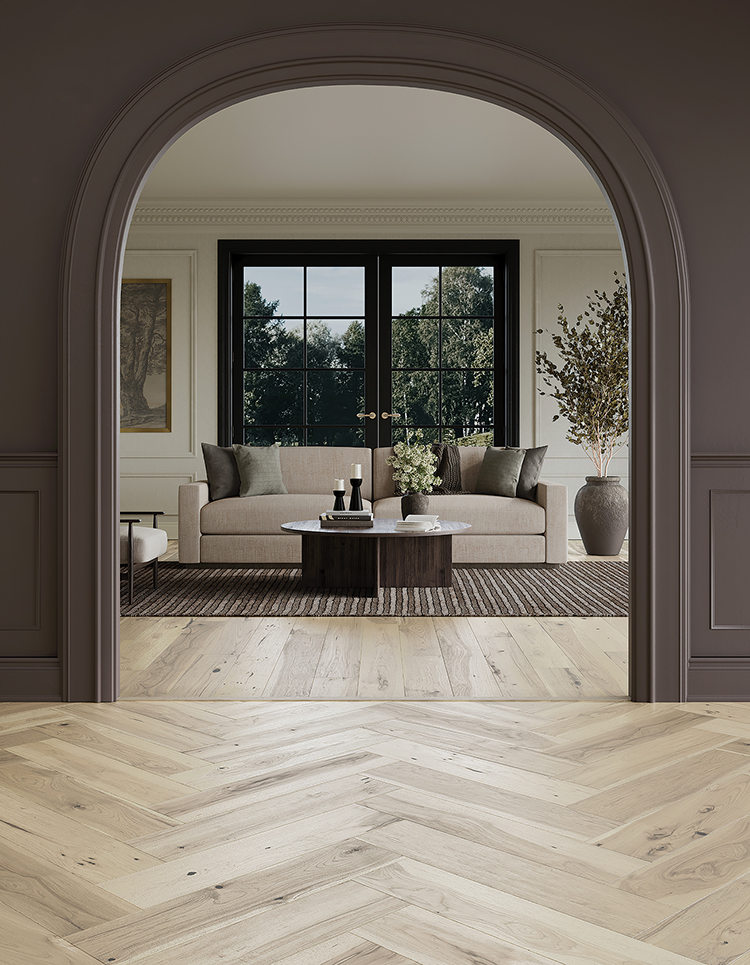
Steve DeCarlo, CEO of Bauwerk NA, which goes to market under the Somerset and Boen brands, points out that some of the most-desired flooring design trends are best served by hardwood. “Wider and longer planks are things you can’t easily find in LVT, and there is a trend towards thicker product as well, and wood solves that,” he says.
Hardwood is typically sold for its aesthetic story, while LVT is primarily sold for its performance profile. Perhaps if hardwood was widely perceived as offering both, more consumers would be motivated to jump through the financial hoops necessary to afford it.
Lancianese believes that hardwood could benefit from further innovation that positions its performance as more akin to the lookalikes. “This needs to be more marketed as an industry,” she says. “With our domestic-made products, we have splash-proof technology to improve water resistance, and I believe we will continue to see those types of top coatings used to add from a performance standpoint but not take away authenticity.”
Says Owen, “As a whole, the industry has to do a better job at point-of-sale with educating RSAs and those individuals interacting with consumers to sell the value proposition of wood. When a consumer walks into a typical retail location, they can be overwhelmed, and the easy sell is the most affordable option, but we have been focusing on trying to teach people how to sell the value of hardwood flooring. We are going to do more helping contractors have tool kit pieces to communicate that value.”
RAW MATERIALS
Interviewees had varied responses regarding raw material prices, which is likely due to the variety of materials they source and the range of areas they source from.
“The cost of lumber is always going to fluctuate to some extent, but if you look at how it has mapped over the years, it has leveled off a little bit compared to the pandemic, but it’s still higher than pre-pandemic, which may be the new norm,” says Lancianese.
“We have used pine a long time for base core plies, and that supply chain has gotten more difficult, in part due to climate-based issues and in part due to global economics because of tariffs and such,” says Al Boulogne, senior vice president of residential product and marketing for Mannington. “A lot of suppliers are moving to eucalyptus, which comes from countries easier to buy from. The one thing I expect now is that everything will constantly be changing, even weekly. You have to be on your toes.”
“The return of character grade in some areas may be driven by the fact that it’s hard to get select-grade lumber,” notes Natkin.
Wade Bondrowski, director of U.S. sales for Mercier, has had a slightly different experience. “Raw material prices have stabilized because we don’t feel the influence of Asian buyers, which have boycotted lumber from the U.S., but the fixed costs of machinery, fuel and other stuff have gone up, though at a smaller increase than we have seen in recent years,” he reports.
Several companies reported having to implement more than one price increase last year.
THE PRODUCERS
AHF Products believes it outpaced the market in 2025 with growth in both its solid and engineered businesses. The company manufacturers all its hardwood products in its own facilities, most of which are in the U.S. with one facility in Cambodia. The company made its foray into the commercial hardwood market last year with TimberTones densified engineered hardwood, under the Armstrong Flooring brand, building on the success of its densified residential products, which were introduced in 2021.
In late 2024, AHF entered into the unfinished engineered hardwood business, and that operation hit its stride last year.
In the first half of 2026, the company reintroduced its Bruce Natural Choice in 5/16” thickness. Due to technology improvements around its RH adhesive, the solid product can be glued down atop a concrete subfloor, such as in the growing market of the sunshine states. Under the Bruce brand, the company is also rolling out its Dundee product in a low-gloss finish.
At Surfaces 2026, the company also introduced new select-grade engineered products, which are U.S.-made and will retail at a price range of $7/square foot to $12/square foot. In addition, in the first half of 2026, the company will bring to market a rift and quartered 5” line, additional oak products, and herringbone additions to its Robbins and private label lines.
The company has also expanded its hardwood offering into its Crossville Studios showrooms, under the Crossville Studio brand.
AHF has such a broad hardwood offering at this point that it’s actually easier to say what its portfolio doesn’t include: greater than 5” widths in solid and exotics. The company serves all channels and goes to market with hardwood under the Bruce, Hartco, Robbins, HomerWood, LM Flooring, Armstrong Flooring, Capella, Hearthwood, Raintree and Tmbr brands.
Last year, AHF consolidated the Kentucky manufacturing facility that made engineered hardwood products, shifting those operations to other U.S. facilities. The company offers hardwood products that range from $3/square foot at retail up to about $14/square foot.
Shaw believes it outperformed the market in 2025 with its two-brand hardwood strategy serving it well. Across its two brands, Shaw Floors and Anderson Tuftex, the company spans the price range of hardwood with a good-better-best offering. The Shaw Floors brand is characterized as an “authentic connector” for active homes and practical consumers, while Anderson Tuftex is defined as “eco-luxury.”
In January 2026, the company rolled out two new offerings under each brand. Under Shaw Floors were Bridgewater Eucalyptus and Cornerstone II. Bridgewater Eucalyptus offers a premium “exotic” look at an affordable price point, while Cornerstone II, at a mid-level price point, is an on-trend refresh of the original Cornerstone, which targets the middle of the market.
Under Anderson Tuftex, the company rolled out Artisan Oak, which is a 71/2” handscraped white oak with a chiseled bevel, available in several tones, including more medium to deeper browns. For the 71/2” Valencia Walnut, the design team used unique chemistries to produce unexpected tones in the wood.
With activity concentrated at the mid to upper end of the hardwood market, where consumers are able to buy without borrowing, Shaw is working to evolve its portfolio toward design-forward product that captures that market.
Shaw manufacturers the bulk of its builder market hardwood offerings in South Pittsburg, Tennessee and some higher-end product in South Carolina. It imports the balance from offshore supply partners.
Shaw goes direct to its retail partners. It works through a few small distributors to service the builder business. It sells in home centers as well.
In 2025, Mullican completed the installation of a new finish line in Johnson City, Tennessee, advancing its capability for more dual-stain products as well as to integrate some new finishing techniques.
In addition, the company continues to launch its Tennessee Artisan, 75/8” wide engineered collection, 1/2” thick with a sliced veneer, that is made in Johnson City from Appalachian-sourced white oak and hickory. This introduction is part of Mullican’s expansion of wider-width products. Mullican is also expanding its European White Oak Castillian line, which features 6” and 7” widths.
On the solid side, in the second half of 2026, Mullican will introduce 3/4” products in both white oak and hickory.
With manufacturing in Holland, New York; Ronceverte, West Virginia: and Johnson City, Mullican serves the independent retail market through distribution. It also serves new construction as well as the commercial market. The company’s portfolio covers the full range of the market—from entry level to upper end. It imports a small amount of product.
In October 2024, Mirage announced Jean-Pierre Thabet’s appointment as president and CEO, following 40 years with his father, Pierre Thabet, at the helm.
Mirage sells direct to dealers as well as through two distributors in the U.S. market. It also offers hardwood products to the builder channel.
The company recently introduced a 9” width in some products as well as a new collection of white oak with a smooth finish called Bluum.
This year, Mirage is adding extended lengths, ranging from 34” to 87”, to its 73/4” width offerings, including the Blanc, Muse, Bluum, DreamVille, Lively, Sweet Memories and Autumn collections.
Mirage has tailored its collections to be easily navigable for both the RSA and the consumer. Each collection features one species, two grades (character and exclusive), two textures (smooth or brushed) and one finish, as well as a choice of platform thickness (3/4” or 9/16”) and desired pattern (linear, herringbone or chevron).
All the company’s floors are manufactured in St-Georges, Quebec or in Virginia and go to market under the Mirage, Vintage, Ten Oaks and Alexandra brands.
Mohawk’s engineered hardwood portfolio of products goes direct to market under the TecWood brand. The company serves the independent retailer, builder and multifamily channels with a full-service hardwood portfolio that includes a low to high span of price offerings covering all major constructions.
Due to the tariff uncertainty last year, Mohawk, which fully sources its hardwood portfolio, opted to maintain a hold pattern and made no changes to its sourcing programs. For the same reason, it didn’t roll out any new products, dubbing 2025 as an “internal-focused year.”
Mannington’s exit from the residential carpet business, a decision it announced in October 2025, has freed its rep team up to focus entirely on the promotion of its hard surface products, which include hardwood. The company saw great activity in the latter half of the third and fourth quarters last year and notes that those customers who have the expendable income to purchase without borrowing are driving sales in better goods, such as hardwood.
Mannington prioritizes consumer feedback as part of its ideation process with hardwood products but also follows its “creative spirit.” This year, the company is rolling out products that are longer, wider and warmer-toned as well as of mixed character. The company points to its Artisan Walnut as an example of how it is pushing its portfolio creatively; to bring out the color of the natural wood, Mannington steams and fumes it, then applies a low-gloss finish. Though the hardwood team considered Artisan Walnut a bit “offbeat” with current market trends, it has been a hit with consumers, who, Boulogne believes, are hungry for visuals beyond European white oak. The company plans to further expand its non-European white oak-look offering.
Last year, the company also introduced some of its most popular visuals in the herringbone format.
Mannington has a few entry-level products but focuses largely on the mid- to higher-end of the market, selling hardwood through both distribution (central U.S. and mid-Atlantic) and direct (on the coasts) to independent retailers and some select regional builders. The company’s hardwood offering is not sold in the big boxes.
Mannington sources its hardwood products from manufacturers in Southeast Asia, central America and North America, maintaining close relationships with its suppliers to keep its supply chain pure. “For the most part, we have three main suppliers that we lean on for 85% of the line, and for the other 15%, we will play around with different suppliers,” explains Boulogne.
Kährs had planned to launch new products in the second half of 2025 but decided to delay those launches until Surfaces 2026 due to the market volatility created by the tariffs. The company is expanding into new formats within existing collections. It added an 8” wide x 6’ long format to a collection of European white oak that had previously been available in only 5”. In addition to its value-oriented Life Collection, Kährs added wider formats with some brushing. The Life Collection utilizes a HDF core and is suitable for light commercial and multifamily applications.
Kährs serves independent retailers and higher-end builder and multifamily contractors with its engineered wood products. While the multifamily business has slowed as of late, Brennan says, “That’s still a big piece of who we are.” The company’s products are primarily made in Europe with a smaller portion made in the U.S.
With the distribution-level consolidation taking place over the last several years, Kährs, which went to market solely through distribution previously, has now opted to go direct to dealers and contractors in some areas, feeling like its brand can get lost in the hands of massive distributors. As part of this approach, the company has taken some marketing efforts in-house: increasing its online presence, tweaking its display and advertising directly to the consumer. The company has found that many dealers have responded positively to this more hands-on approach to service.
In November 2025, Bauwerk North America, which goes to market under the Somerset and Boen brands, welcomed Steve DeCarlo as CEO. DeCarlo joined the flooring industry in 1995, and has previously worked with Shaw, Spectra, Milliken and LX Hausys.
In addition, Martha Wakelin was named director of marketing and product development. John Neugent was named director of sales. And Andrew Messenger was named vice president of manufacturing. DeCarlo believes the new leadership team is “building on a great foundation.”
Product-wise, the company manufactures a selection of red oak, white oak and hickory products in both solid and engineered formats in Somerset, Kentucky. Both Somerset and Boen go to market through distribution, serving the independent retail, builder and multifamily channels.
Somerset and Boen have a partnership with Sherwin Williams to ensure that they are making improvements in the areas of scratch-, stain- and scuff-resistance, as well as pushing
development from a design point of view. “That is very important as we move forward and where we are spending a lot of our time with our partners,” DeCarlo says.
Lauzon continued making investments in plant optimization over the last year, including assets in its engineered plant, as getting workers in the remote areas where it operates can be a challenge. The company also made a multitude of improvements to its finishing line to make more specialized finishes, such as those that make red oak look like white oak.
As a Canadian company, in early 2025, Lauzon was nervous about the implementation of U.S. tariffs but reports that the market has been stable. According to the firm“Overall, 2025 was a positive year. The first three quarters were good, though there was a slowdown in Q4. The first quarter of 2026 was tougher.”
At Surfaces, Lauzon launched a full set of new colors in its Essentials line, a high-volume series for the company, and early signs indicate that the recoloration is a success.
Lauzon has several strengths that set it apart. First, it is vertically integrated, even managing its own forests, with most of its wood sourced within 200 miles of its headquarters. Second, it stocks a lot of product, which means a quick turnaround on orders.
Lauzon goes to market direct, through distribution and through private-label partnerships. Last year, the company added some new species to its offering with solid white oak and solid hickory.
Mercier is currently rolling out its new Emblem, a better quality, 71/2” product in both oak and distinction-grade Appalachian maple. Board lengths are up to 86”.
The company is rebranding its finish, which also has an updated formulation, moving from Generations and Generations Impact 2500 to Liv and Liv Up. The new formulation offers ten times better scratch-resistance and better cleanability. The company takes pride in its finish technology, as it was the first North American company to offer a factory-applied finish. The company’s products are all made in North America made with logs from both the U.S. and Canada.
While Mercier has primarily focused on the East Coast and Midwest markets, it is currently expanding westward toward California and the Southwest. That expansion has been facilitated by two factors: a capacity increase and an expansion of offering in the wider widths those markets desire. The capacity increase was generated, in part, through investments that enabled a 20% increase by eliminating a bottleneck at packaging operations.
Over the past three years, Mercier has grown its business with all its distribution partners. In addition to independent retail, the company serves the small, regional homebuilder channel. The company’s products are 100% North America-made for the U.S. market.
Over the past year, one of Preverco’s biggest developments has been the launch of a new finishing technology called Top Protection. Top Protection offers high resistance to wear while maintaining the flexibility needed to better absorb daily impacts, significantly improving the long-term performance and appearance of the floor.
Preverco’s Flex engineered platform is one of its flagship innovations, designed to be one of the most forgiving engineered flooring systems on the market when it comes to subfloor imperfections, making installation significantly easier and more reliable for installers. In addition, the platform naturally helps reduce noise transmission.
The company also offers an engineered product that is 100% made from locally sourced materials, while also remaining competitive on pricing.
Preverco takes pride in offering flexible and customizable hardwood programs, which include both solid and engineered platforms with a wide variety of options around finishing.
Preverco’s route to market is primarily direct-to-dealer. Its main channel is specialty flooring dealers. It also serves export markets, select international projects and dealer partners abroad.
The company’s products, all manufactured in Canada using 100% locally sourced resources, retail between $6/square foot and $12/square foot.
In 2026, Preverco is launching new color collections across oak, white oak, maple and birch, developed using a new color application technology. For oak, the technology allows the company to soften the grain pattern and control the red tones for a white oak look. On maple and birch, the technology produces cleaner, more uniform color results than are available with standard techniques.



Join Our Newsletter
Get the latest flooring industry news delivered weekly.