



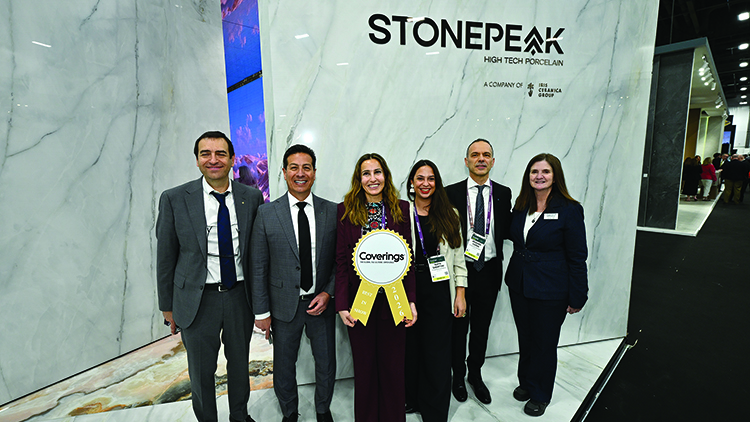
Stonepeak Ceramics was honored with a Best in Show award at Coverings for its “Magical Journey” booth concept.
By Meg Scarbrough
Tile is evolving in multiple directions at once. At Coverings 2026, that shift was most prevalent with the market leaders who are pushing beyond traditional floor and wall applications into more dimensional, design-driven and performance-oriented surfaces. The evolution is happening alongside a more uneven market. Demand remains pressured by affordability concerns, tariffs and broader uncertainty, even as innovation continues to accelerate across the category.
What was on display in Las Vegas also reflected a faster-moving global pipeline. Trends are no longer developing in isolation—they’re shaped across international markets and introduced to the U.S. in near real time.
Referencing Stonepeak Ceramic’s immersive “Magical Journey” installation, an alchemy-inspired concept that has traveled through global design events, Sofia Sabattini, director of marketing for Stonepeak, said, “This is the first U.S. stop. We’re bringing this global concept and making it resonate with the U.S. market.”
That overlap between global exhibitions and U.S. introductions is accelerating how quickly new ideas, from color to texture to format, are refined and brought to market.
A MARKET UNDER PRESSURE, BUT STILL EVOLVING
By the numbers, the U.S. ceramic tile market continues to face pressure.
U.S. tile consumption totaled 2.57 billion square feet in 2025, down 4.9% from the previous year, according to data from the Tile Council of North America (TCNA). “It’s the fourth consecutive year that the market has contracted,” said Eric Astrachan, TCNA executive director.
The forces driving that slowdown are both familiar and persistent. “Affordability challenges continue to weigh on the housing market, while tariff uncertainty, uneven construction activity and rising trucking costs are also dampening demand for tile,” Astrachan said.
At the ground level, those pressures are most evident in residential. “Consumption on the residential side continues to be soft,” said Joe Lundgren, a tile industry consultant and former Dal-Tile marketing executive. “We’re not seeing a whole lot of movement on the consumer side.”
Higher mortgage rates continue to play a central role in that hesitation. Lundgren notes, “People are saying, ‘I don’t want to give up my 2.9% interest rate and go buy a new house at 6.5%. I’m going to remodel my current home.’”
That shift is redirecting activity away from new construction and toward remodeling, though not always in ways that show up clearly in traditional indicators. In many cases, the work is smaller in scale, more fragmented and less visible in top-line metrics.
Looking ahead, Lundgren expects more of the same. “2026 is going to be flat; I don’t think we’ll see any increase,” he said. “If anything, we’ll see increases on the remodel side.”
Imports continue to account for the majority of U.S. tile consumption—more than 72% of the market by volume—but the composition of that supply is shifting.
“Spain is now again the largest exporter to the U.S. in units, making up 21.4% of imports [by volume]…Italy was the second largest exporter,” Astrachan said.
At the same time, several key suppliers have pulled back.
“So really, what you’re seeing is just Spain and Italy went up, and pretty much everybody else went down,” Astrachan said.
From a value perspective, Italy continues to lead the market, reinforcing its position at the premium end of the category. And that premium positioning is becoming more important as the market adjusts.
Taken together, these dynamics point to a market that is contracting in volume but evolving in composition—toward higher-value products, more selective demand and a greater emphasis on differentiation.
A MULTI-SENSORY, DESIGN-DRIVEN FUTURE
If the market data suggests caution, the design direction suggests acceleration.
Perhaps the most dominant theme this year is tile’s evolution into a multi-sensory material. Across themes like “Haptic Experience” and “Articulated Accents,” manufacturers are emphasizing texture, relief and dimensionality.
“It’s really all about creating tiles that engage the senses—layered, immersive experiences,” said Alena Capra, ambassador for the Coverings expo and principal with Alena Capra Design.
Advances in glazing, digital printing and manufacturing are enabling surfaces that invite touch as much as they attract the eye. Subtle ridges, carved effects and raised detailing are replacing the flatter visuals that have defined much of the past decade.
That tactile shift is also becoming more nuanced. Rather than exaggerated textures, many manufacturers are focusing on controlled relief—surfaces that interact with light and touch in subtle ways, adding depth without overwhelming a space.
Closely tied to that evolution is the influence of craft. The “Tailored Craft” trend reflects a growing crossover between tile and soft materials like textiles, leather and upholstery. Across collections, this translates into stitched effects, woven visuals and surfaces that echo the language of fashion and interior soft goods.
At the same time, the aesthetic pendulum continues to swing toward restraint.
Trends like “Brutalish Sanctuary” and “Organic Minimalism” highlight a preference for soft, grounded interiors built around natural material looks—concrete, stone and terrazzo—often rendered in matte finishes and desaturated palettes.
Rather than stark minimalism, these looks lean into warmth and authenticity, pairing tactile surfaces with calming colorways.
Color remains a key driver, with green continuing its multi-year ascent. “Green has longevity,” said Capra. “If we’re continuing design with wellness in mind, the green continues to be a part.”
The “Jade Terrain” trend captures that direction, while the broader palette is expanding into warmer territory—chocolate browns, cinnamon tones and earthy neutrals that bring a sense of depth and comfort to interiors.
Running alongside that restraint is a more expressive direction. The “Gilded Age” trend introduces metallic finishes—gold, bronze, copper and silver—through veining, glazes and dimensional accents, adding reflectivity and contrast within otherwise muted palettes.
At the same time, “Tile as Art” continues to gain traction, with bold graphics, murals and decorative storytelling transforming tile into a focal point rather than a background material.
SCALE, TECHNOLOGY AND THE EXPANDING ROLE OF TILE
Tile’s evolution is not limited to aesthetics. It is also redefining scale, performance and application.
While large-format panels and slabs continue to grow, Coverings also highlighted a resurgence in small-format tile. The “Micro-Illusions” trend showcases how advancements in printing and detailing are allowing smaller tiles to deliver high-impact visuals.
“Small-format tiles [are] really having a moment…high-impact design packed into there,” Capra said.
Together, these shifts reflect a category expanding in both directions—offering designers greater flexibility across applications and price points.
Technology is playing a central role in that expansion. “There’s so much with technology—printing, textures, lighting…induction,” Capra said.
Manufacturers are pushing realism further than ever. “We’re really bringing those white marbles to life with the additional performance of porcelain slabs,” Sabattini said. “You can see that it’s really giving that marble effect when it’s hit by light.”
At the same time, digital printing continues to evolve rapidly. “You’re seeing a lot of things, all done with inkjet now,” Lundgren said. “That makes it much easier to manufacture.”
That capability is also raising the bar for differentiation. “Inkjet’s given us the capability to really mimic one another much easier, so they’re trying to differentiate,” Lundgren added.
Sustainability is also becoming more tightly integrated into innovation.
Stonepeak is developing a hydrogen-fired kiln in Italy that will entirely use green hydrogen-powered by renewable energy and produced using a pioneering, bespoke system.
“It’s taking the water, the sunlight…and producing the hydrogen…to feed the kiln,” Sabattini said.
These advancements are reshaping not only how tile looks, but how it is made and where it can be used.
Equally notable is tile’s expanding role within the built environment.
“It’s more than just floors and showers; we’re seeing ways we can integrate tile—cladding an entire room and the ceiling,” Capra said.
Manufacturers are embracing that evolution. “We’re breaking down the preconceived notion that comes with the word ‘tile,’” Sabattini said. “It isn’t just your bathroom tile, it is something that improves your relationship with the environment.”
A CATEGORY RESET
Despite ongoing challenges, the mood at Coverings 2026 was far from pessimistic.
“There’s been so many years of just flat, we’re poised for [growth],” Lundgren said.
In many ways, the slower market has forced meaningful change.
“It’s making our distributors better businesspeople…improving their supply chain…so when we come out of that they’re going to be poised to really grow,” he said.
The past four years have not simply been a downturn; they have been a reset. And as the industry looks ahead, the companies best positioned to succeed may be those that can navigate not just demand cycles, but also the increasingly complex intersection of trade, innovation and design shaping the future of tile.

Join Our Newsletter
Get the latest flooring industry news delivered weekly.