




Commercial Market 2025: The market was about flat with hard surface outperforming carpet – June 2026
Introduction by Darius Helm
Statistics by Market Insights
2025 proved to be another challenging year, beset by tariff volatility, international tensions and elevated inflation and interest rates. Some commercial segments were notably strong, while others were soft. Total commercial flooring revenues, including mainstreet, were down slightly to $6.618 billion, while specified sales were up a hair to $4.968 billion.
Specified hard surface flooring was up last year by 3% to $2.108 billion, taking share from specified carpet, which was down about 2% to $2.860 billion. But while carpet still makes up the majority of specified sales, at nearly 58%, when it comes to total commercial (including mainstreet), with hard surface at $3.317 billion and carpet at $3.301, marketshare is virtually 50/50.
Some manufacturers reported tariffs impacting their business while others were more buffered, but all agreed that the impact has been severe on jobsite construction materials (beyond flooring), and this has affected the momentum of many projects, contributing to backlogs. According to the Associated Builders and Contractors trade association, nonresidential construction prices as of April 2026 are already 7.4% higher than in April 2025.
According to insiders, almost every dealer attending the Fuse and Starnet meetings earlier this year felt they had a strong backlog, and that helped drive business last year. However, it didn’t necessarily help margins, because in many cases flooring costs have risen from when contracts were signed to when the installations were completed.
MARKET SEGMENT UPDATE
The consensus among manufacturers and industry experts is that education was the strongest segment last year, led by K-12, followed by healthcare, which includes acute care and medical office buildings. Most interviewees also noted that hospitality had a strong year.
Corporate, or workplace, is the largest commercial sector, by most estimates accounting for 20% to 30% of the flooring market in dollars. In square footage, it’s just under 20%. However, that square footage is down significantly since Covid. According to CBRE, corporate policies about remote and hybrid work have resulted in a 10% long-term reduction in demand for square footage.
However, CBRE and flooring insiders agree that there are clear signs of reaching some sort of equilibrium in the corporate segment. CBRE notes that the U.S. office market has moved past the post-pandemic “space destruction” phase to a rebalancing and recovery cycle, due in part to increased tenant demand and a historic permanent removal of outdated office space.
Everyone agrees that most of the gains over the last year have been in Class A properties, with more of a focus on renovation than new construction. CBRE reports that, as end users trade up and expand into Class A, the vacancy rate at those higher-tier properties has fallen to 12.7% compared to the overall office vacancy rate of 18.6%. And overall vacancies have inched down.
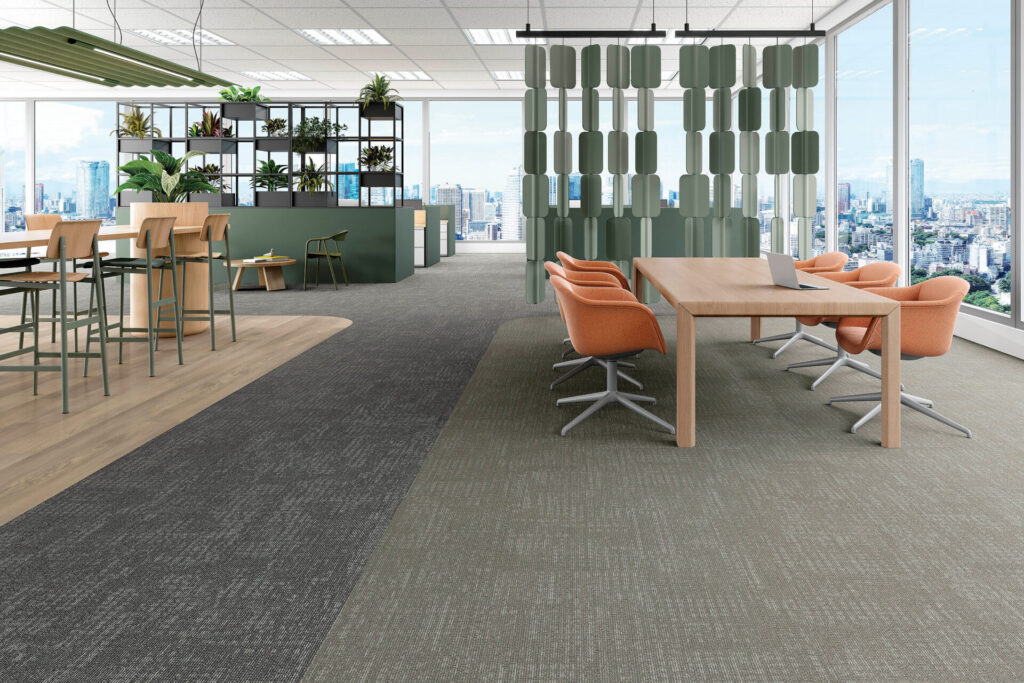
Also developing is the design of office space, to accommodate the new normal, which for many is a four-day week in the office and work from home on Friday. Zack Adamson, Engineered Floors’ vice president of commercial, notes that the need for effective collaboration has helped drive employees back to the office, pointing out that space design has changed since Covid, often with “almost a hotel arrangement with offices” in terms of reserving office or conference room space. And colors have changed from corporate hues—with the blues and charcoals and jewel accents in dynamic patterns, projecting strength, confidence and competence, giving way to warm, earthy residential tones that are more comforting and supportive.
Patrick Keese, EVP and president of Milliken’s flooring business, says, “There is a recognition of new ways of approaching workplace that better serve associates. The myth of the open workspace as a collaboration and creativity catalyst has been debunked. Offering more choice for associates—quiet spaces, individual meeting pods and a variety of gathering spots is driving workplace design.”
And Jim Poppens, Interface’s chief commercial officer, notes that we are seeing a maturing of the trend of amenities for amenities’ sake, with the focus shifting to acoustics, teleconferencing systems and other solutions for current needs.
Also, Shaw and Mannington, among others, report that tenant improvement business has been picking up, though it is still soft.
The education segment drove commercial gains last year. While both higher education and K-12 were up, K-12, which is about twice as big as higher ed, was also the more robust sub-segment. Even with all the uncertainty, bonds are still getting passed, notes Antonio Bucca, Tarkett’s senior director of soft surface product. Adamson adds that activity was fairly regional.
And the consensus is that in 2026, K-12’s growth is still steady.
Higher education, with its reliance on endowments and private funding, also managed growth last year. Universities have been particularly impacted over the last year, from funding issues to political directives to the impacts of immigration policies. There are anecdotal reports of some projects being paused, but there’s still plenty of activity.
For some manufacturers, particularly those with a broad resilient offering, healthcare was just as strong as education last year. There is a wave of demand for medical office buildings, clinics, urgent care centers. While carpet tile has its place on the public space side of healthcare properties, hard surface flooring dominates—mostly homogeneous and heterogeneous sheet, LVT, specialized vinyl tiles and rubber flooring.
Senior living, however, underperformed last year. Some interviewees noted pullback from larger owners, pointing to a lot of recent consolidation in the industry. However, smaller players have been more active. And it’s a segment in the midst of long-term growth, so prospects are good. In fact, most firms report that the market is up so far this year. Carpet, including broadloom, has much bigger role in senior living installations than it does in healthcare settings.
Hospitality is an important segment for several of the top flooring manufacturers, including Shaw and Mohawk’s Durkan brand. Jeff West, Shaw Commercial’s vice president of marketing and design, says that the market was robust last year, and so far this year, sample activity is healthy. He anticipates that the market may be flat this year, then up again in 2027.
Charley Knight, CM Hospitality’s vice president of sales and development, says he’s been seeing a lot of conversion between hotel brands to offset construction costs. He also notes that construction pipelines have stretched from 12 months to two and a half years in many cases. And he adds that the wave of renovation anticipated after the pandemic is yet to fully materialize. “There’s a lot of tired product out there,” he says.
The retail segment was flat to up for most players. Mohawk Group president Mike Gallman reports gains in the banking and communications niches, as opposed to typical retail stores. Shaw Contract notes healthy activity in the segment, as does Philadelphia Commercial, Shaw’s mainstreet brand. Philadelphia Commercial also reports that businesses is up for churches and other houses of worship. And government business was up marginally, more at the state level than at the federal level.
Multifamily has been a mixed bag. Some metro markets are oversaturated, like Miami; others have room to grow, like Texas, for instance. Generally, high inflation and interest rates and overpriced housing are forcing renters to stay put, and that slows renovation rates. Mind you, renovation rates are already being slowed by the switch from carpet to hard surface, which has a longer functional lifespan.
Adamson reports that he’s seeing developers “skewing for more density”—in other words, building vertically—and a lot of that is occurring outside of the major metro markets and in smaller communities. It’s a significant trend in commuter towns encircling big cities.
One sector with a lot of momentum is high-tech projects. It started with a wave of life sciences projects just a few years ago, and as that segment has slowed, the AI boom has stepped in to drive construction of a huge number of data centers across the country. Pew Research Center reports that there are over 3,000 data centers in operation right now, with another 1,500 in various stages of development. Most of the new ones are in rural areas in the South, with another big chunk in the Midwest.
For both cooling purposes and electrical systems, raised access flooring is a go-to in many of these data centers, led by firms like Tate Access Floors. A range of floorcoverings is being specified for installation atop the raised access flooring, from electrostatic-dissipative resilient flooring to, surprisingly, high-pressure laminates. Offering these types of specialized floorcoverings is a high priority and big opportunity for manufacturers, large and small, as this segment is expected to continue to dominate the commercial new construction market.
FLOORING CATEGORY UPDATE
Commercial carpet revenues fell about 2% in 2025, after falling 1.5% in 2024 and nearly 4% in 2023. Volume was down even more sharply across this same timespan for multiple reasons. Historically, the conversion from broadloom to carpet tile has driven that delta, but the biggest impacts from that share shift is largely in the rearview mirror. A bigger impact these days is essentially from rising prices.
On the issue of price increases, Gallman points out that mills have to strike a balance between maintaining production levels (a whole set of costs and challenges arise when mills adjust production) and passing through costs, so they may need to lower their margins in the short term to maintain their production efficiencies—and their share of the market.
Also, the higher end continues to outpace the overall market. Much like what we’ve seen in the residential market, as carpet loses share of square footage, it enables the selection of higher-priced carpet.
At the lower end, LVT is gaining an advantage over entry-level commercial carpet, according to industry veterans, in part due to a dearth of experienced carpet installers, making LVT the more affordable option.
Carpet’s share of the commercial built environment is strongest in corporate, where performance attributes include acoustical mitigation, comfort underfoot and even visual impact. A sea of concrete or wood-look LVT, for instance, generates a different response when installed with islands of carpet and rugs.
The labor problem is even more pronounced when it comes to broadloom, though it’s offset to some degree by the shrinking opportunities. Broadloom’s strongest market is hospitality, though carpet tile and vinyl flooring are taking some share. Senior living is another major broadloom market. Notably, high-end commercial carpet often goes to corporate, where its rich, luxe finishes remain an essential element in the rarefied air of executive suites and conference rooms.
Carpet accounts for about 50% of total commercial sales, and the next big piece is resilient flooring, accounting for another 30% and growing every year. A decade ago, its share was less than 18%. Gains are almost entirely in the LVT category, which is largely gluedown flex or looselay flex, which is twice as thick in order to be installed alongside carpet tile without transitions (and is also generally glued down).
Last year, growth in the education and healthcare markets, where hard surface accounts for most of the flooring, drove resilient sales. Sheet vinyl, which has over time retreated from institutional environments, replaced by LVT, still has a near-unassailable position in high-performance environments like acute care facilities or high-traffic, high-moisture areas. And it’s a more affordable solution than ceramic tile in a range of wet applications, like bathrooms and utility rooms.
VCT used to be widely used in institutional and retail environments with high performance requirements, with its low initial cost making it that much more attractive—and that’s important, since it’s notorious for its less-than-attractive speckled designs. Over the last couple of decades, it started to fall out of favor, due in part to the design limitations of its homogeneous construction, but also because of its onerous maintenance profile.
However, according to AHF Products, which is now the only domestic VCT producer, sales have started to pick up for the first time in two decades. The basic proposition is that LVT, which, along with polished concrete, is what replaced most of the VCT out there, uglies out and doesn’t last as long. Surfaces get scratched and marred. VCT is largely immune to these insults, since regular buffing and polishing leaves the surface as good as new.
The other big commercial category, accounting for 17% of total revenues, is ceramic tile. Ceramic tile has a unique position in the commercial market. On the one hand, it is the go-to utilitarian solution for wet areas throughout all the segments and scales. That’s where base-grade product has its strongest position. On the other hand, driven by design developments over the last couple of decades, ceramic installations are often the high-design public face of a business. Lobbies, entrances, reception areas—the marbles of the past have been replaced with better-performing and more affordable porcelain tile.
Dal-Tile reports that larger format tiles continue to trend, along with gauged porcelain panels for all applications and outdoor pavers.
The education segment, where there is sustained demand for high-performance products, helped drive ceramic sales last year, and the market is still looking strong this year.
LOOKING AHEAD
The American Institute of Architects’ Architecture Billings Index (ABI) is generally considered to be a strong indicator of the strength of the market, with scores above 50 reflecting an overall increase in billings. It tends to reflect flooring sales nine months to a year down the road, maybe longer now, with a growing number of project timelines pushed out for two or more years.
It’s notable that the last time the ABI went into positive territory was in October 2024, and that was a blip—the only time it has gone over 50 since June 2023—three years ago!
The answer may lie in backlogs, which most interviewees acknowledge helped drive gains last year. Poppens notes that orders are up 8% this year, and the backlog is up 18% year over year. West notes that corporate business is up this year, and senior living, retail and education are all up by double digits, and he adds that so far this year, carpet is outperforming resilient—largely due to corporate gains.
In other positive news, most interviewees report that they have not heard of many projects being put on hold because of the petrochemical supply issues through the Strait of Hormuz. However, they concede that the hopes they had just two months ago that a quick resolution could drive market gains in the second half of the year have largely diminished, and most feel that a return to healthy growth may not come until 2027.
Read more from this report below:
Commercial Hard Surfaces Report: Commercial hard surface business grew by 3% in 2025



Join Our Newsletter
Get the latest flooring industry news delivered weekly.