




Interview by Kemp Harr
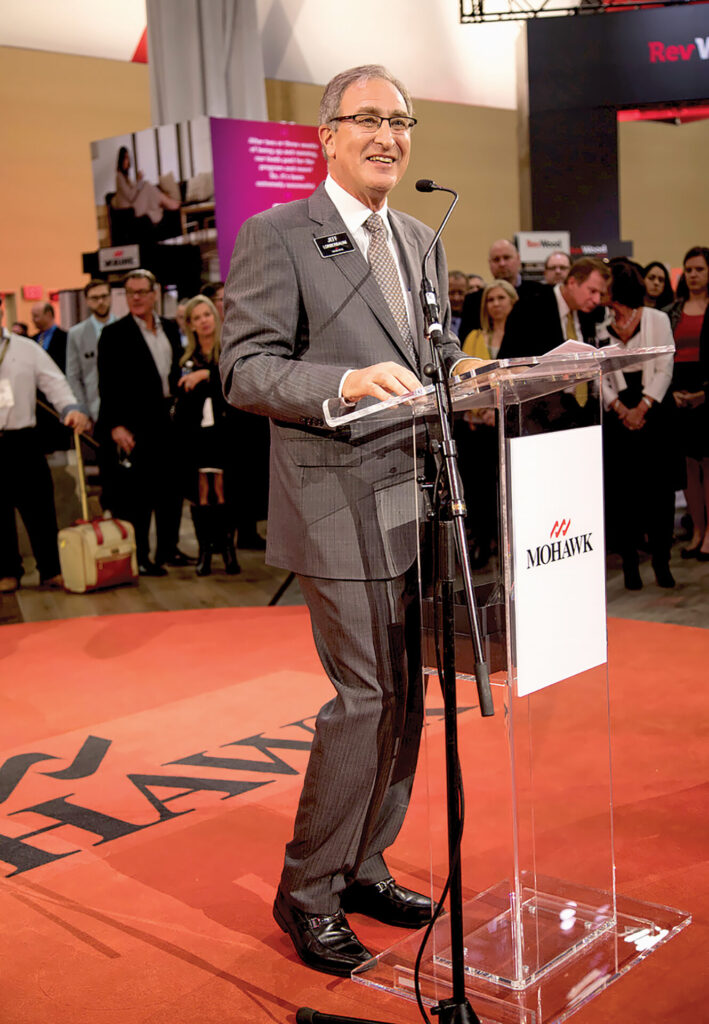
Jeff Lorberbaum was born into the flooring business, his parents having founded Aladdin Mills during his early childhood. He came up sweeping the factory floor and, after college, joined his father at Aladdin full time as “owner in training.”
Mohawk acquired Aladdin in 1994. In 1995, Lorberbaum was named president of the combined organization, and, in 2001, he became CEO. Under his guidance, Mohawk has experienced a great deal of expansion—including its entry into hard surface flooring through the acquisitions of Daltile in 2002, Unilin in 2005 and IVC in 2015.
After 50 years in the business and 30 at the helm of what is now the largest flooring business in the world, it was announced in June that Lorberbaum would retire as CEO, effective September 30, with Paul De Cock succeeding him. He will remain chairman of the board.
Jeff and his wife, Sarah, live in Chattanooga, Tennessee. They share two grown children and grandchildren.
Q: When Mohawk announced your retirement as CEO, many people across the industry began to reflect on your 50-year career and all you’ve accomplished.
A: It may be cliché, but it’s interesting to think back on my career and how quickly time has passed. I graduated from college and came directly to work—there was no time off for self-reflection then, so I’m doing that now. We all start out being the youngest person in the room with little or no experience. In what seems like the blink of an eye, I became a seasoned industry veteran who has already experienced some version of everything we’re now going through again.
It’s been an unimaginable experience to work with all of the extraordinary people within our company, as well as our customers and suppliers. I’m grateful for all the friends I’ve made through the years and the relationships that supported Mohawk’s success. Though I’ve been thinking about the past, I remain excited about the future. Mohawk has a great team, a strong strategy and tremendous opportunities to help our customers succeed. I’m certain that we’ll raise the bar even higher in the future.
Q: Looking back over those five decades, how have you changed as a leader?
A: I started in a small family business that was making rugs, which we sold to large retail chains across the United States. The business evolved into a Fortune 500 public company with international operations on four continents. As the size and scope of the business changed, so did the way we managed it. In a smaller business, usually there is a limited group that defines the strategy and executes the actions. There are limited resources and people, so the leader becomes involved in all the significant decisions and much of the implementation.
As the business grows in scale and complexity, the leader’s role changes to building a strong organization and motivating creative people to work together and establish competitive advantages that retail partners and consumers prefer. My father compared leading a business to being the conductor of an orchestra. To achieve an extraordinary performance, you need all the musicians working in sync.
Q: Are there behaviors that made you successful early in your career that you later had to modify?
A: Any successful manager has to change as the business’ needs change. In a smaller business, the senior leadership can meet frequently and discuss the strategy, tactics, challenges and opportunities. They can be involved in the details of most of what’s happening and assist the organization as required. It’s easy to communicate with a limited number of people so that everyone’s aligned.
In a large organization, the functions become much more specialized, which has its benefits, but it’s more difficult to ensure that all the parts are working cohesively together toward the same objectives. To return to my father’s orchestra metaphor, the number of musicians grows, and the music becomes more complex. Everything has to be done in greater detail so that every department and person can understand their role and how their decisions impact the entire enterprise. It requires greater communication of
the strategy, goals and metrics to manage the organization so that all the individual actions effectively support each other and work to achieve the common objectives. When done well, it’s amazing what a strong organization can accomplish together.
Q: When you think about the talented people on your team through the years, were there qualities that told you if someone had the potential to lead a major business?
A: Successful leaders need to be able to define a vision for the organization that is going to create greater value for its customers. They have to surround themselves with talented professionals who can define a future state that’s superior to where they are and motivate the organization to follow. They have to build trust by doing what they say and having integrity in everything they do. They have to be good at driving execution and holding teams accountable for the results.
At Mohawk, we identify people with high potential and move them through different functional areas so that they can gain the experience and knowledge to make the best decisions and satisfy our customers’ expectations better than their alternatives. Over time, you can see how people have exercised those traits in real-world situations and know they have the qualities to be a successful business leader.
Q: Your own leadership path included becoming Mohawk’s chief operating officer after Mohawk and Aladdin merged in 1994. In 2001, David Kolb selected you to succeed him as CEO while he remained chairman of the board. What lessons in leadership did you learn from David before you became CEO?
A: I worked with Dave for seven years before he retired, and we were a good team. He was a chemical engineer and an attorney, which is a rare combination. I grew up in a family carpet business, and he had been recruited from the fiber industry, so we approached ideas from different perspectives and worked well together.
I had grown Aladdin’s business organically, whether that was by expanding from rugs to carpet, backward integrating into fiber manufacturing or creating a national distribution network. Dave saw acquisitions as a path to faster growth and felt we needed to consolidate the industry, or we’d end up being consolidated. By 2001, Dave was ready to retire to spend more time with his family. The board appointed me as the company’s second CEO, and I was glad to have Dave’s support during that transition. Continuity is important for the success of any business.
Q: Did that experience influence how you are now handing leadership to Paul De Cock?
A: I’ve collaborated with Paul since the Unilin acquisition in 2005. He’s held many positions in the company, including running a board manufacturing plant, the European flooring business, the U.S. hard surface business and the Flooring North America business. Most recently, he’s served as chief operating officer of the entire company. I didn’t hand Paul the CEO position—he earned the board’s confidence through his 20 years with the business. We’ve spent a great deal of time focusing on how to make this transition a positive and straightforward process.
Paul has many strengths, and I believe he’ll take Mohawk to the next level. The work we’ve done during the past few years has positioned the company to deliver sustained profitable growth and long-term value creation. We’ve focused on improving the efficiency and effectiveness of our operations as well as delivering product innovation, enhanced service and advanced tools to help tens of thousands of customers around the world become even more successful in their markets. I’m eager to see what the future holds.
Q: You mentioned David’s focus on acquisitions. The 2002 Dal-Tile acquisition was Mohawk’s first transformational step beyond carpet and rugs. What gave you the conviction to make such a large strategic move so early in your tenure as CEO?
A: One aspect of leadership is recognizing how to take advantage of changing situations. Through the first half of my career, carpet represented about two thirds of the U.S. flooring market. By the 1990s, consumer preferences were changing enough to suggest a secular shift in the market was likely. Before pursuing a hard surface acquisition, we began to sell ceramic tile in our Florida region. We used that program to gain a better understanding of the product, the competition and the level of interest our customers would have in purchasing other products from us. Dal-Tile made sense as an acquisition because it was the largest U.S. tile manufacturer with market leadership, operational advantages, brand awareness and an established customer base.
We also had the financial strength to invest in the business, which expanded its sales and margins. With our expansion into hard surface flooring, Mohawk introduced many carpet retailers to other product categories, and that became the catalyst for many of them becoming total flooring retailers.
Q: Soon after Dal-Tile, you expanded the business into a new geography. The 2005 Unilin acquisition gave Mohawk technology, a strong brand, European management talent and, ultimately, your successor as CEO. What did you recognize in Unilin that others might have missed?
A: Unilin went through an auction process to determine what would be the best option for their shareholders and family. Mohawk became involved near the end, and the combined business added value to both companies. Mohawk wanted to establish a leading U.S. position in laminate flooring just as we had with ceramic tile. The Unilin team wanted to ensure the long-term success of the business, having nurtured it from a start-up, and they saw opportunities to expand into the U.S. market. Unilin had already established the business as the leader in laminate innovation in Europe and had a manufacturing facility in North Carolina to grow their U.S. business. They offered differentiated products with unique features compared to other laminate choices. With our customer relationships and national distribution advantages, we were positioned to fulfill their ambitions in the U.S. and invest in the European business.
Twenty years later, Mohawk remains the leader in premium laminate in both the U.S. and Europe by delivering innovative visuals and performance features. We expanded geographically outside of Europe and entered new product categories to significantly grow the business.
Q: Do you take talent into consideration when considering acquisitions?
A: In our industry, all companies with capital have access to similar equipment, materials and software. When we acquire a company, the most important asset they have is their people and how they innovate better designs and features and enhance their productivity, service and customer relationships. Through the years, we leveraged the best talent in the companies we acquired to develop centers of excellence for each product category that we sell across the world. We harness their creativity and expertise to deliver trend-setting products, select the best equipment and grow the next generation of talent.
Q: Many Mohawk executives quote your expression, “Congratulations—you’re halfway there.” Where did that philosophy come from, and how do you maintain relentlessly high standards without exhausting or discouraging people?
A: Business is not like running a single race where you win at the end. There is no end! The goal is to sustain the business through generations—forever. We look at our business as a continuing evolution that never stops. Every creative step that provides the next innovation is just the best you can accomplish at that moment in time. It doesn’t matter whether it’s a marketing strategy, a new product or an innovative operational process. “Congratulations! You’re halfway there” represents the celebration of the next step in this evolution. As soon as you’ve completed that step, the challenge is to take it even further. You can think of it as an Olympian who just broke the world record. What does he do the next day? Wake up and work harder to break his own record. Standing still means that others will pass him by. The industry, the market and technology are constantly evolving, so the only way to stay ahead is to continue progressing. Success lays the foundation for further success; it’s not a stopping point.
Q: What advice do you have for those independent dealers who are seeking to build a successful family business in the flooring industry?
A: Running a successful retail store is never easy, and every retailer’s situation is unique. I’ve had the opportunity to spend time with hundreds of our retail partners, particularly at our Edge Summits. Listening to their challenges, learning about their businesses and understanding what they need to succeed has been one of the most rewarding parts of my career. I have tremendous respect for independent retailers because their businesses represent not only their livelihoods but often their families’ legacies, as well.
The best general advice I can offer to retailers is to know your customers and build your business around serving them better than anyone else. That requires looking critically at every part of the experience—from your advertising and website to the appearance of your store, the quality of your sales team and the service you provide through installation. Your sales associates should understand your customers’ needs, explain the value of different products and help customers make the best choices for their homes.
Just as important is what happens behind the scenes. Strong systems, processes and reporting allow you to understand what’s working effectively, identify where you can improve and continually make the business better. Every part of the operation can either become a competitive advantage or a barrier to growth. Using reports wisely and well helps you make better and faster decisions on how to improve performance.
Finally, every retailer needs to surround themselves with strong partners. The best suppliers do more than provide products. They should help you improve your merchandising, marketing, training and overall customer experience. At Mohawk, we view that relationship as a true partnership. Our success ultimately depends on the success of our customers, which is why we’re working to build stronger connections that will deliver even greater opportunities in the years ahead.
Q: You grew up in Dalton but chose to attend the University of Denver. What drew you that far from home?
A: When I was in high school, my parents learned about a small boarding school in Tennessee that attracted students from across the county. In addition to a strong academic program, the school offered opportunities that were rare at the time, like computer programming classes with punch cards and wilderness-based experiential learning that emphasized problem solving and teamwork. Boarding school gave me experience in being self-sufficient, so I didn’t consider geographical restrictions when I began to consider colleges.
My decision to attend the University of Denver wasn’t out of the blue. I had been to Colorado on skiing trips, and I liked the area. A good education depends on what you put into it more than where you go.
Q: Did you study business in college?
A: My parents might have said I studied partying and skiing too much. I started out as a math major, but I ended up with a degree in finance with a strong focus on accounting and math, as well. I chose a major that would give me a strong foundation to build upon. I was lucky to join a family business and be able to move across all the functions to understand how they work together and make a business successful. A good education prepares you to keep learning because you’ll constantly face new challenges throughout the rest of your career.
Q: Did your education prepare you for success as a leader?
A: Growing up in a family business, my first job title was “OIT,” owner in training. I learned about business during dinner-table discussions, shadowing my father when he’d walk through the plant and listening to conversations about equipment, products, vendors and customers. A business education is practical, and you learn the fundamental concepts. The real education comes from working in a business. Even though my degree was in finance, I became a self-taught engineer, optimizing processes and systems. That’s what was needed, so that’s what I did. I don’t want you to think I’m a fast learner—I stayed in training until I was 40, and my father retired. He never stopped pointing out how I could improve whatever I was doing. He was my post-graduate education.
Q: Did you and your wife, Sarah, meet in college?
A: We did, and she has definitely had a greater impact on my life than the college degree. I was able to convince her to relocate from Denver to Dalton, so that shows I gained some skills at persuasion in addition to my degree. I was lucky because I found someone smarter than I was, and she has been helping me make the right decisions throughout our time together.
Q: You joined Aladdin Mills in 1976, shortly after college. What responsibilities did your father initially give you, and what did you need to do to earn greater authority?
A: I joined Aladdin at birth! I grew up in the plant. I was working there during summers as a teenager and learned about the business as well as doing chores like cleaning the plant floor. I learned many lessons, like “Do it right or do it twice.” I learned that lesson the hard way—I once had to sweep the entire building twice in a row!
When I returned to Dalton after college, I started at the bottom and worked my way through all the different functions across the business. I learned how all the parts fit together to enhance the enterprise. Aladdin had a strong team of people, and we worked together to find ways to increase productivity, improve quality and provide superior service. We became a low-cost producer, and we were one of the first to backward integrate into fiber production. We constantly worked to identify ways to improve our operations, product offering, distribution and sales strategies.
The business was growing rapidly, and I was eventually put in charge of all the operations. It was an exciting time as we grew to become one of the top carpet manufacturers. The most important thing for any growing business is attracting, retaining and developing talented people. We were fortunate that we had more than our share during that time at Aladdin.
Q: You and Bob Shaw have arguably been the two most consequential flooring leaders of the last half-century. What did competing with and observing Bob teach you?
A: Living in Dalton, your friends and competitors were one and the same. Everyone worked to maximize their business during the day, and afterward, your families socialized together. It was an extraordinary place to live, and everyone contributed to making the community better.
Bob has been a good friend for many years. He has always been an exceptional entrepreneur because he had a vision that advanced his business and the entire industry. Bob took chances that few other leaders would have attempted, and more often than not, he beat the odds. He’s a strategic thinker, a clever problem solver and a passionate advocate for people. He built an excellent organization and has mentored a lot of people who are still leaders in our industry today. And just in case he hadn’t proven to all of us how successful he’d been, after he retired, he decided to do it all over again!
Q: Once Paul is running the day-to-day business, how do you hope to spend the additional time, and what are you personally looking forward to most in this next chapter?
A: Paul is in charge of running the business and the day-to-day operations. I will continue as chairman of the board and will be available to assist the team in any way they need.
On more personal terms, Sarah and I are going to spend more time with our children and grandchildren and travel to places we’ve always talked about visiting. The world is full of fascinating places, and we look forward to some great adventures. Who knows? I might even find some opportunities to assist other entrepreneurs and help them along their journeys.
Q: Fifty years from now, when people discuss Jeff Lorberbaum’s contribution to the flooring industry, what would you like them to say?
A: Fifty years from now, I don’t believe anyone will remember this moment in time. Our industry has always been more focused on the future than on the past. The past is behind us and unchangeable; the future is yet to be defined. I wish I had a crystal ball because I’d love to know what the flooring industry will look like in 50 years. I believe our industry will remain strong and that Mohawk will continue to thrive. Based on the past, I can say with certainty that our retail partners will remain our top priority, and we’ll continue to deliver new products, displays, marketing and digital tools to support them. Now, what that will look like is anyone’s guess, but that’s the exciting part for all of us.



Join Our Newsletter
Get the latest flooring industry news delivered weekly.