




Tools of the Trade: Tool innovation continues as the installation trade transforms – Sept 2026
By Jessica Chevalier
While a blade might seem like a blade and a knee pad a knee pad, there is more innovation in the world of flooring installation tools than it might first appear. With ever-tightening construction schedules and an aging and short-staffed installation population, tool companies are on an endless quest to improve efficiency and safety to keep installers productive.
Innovations in tools range from minor tweaks to larger-scale rethinks but, in both cases, require that installers buy in doubly—with both their time to learn how to use the new tools and their dollars to invest in acquiring them—when sticking to what they know and already have in their toolbox is the path of less resistance.
And for their part, tool manufacturers must succeed not only at innovating new tools and methods but also at getting this information out to an unwieldy population comprised largely of subcontractors, some of whom prefer working off the books and out of sight—making them a particularly difficult group to target.
The fact is, however, as long as flooring products are evolving, so will the tools needed to install them. “New flooring products absolutely determine tool design,” explains Brad Miller, vice president of global product innovation for QEP, which sells tools under both the QEP and Roberts brands. “Thicker product, thinner product, bigger product: any change to flooring could create a need for a new tool.”
He continues, “For tile, the sizes have grown from 18”x18”, once considered large format, to now 4’ x 8’ panels, so we had to develop the tools and equipment to keep up with the trend. A little over 20 years ago, our CEO Lewis Gould developed a 40” bridge saw, and I remember thinking, ‘Why would anyone need a tile saw this big?’ As it turns out, he was way ahead of his time. It is the same thing on the wood flooring and carpet side. We are currently finalizing designs and about to launch over a half a dozen new tools in this category due to requests from our team based on input from installers.”
NEW TOOL DEVELOPMENT
Crain Cutter Co. hires former installers as its sales reps, and these individuals act not just as salesmen but also as educators to the installation community, explains Darwin Spencer, national sales manager at Crain. The company, family-owned by its third generation, makes its products in the U.S., though some parts are sourced from abroad.
In terms of innovation, like QEP, Crain keeps its ear to the ground with the installation community, listening for challenges that could be addressed with new tools. The company’s three sales reps each make 120 points of contact with the installation community annually and seek to respond quickly to concerns in the community that could be addressed with tool developments. Sometimes this results in the company coming up with an idea for a new tool.
Spencer offers a current example: “We are putting more LVT on stairs than ever before. Do installers need a scriber specifically for this purpose?”
Roberts made significant improvements to its power stretcher head in response to feedback it heard from installers and has now introduced its Falcon Power 44 Stretcher, which features a patent-pending 44” tailblock that gives the installer the ability to span a doorway while stretching carpet.
And under its QEP Products brand, the company is developing new solutions for its gauged porcelain tile panel installation—a new category for the company—addressing installer pain points around other tools on the market. “The tools needed to install the ever-growing large tiles and porcelain panels are very specialized, and installation can be dangerous if the right tools are not used,” says Miller.
In fact, specialization is behind a good amount of current tool development. “We are definitely seeing a call for more specialized and specific tools for certain applications,” he adds. “The Swiss Army knife days are long gone, and the installers want a quality tool to do the job correctly.”
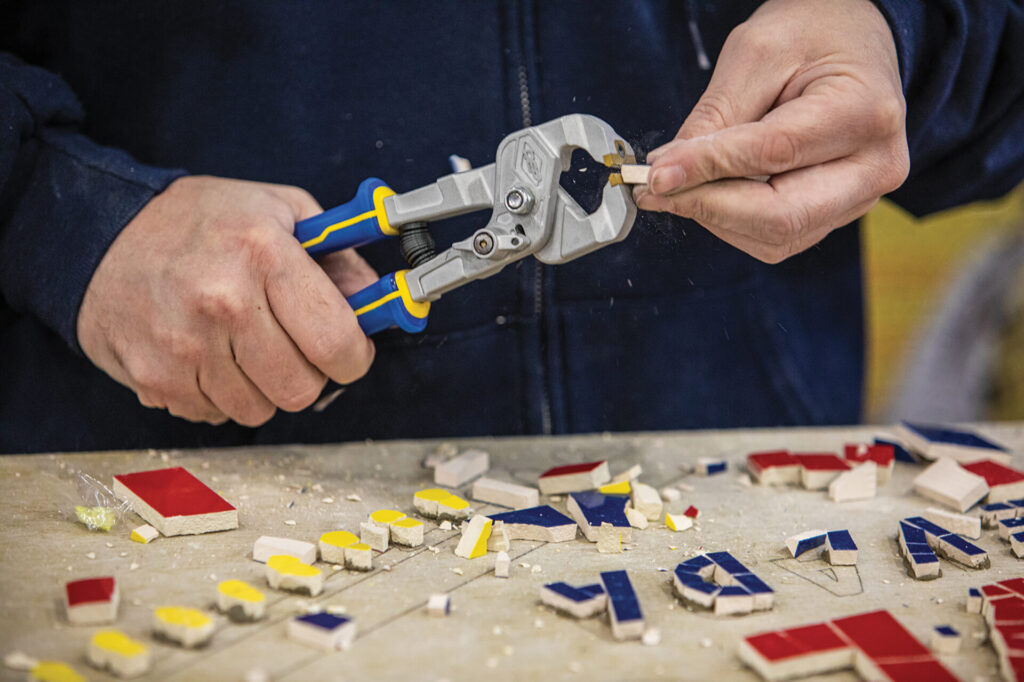
Recently, QEP introduced its Artisan Power Nippers, which were developed based on a design idea and input from mosaic artist David Arnott.
In terms of getting a new tool to market, timely development is the greatest hurdle QEP faces, as the process of developing and introducing a new product to address a need can be lengthy. “We design our products in-house and have invested in being able to do 3D print prototypes in-house to save time,” he explains. “However, we then send the prototypes out to a core group of professional installers for testing and feedback. We make changes based on their feedback, 3D print new prototypes and repeat the field-test process. Once a tool is finalized, we start making the molds and then move to manufacturing. The whole process can take anywhere from eight months to a few years depending on how complex the product is.”
Ideas for new tools sometimes come from installers themselves, says Spencer, and those can be either in idea form or a prototype that an installer has fashioned themselves. In these cases, Crain educates the installer about how to protect their intellectual property and, if the company believes the idea is a good one, will sometimes make the installer an offer to buy out the concept for production. Often, these ideas need tweaks, with the company team making engineering and design changes based on feedback from the full team and installation professionals.
“Our design team has a list of projects that are heavier on new innovation but do include product enhancements,” says Miller. “With everything we design, we ask ourselves, Why do we need this? What problem does this solve, and how can we make the end-users’ experience better? Sometimes we are developing the next patentable product, and other times it’s figuring out how to upgrade the performance or ergonomics on an existing product.”
Key to bringing a new product to market, however, is profitability. According to the latest U.S. Bureau of Labor Statistics data, approximately 112,300 flooring installers, tile and stone setters, and floor finishers worked in the United States in 2024, a relatively small customer base to target with new products.
TIME IS MONEY
With the installer community short-staffed of trained craftsmen and construction timetables crunched, one key focus of tool development is saving time on the jobsite.
“Anything we can do to help an installer cut time out of an installation without cutting corners or going against industry standards is key,” says Miller. “Some of our biggest successes have been relatively small innovations. Take, for example, the bucket hooks on our margin trowels and bucket scoops. Installers love this feature addition because it saves time from cleaning off trowels when they fall in the thinset during installation.”
QEP recently introduced its Katana manual tile cutters that rip a 48” tile in seconds versus using a wet saw, which takes minutes and can be messy.
One of the driving concepts in creating new tools for flooring installation is that keeping installers on the floor is key. First of all, nothing is harder on the installer’s body than the repeated up-and-down motion. But secondly, keeping them on the floor also increases productivity, as they are focused on the work and less inclined to be distracted by other factors.
“Anything that keeps the installer on his knees is a money maker,” explains Spencer. “The retailer or contactor doesn’t make money when the installer is walking around. They make a phone call. Answer a text. Go to lunch. Fight with the help. But when they are on the floor, they are focused on the job, so installation tools that can be used without getting up are key. If the installer can stay on the floor for five hours, they are much more profitable.”
He continues, “We want installers to understand that there are opportunities and solutions out there.” For example, the company has guillotine cutters outfitted with wheels so that installers in a kneeling position can easily move them as needed across the floor without standing up to reposition.
PRESERVING & PROTECTING
Creating tools that serve the aging installer population is another focus for tool manufacturers. “The older guys deal with arthritis and the loss of strength in their hands, so we think about ergonomics,” Spencer explains. “For years, razor knives and utility knives did not fit the profile of the hand. We started making our knives bigger because more surface area of the hand on the tool means it requires less strength and prevents injuries like carpal tunnel. We have also created tools that hook into the hand, so you don’t need as much grip strength to hold it.”
Another example relates back to the physicality of working on stairs. Crain designed its Stair Claw tool to assist installers in stretching and forming stiff carpet over steps. “We want to prevent back torquing and maintain good alignment and posture,” says Spencer.
Historically, the bodily harm of installation was simply accepted by many installers, but that is beginning to change, says Miller. “We are now more aware of the wear-and-tear a body can take from the physicality of installation. When we explain why we developed the product, to give better leverage, to enhance the grip or to utilize the natural angles of their body while in use to reduce fatigue, they really appreciate it. We spend a lot of time with installers talking to them and watching the way they do their job, which we take back and apply to our tool designs.”
BRINGING PRODUCTS TO MARKET
Crain makes most of its new product introductions at Surfaces, which allows it to demo use of the tools there for the installers in attendance. Each year, the company seeks to introduce three to five new ideas or improvements, and these are featured on the company’s catalog cover. “It might be something small like improving a knee kicker to be more reliable and not tear the carpet,” says Spencer. According to Surfaces data, installers accounted for 12% of attendance in 2023.
In addition, the company makes some education videos on the use of new tools, with Spencer noting that third parties often also make videos demonstrating the use of new tools, which can be good or bad depending on the quality of the installer making the video.
QEP takes a multi-tiered approach to educating installers on a new product. “First, we release new products to a small group of social media installers and ask them to review the products online,” explains Miller. “Then we get in front of the industry training groups and make sure they are familiar with our products and support them in their training events. Lastly, we demonstrate the new products at customer in-person events and industry tradeshows so we can make sure that installers get to touch and feel the product. We have found that in-person demonstrations are the best form of education, since you get instant, raw feedback.”
For some products, more often with hard surface, flooring manufacturers will recommend specific tools. And, at times, Crain will collaborate with a flooring manufacturer to create a new tool for a specific product—for instance, the company worked with Protect-All to create a new power groover.
But for the most part, notes Miller, manufacturers are not in the business of educating installers about what tools they recommend to install the flooring they produce or sell. And, he adds that, in fact, “many tools are designed in response to the installation challenges that installers encounter after new flooring is already launched into the market.”
Crain seeks to support better installation practices. For instance, the company will not warranty its carpet power stretcher if the installer uses a spike, as spikes damage both the carpet and the subfloor. “When you put morals in front of money, you earn trust from the manufacturers,” notes Spencer.
MOTIVATING INSTALLERS
Spencer feels frustrated at times that the installer community, of which he is a part, isn’t as motivated to improve their practices and processes as they could be. “The CFI (International Certified Flooring Installers Association) guys are amazing,” he says. “For the other 75% of installers, this is just a paycheck to them. You have vendors and distributors willing to teach them stuff to help them make more money, but they don’t want to take the time to learn.”
Spencer believes this goes back to one of the central problems feeding the installer shortage dynamic: poor pay and low respect. “One way to get American kids interested in floorcovering installation would be to pay them what an electrician or plumber makes,” he says.
Miller notes that he sees some mom-and-pop stores heading the way of treating installers right. “In smaller markets, they don’t want to lose a good installer; a good installer is turnkey,” he says, adding, “I wish floorcovering installation was respected more by the rest of the construction industry.”
For their part, some tool manufacturers do what they can to assist. “We pledge to help by continuing to innovate and improve tools so that installations go smoother; time is money,” says Miller. “We are also very active with industry training organizations and encourage installers to get training and continually learn as much as they can to allow them to charge what they are worth. Knowledge is power.”
COMMERCIAL CONTRACTOR PERSPECTIVE
Keith Chesnut, a buyer with Fromkin Brothers—a family-owned interior finishing company based in Edison, New Jersey and serving five states—reports that he is seeing the most tool innovation around sheet vinyl installation, ceramic tile material handling, on-site evaluations and measuring jobs.
In the sheet vinyl category, tool purveyors have improved the ergonomics of knives and other hand tools to help reduce fatigue and improve safety. For instance, the old-school skiving knife—used to trim excess flooring material around a heat-weld—has been replaced by the Mozart knife, which is more ergonomic, reduces floor gouging and, due to replaceable blades, eliminates the need for resharpening. “The Mozart knife has been a huge improvement in safety and speed for cutting after they run the weld,” says Chesnut.
On the ceramic side, the introduction of larger-format slabs has introduced higher risk for material damage as well as increased risk of injury for installers, who have to move, maneuver and install the heavy and awkward porcelain panels. Traditionally, installers used simple deck carts, like the ones available for customer use at Lowe’s and Home Depot, to transport heavy materials, but newer A-frame carts equipped with suction cups and straps make it safer and easier for installers to move and position porcelain panels with less risk to both the material and the worker.
Protecting the installers’ knees is another area of concern. Kneepads have transitioned from simply padding the kneecap to offering shin support systems, and some companies offer versions that feature casters as well as a bike-style seat, enabling the installer to move around the worksite on wheels. Additionally, attachable chest pieces to support the installer’s back are available.
Education of installers about new tools is a particularly important part of the process, Chesnut believes, especially as installers are often reticent to change their tried-and-true methods. “The installers are very set in their ways as to how they do things,” he says. “To get them to change is difficult.”
As the buyer of installation products for Fromkin Brothers, Chesnut says he has learned a lot about new tools by tapping into tool manufacturers’ social media outlets. “It gives the manufacturers an inexpensive and live-action opportunity to see their products in action,” he says.
However, for installers, Chesnut has noted that the willingness to try a new tool or method is often a matter of recommendation from a trusted peer.
He notes that new tools can face hurdles not only in terms of introducing new techniques but also because they must offer enough efficiency to justify their investment. “Tools are a huge part of what we do and a huge expense,” says Chesnut. “The amount I spend on blades and trowels and self-leveling pins and other tools adds up to hundreds of thousands of dollars annually.”
That said, increasing efficiency is a major concern with the tight construction timelines that commercial contractors face on the jobsite today. “Shrinking construction installation schedules, especially as a project progresses, are making the demand for fast, efficient installation a must,” he says. “Material handling is an important category. The less time guys spend moving material around on the jobsite, the more they can get installed.”
Another way of saving time on a jobsite is protecting workers from basic injury. “We strive for a construction environment with zero incidents,” says Chesnut. Innovations in glove technology are focused on preventing accidents with new polymers that allow tactile sensation while also protecting the hand.
Regarding technology, “Tool manufacturers are incorporating data capturing, micro processing and wireless solutions into their tools to check subfloors and measure rooms on site,” explains Chesnut, “to be able to compare real-life measurements with drawings in seconds, giving the contractor a real-time feel for the material quantities needed for the job.”
He expects to see the use of AI and mobile app technology grow in the next handful of years, “to simplify acquiring instructions, plans and correspondence and to bring the office and field closer together on projects.”



Join Our Newsletter
Get the latest flooring industry news delivered weekly.