




By Jessica Chevalier
Though the carpet tile category’s years of rapid growth may be in the rearview mirror, the now-mature segment remains a key problem-solver across commercial sectors. Carpet tile’s ease of handling and installation has long been lauded as a major advantage, especially today, in this age of fast-track construction, as is its relative breathability, compared to some hard surface flooring, since projects often move ahead before slabs have time to fully cure. These attributes complement the category’s other well-established strengths, including design flexibility, ease of maintenance and strong sustainability credentials.
Looking ahead, carpet tile suppliers are focused on leaning even more deeply into the product’s solution-oriented assets to lighten the load for end-users, specifiers and installers.
STARTING STRONG IN 2026
Shaw Contract’s 2026 began well, and Jeff West, brand leader of Shaw Contract, notes that if 2026 continues on its current trajectory, it will be the first time carpet tile has outpaced resilient since the company added the resilient category to its offering. He attributes this both to the leveling of LVT’s dynamic upward trajectory and to the fact that the workplace segment—long a stronghold of carpet tile—is bouncing back following the slower work-from-home years of the Covid era.
Looking at the carpet tile category as a whole, Brack Dukes, manager of mainstreet and commercial sundries at Mannington Commercial, notes that while it has been flat the last two to three years, this year so far has been an improvement. He adds, “We’re seeing an uptick. Internally, we have marginally outperformed the market, so we feel good about that in such a mature business unit. It’s been a good year.”
Mohawk’s Robb Myer, vice president of Aladdin Commercial, doesn’t attribute the category’s success only to market conditions but also to the advantages of the product itself. “We are moving more volume,” he says. “The customer is more intrigued by carpet tile than broadloom. They can use the product to make a design statement, and it offers flexibility with reuse of space. Ten years ago, carpet tile was the thing to do because it looks good. Now, it’s more about a better sustainability story. You don’t have to replace everything—just what needs to be replaced.”
“While demand for carpet tile remains a cornerstone of commercial interiors, the category is experiencing a dynamic evolution driven by human-centric design,” says Jackie Dettmar, vice president of marketing, design and product development for Mohawk Group. “We are seeing a significant shift across all sectors—from corporate workspaces and healthcare to education—with a primary focus on the people occupying the space. Today’s clients are prioritizing acoustic support, sensory engagement and measurable sustainability, like our ultra-low carbon backing. Carpet tile is uniquely positioned to meet these demands, offering the modularity to create customized zones within a workplace, the tactile warmth needed for resimercial environments, and the biophilic textures, patterns, and other strategies that support overall wellbeing.”
Carpet tile’s story is no longer one of gobbling up marketshare, though some opportunities do exist, says Bentley Mill’s Brooks Turner, vice president of sales. “The last couple of years, the carpet tile market has somewhat stabilized,” he notes. “Today, there are few segments where carpet tile is taking share, but the one segment where carpet tile could take share is hospitality, where there are still rolled goods used.”
Turner estimates the overall split to be 80-20, carpet tile to broadloom. He notes, “Outside of hospitality, law firms and financial brokerages might use rolled goods, but other than that, you’re hard-pressed to find others that do.”
While the market has largely been good in 2026 for carpet tile players, Tarkett’s Antonio Bucca, senior director product of soft surface at Tarkett, characterizes activity as “strange,” adding, “Demand is there, but there has been a weird shift in seasonality—orders are coming later, the busy season is later, but order numbers in the in-between times are higher than normal. There is lots of uncertainty out there. Lots of products are being put on hold but then being restarted later.”
Zack Adamson, vice president of Engineered Floors’ commercial division, has similarly seen some unevenness. “Demand has remained relatively stable over the past year, though project timing and capital spending have fluctuated by segment and geography,” he says.
In these situations, while customers may be ordering later, they are still expecting delivery on the same schedule, says Bucca. Educational institutions, for instance, have a hard stop with the start of a new school year, so regardless of when the order was placed, they want the project complete before school starts.
“There is a higher expectation of service,” Bucca notes.
CORPORATE REBOUND
Carpet tile and the corporate/workplace sector are tightly tied. While the product is used across the entire commercial space, its first and strongest roots remain in the corporate market. With its contemporary design and modular format, it is well-suited for workplaces seeking to make appealing spaces with aspects of wayfinding or place-making, ease of maintenance and its ability to be reformatted if need be. In addition, it is the go-to choice for offices with raised access flooring systems.
Following the pandemic, the corporate sector has changed. First of all, interviewees agree that, within the corporate
market, renovation is outperforming new construction, which makes sense as there was a widespread glut of open office space following the pandemic. At this point, explains West, a few scenarios are playing out that are generating renovation work. Some employers are demanding that their workers come back to the office or strongly encouraging them to do so and are updating their office space to make it more appealing for its returning team. Others are releasing space that they no longer use, and, as this space goes back on the market, it is rented by a new corporation and renovated.
FASHION FORWARD
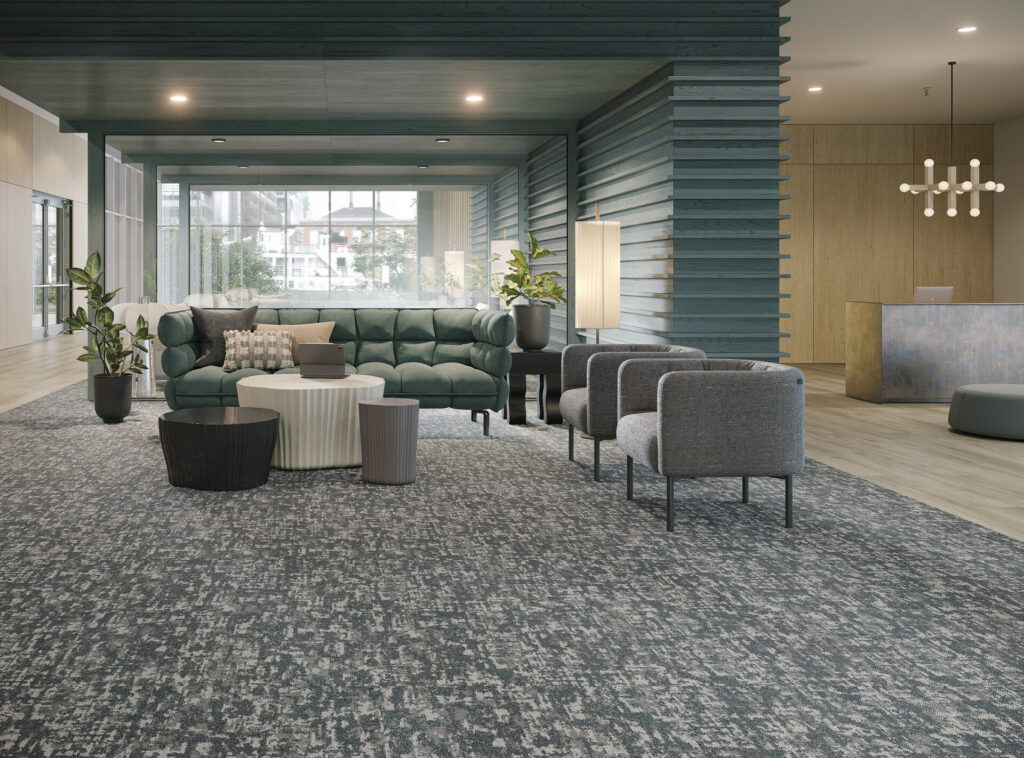
Carpet tile may have remained simply a utility product, as it began, were it not for its pretty face. The category has staked its claim as a fashion icon through years of design leadership and continues to be a hub of design innovation.
Right now, the commercial market is amid a warming trend from an aesthetic perspective, which interviewees surmise is being led by workplace, the largest commercial segment, as it hopes to lure employees back to the office with cozy, welcoming interiors following the work-from-home era. “Commercial interiors are leaning into warmer tones and more approachable neutrals to encourage wellbeing and connection while maintaining functionality and durability,” says Anne Marie Lisko, vice president global product category management at Interface.
But the inclusion of warmth is also a counter to the cool greys that trended for nearly a decade, drenching everything from flooring to furniture to paint and patterns in colors that felt more aloof and polished than welcoming.
Among the flooring categories, biophilic design took hold in carpet tile first, as David Oakey looked to nature for his design inspiration.
In recent years, biophilic design has surged across flooring categories and other interior finishes. And interviewees agree that it is no longer a trend but a standard, as it offers scientifically proven benefits to humans visiting or inhabiting those spaces. “Organic and biophilic-inspired visuals remain prominent, particularly in healthcare and education environments, where they help create calming, restorative spaces,” says Lisko.
While fashion-forward is a big part of carpet tile’s appeal, there is also a need for more quietly functional pieces. “It is interesting because everyone wants high design, high
movement looks but needs the basic product,” says Bucca. New and high-style, Bucca reports, are always a must, as it keeps the specifiers eyes on your brand and offering, but staple products can be bigger sellers.
CATEGORY INNOVATION
Much of the carpet tile category’s current innovation journey focuses on further improving sustainability and performance.
On the sustainability side, this generally involves integrating more recycled content. Shaw Commercial’s ReTurn program takes back EcoWorx-backed carpet tile and turns it into more EcoWorx carpet tile. The program has taken back one billion pounds of product in its 20-year life.
Forbo’s Flotex hybrid carpet tile, now produced in the U.S., has a 30-year life, which certainly checks the “reduce” box on “reduce, reuse, recycle.”
A leader on the sustainability front, Interface offers some carpet tile styles that are carbon negative with the goal of being fully carbon negative by 2040—without the purchase of carbon offsets.
Performance-wise, late last year Shaw Commercial introduced EcoWorx M, a high-moisture solution to go on green slabs. EcoWorx M is a breathable product, featuring a network of capillaries that exhausts the moisture across the backing and thereby prevents adhesive failure and moisture build-up.
“The market is seeing abbreviated schedules,” says Turner. “What does that mean for the subfloor? You have no influence on what’s underneath your product, but you own it once your flooring is atop it.”
Bucca notes innovation efforts around moisture issues. “Tile with higher moisture limits is easier for installation. Everyone is leaning towards serving the high-moisture environment.”
“Design gets you noticed, but understanding how people use a space and the needs of the space from a performance angle determines whether the product succeeds,” adds Cochran.
THE MANUFACTURERS
Interface offers an extensive selection of commercial carpet tile in a wide range of patterns, sizes, and price points. Its carpet tile products work as part of an integrated flooring system alongside Interface LVT, Nora rubber flooring, and Flor area rugs.
Demand for carpet tile remains strong for Interface. In Q1 2026, its carpet tile billings were up by double digits. This growth is supported by the company’s ability to serve a wide range of customer needs, from value-driven solutions to premium products.
Interface serves the following segments: corporate, education, healthcare, government, retail, hospitality and residential living. Its priority segments are corporate, education and healthcare.
The company reports that, in Q1 2026, corporate was its strongest-performing segment, with global billings up 16%, with demand supported by return-to-office initiatives, renovation activity and flight-to-quality trends, where tenants and buyers upgrade from older spaces to premium, modern environments, in Class A office environments.
Healthcare also performed well, with global billings up 11%, supported by long-term demand trends and the company’s differentiated product portfolio. Interface continues to see specification of carpet tile in healthcare spaces such as waiting areas, lobbies and break rooms due to its performance benefits and design flexibility.
Education billings were up 1%. Demand continues to be driven by modernization initiatives across both K-12 and higher education, as well as the need for durable flooring solutions that can accommodate a variety of budgets and project scopes.
Interface recently launched The Warm Edit, a curated design framework that brings together new and existing warm neutrals across its portfolio into a cohesive toolkit for specification.
In addition, recent introductions include Crafted Connections, featuring three textile-inspired carpet tile styles designed for layered, neutral-based design with a modern twist, combining woven textures, bouclé tweeds and batik styles into one coordinated collection at an accessible price point; Open Air Expansion, which builds on the Open Air platform with eight new colorways as part of The Warm Edit, available as part of Interface’s QuickShip program; and Forest Within, which offers four distinct products that reflect birch bark, shifting seasons, organic visuals and patterns that charge spaces, capturing biophilic realism.
Interface manufactures carpet tile locally in each of its three major regions: North America, Europe, and Asia and Australia.
The company will introduce three new lines in Q3. Twist & Texture features seven knit-inspired carpet tile styles drawing inspiration from the rich heritage of textile crafts; it will be available in August through QuickShip. Perfect Pitch, also available in August, includes three carpet tile styles with richer tones, softer neutrals and sharper details, reflecting the growing demand for warmer neutrals in high-performance workplaces.
Looking ahead, the company is focused on expanding its carpet tile portfolio across both premium and more accessible price points.
Last year, the company incorporated captured carbon in its manufacturing processes as a key raw material to store more carbon and lower the carbon footprints of its carpet tile products. The company has reduced the carbon footprint of its carpet tile by 40% since 2019. And 66% of the raw materials used to manufacture its carpet are from recycled, bio-based or captured carbon materials.
Design is at the center of all Shaw Contract’s activity. “We design with the customer in mind, to make sure of a product’s fitness for use,” says West. “We want it to be designed at the right time for the right place, to connect with a family of products with the end-user in mind.” Shaw Contract’s design teams are divided by different focuses: education, healthcare, office, etc.
He adds, “The richness of understanding those markets helps direct design. We start with design and then move to sustainability. It’s not only design that matters but how to design for now and the future.” The company’s ReTurn program makes this design thinking possible.
Carpet tile has been a strong category for Shaw Contract in 2025 and 2026, and West believes this can be attributed to a few factors, including the fact that resilient’s zero-to-hero growth has slowed and increasing activity in the workplace market, where carpet tile is a significant solution.
Shaw Contract sees growth in healthcare; retail; education; workplace, primarily renovation work; and multifamily, including new construction. Hospitality is flat, and government is down.
Shaw Contract makes its carpet tile products in Cartersville and Adairsville, Georgia serves all price points except the lowest entry-level.
The company’s Cult Classics launch featured a new backing, EcoWorx Bio, which has a lower carbon footprint. And its new EcoWorx M has had a great response.
Mohawk Group approaches carpet tile development with a design-driven ethos, guided by its “Believe in Better” philosophy to deliver best-in-class solutions that balance design, performance and sustainability across all price points. The company offers specialized backing solutions tailored to specific project goals: EcoFlex One, which is paired with Duracolor Tricor fiber to deliver high-performance results; EcoFlex Matrix, which features a dematerialized design with reduced weight, including the newly added Matrix ULC (Ultra-Low Carbon) backing; and EcoFlex Air with increased underfoot cushioning. These backings work strategically with the company’s core commercial yarn systems—Duracolor and Colorstrand—to meet strict performance requirements.
All carpet tiles are anchored in Mohawk Group’s broader design framework of an overarching narrative with color harmony across materials, ensuring coordination across different flooring categories and yarn systems.
Mohawk Group reports that demand remains exceptionally strong, heavily shaped by the architecture and design community’s growing prioritization of material transparency, environmental accountability and human-centric spaces. The company has seen a notable surge in momentum for solutions that deliver measurable carbon reductions, such as its ultra-low carbon options, and advance sensory health, prompting the company to accelerate portfolio-wide innovations.
The company actively serves a wide range of commercial interiors, including corporate/workplace, healthcare, education/institutional, hospitality and retail. All segments remain active, with workplace/corporate and education experiencing particularly busy cycles. While traditionally heavy broadloom users, the company believes that healthcare and senior living represent its biggest areas for strategic growth and expansion within the carpet tile category.
Mohawk Group’s full carpet tile portfolio is U.S. made with the heart of its production in Glasgow, Virginia. Recognized with the Living Product Challenge Petal Certification, the site utilizes advanced production processes to minimize waste, maximize operational efficiency and significantly reduce environmental impact. All of the carpet tile manufactured at the facility is Living Product Challenge certified.
Mohawk Group’s commercial carpet tile products span from the mid-teens to the mid-$30s per square yard for material only, varying by backing and yarn system configurations.
The company’s focus this year is defined by Techne, a design vision that celebrates the intersection of tech-enabled solutions and artisanal practices, which inspired its 2026 product rollouts including Adaptive Alliance and Assembled Threads.
Looking ahead, the company’s upcoming platform rollouts lean heavily into inclusive design. Early in 2027, the company will introduce Guidelines, a product specifically developed for blind people or people with low vision to put this inclusivity piece into practice.
Mohawk’s mainstreet commercial brand, Aladdin, focuses heavily on three verticals: education, faith-based and workplace, both office property management and traditional mainstreet. Education is a fast-growing segment for Aladdin. These markets often want coordinating products—for example, a faith-based institution may want a broadloom under the pews with a matching carpet tile for the stage.
In April 2026, Bentley Mills named Jim Cusick as president. Cusick had served as interim president in August 2025. In addition, Todd van der Kruik has returned to Bentley, following a stint at Milliken, designing for the company through his Neutral Haus firm.
Bentley offers PVC-free carpet tile with two backing options—hard back or cushion. The company’s core market is workplace, and it also focuses on education and multifamily.
Bentley’s carpet tile products are made in Los Angeles, where the company is headquartered. It offers a full span range of carpet tile products, from the low end to the high end, and, because it is California-based and must adhere to the state’s strict production standards, it maintains its performance thresholds across the span, says Turner.
Bentley seeks to create products that work as part of a collection. The company announced a new collection at Design Week, Land/Mark, and will have another big launch in early November. Turner adds, “We are really leaning back into a color story. While we didn’t see any gaps in our offering, with some of the warm and cream trends, there was opportunity to expand.”
Last year, Bentley was named CARE recycler of the year.
Patcraft offers a comprehensive range of constructions, textures, patterns and price points that work across commercial environments and integrate seamlessly with its resilient flooring solutions.
The corporate segment is Patcraft’s largest, with growing investment in collaborative and hospitality-inspired workplaces. In addition, the company is seeing renovation and occupied-space projects continue to drive carpet tile specification with a strong rebound in corporate workplace and tenant improvement segments, driven by return-to-office initiatives supported by companies investing in office experiences.
The company also serves education, one of its strongest and most consistent segments, followed by multifamily, government, senior living and healthcare.
Patcraft’s carpet tile products are made in Cartersville, Georgia. The company offers a broad portfolio, spanning value-driven solutions to premium design collections.
Patcraft reports that textured loop constructions remain the most requested in high-performance modular products with long-term durability, and larger-format tiles and mixed-module installations continue to grow. To that end, the company’s introductions center on carpet tile and resilient flooring platforms through a space-specific approach. “Innovation is becoming more intentional—not just more frequent, and we’re building collections around customer needs rather than trying to chase trends,” says Cochran.
Several innovations shaping carpet design and its upcoming product introductions include:
• A focus on durability, including stain-resistant yarns or waterproof backings to enhance a product’s performance.
• Innovative installation patterns that help create intuitive zones and directional flow within flexible spaces.
• Sustainability at the forefront of innovation, focusing on the reclamation and recycling of materials, along with material reuse.
Like sister brand Shaw Contract, Patcraft recently launched EcoWorx M. Collections featuring EcoWorx M, like its recent introduction Color Current, are well-suited for segments like education and corporate/tenant improvement. EcoWorx M products can be reclaimed and fully recycled through the ReTurn Reclamation program to be turned into the material ingredients used to make future EcoWorx products.
At Design Week, Patcraft introduced Within Walls, which uses a proprietary tufting technique in select carpet tile styles to produce a product construction for using color and pattern together in a new way.
This year, Forbo launched production of Flotex in Hazelton, Pennsylvania. Flotex is offered in sheet, plank or tile formats, with the modular formats accounting for 98% of sales.
Flotex is a high-performance flocked flooring made of 700,000 nylon 6,6 fibers per square inch. These fibers are not needle-punched but embedded in an adhesive. The product is so dense that liquid will sit atop the fibers, and the product has a 30-year service life.
Of course, that level of performance comes at a cost. Denis Darragh, general manager of North America and Asia for Forbo Flooring Systems, notes that the Flotex customer requires a floor that is healthy, cleanable and durable—all three are crucial if the product is to be financially viable for the end-user, so it is a good fit for a dormitory, for instance, but less so for a hospitality environment, where aesthetics are updated every seven to ten years. Flotex is non-slip, wet or dry.
The technology for Flotex is not new—it was developed in the 1960s—but the visual was long the product’s Achilles heel. However, digital printing offered new opportunity for its aesthetics. “In the past, the end user had to accept the visual to get the performance,” explains Darragh, “but with digital printing, the product has taken off. That’s why we put the factory in for it, so we don’t have to wait for imports. The service profile is two to four weeks for any quantity or pattern.” Currently, the company is converting existing business to U.S. manufacturing and will launch new, North America-styled collections in early 2027.
The product’s sustainability hinges on its 30-year service profile.
Engineered Floors’ J+J Flooring Group and EF Contract offer broad portfolios of modular carpet tile solutions designed for commercial interiors. Collections span a wide range of aesthetics, from biomimicry and organic visuals to highly tailored and textural designs, with performance, durability and sustainability at the core. The company, which manufactures its carpet tile products in Dalton, Georgia, supports projects across corporate, education, healthcare, hospitality and public space environments.
Healthcare and education have been the company’s strongest performers over the past year due to ongoing renovation and capital investment activity, while traditional corporate work has been the most challenged.
Multi-level textured loop constructions remain particularly popular because they deliver both visual interest and long-term performance, the company reports, and modular designs that support customization and mixed-product installations are also in high demand.
The company’s portfolio spans a broad range of commercial budgets, from value-oriented solutions to premium design-driven collections.
Its upcoming introductions will continue to emphasize performance, sustainability and greater design flexibility. “Customers are demanding products that support wellness, carbon reduction goals and differentiated aesthetics without sacrificing durability,” says Adamson. “We also expect increased focus on integrated flooring solutions that simplify specification and installation.”
The company also offers Kinetex, a textile composite flooring made of PET that blends the soft comfort of carpet with the extreme durability of a hard surface.
Tarkett had a good year in carpet tile, as its initiatives came to fruition with successful launches.
Tarkett offers products with two backings. Its non-PVC Ethos PVB is made with 79% recycled content from safety glass and windshields. Ethos is Cradle-to-Cradle Bronze certified. Tarkett also offers Flex-Aire Cushion, which is constructed like the company’s Powerbond but cut to tile.
Education is Tarkett’s largest segment. In addition, the company has many launches for the senior living market. Both those segments are performing well. The company also serves workplace and retail, both of which have underperformed as of late. Government, which falls under institutional, has been steady this year; while Tarkett doesn’t launch products specifically for this segment, its Powerbond is used there extensively.
Tarkett, which makes its carpet tile products mostly in Dalton, Georgia, serves the mid- to high end of the carpet tile market primarily, though it recently introduced a line aimed at the lower end of the market as it is seeing a shift to that price point driven by market uncertainty and budget constraints. The company likes to create collections of coordinating products that span the budget range. Soon, the company will launch Up Front, a walk-off product with patterning.
Mannington offers 50 different carpet tile collections with the goal of targeting all commercial sectors. Within those 50 collections, the company has around 150 styles. Ten collections, in up to 1,000 square yards, are available in its express ship program, which is an important program for the company. An additional quick-ship style will be rolled out later this year.
Mannington also offers two walk-off carpet tile collections for entryways. And the company offers a host of backings, both traditional and PVC-free.
Mannington has a strong footing in the workplace and government sectors. Recently, it has been putting more focus on serving education, and its retail business has been strong, as a sales team member hired to focus on that segment has landed several large accounts. Most of the work the company is seeing right now is renovation-based, and the choice of carpet tile is often driven by a desire for improved acoustics.
Around 90% of Mannington’s carpet tile products are nylon 6,6 with the balance using nylon 6. Mid-2025, the company moved fully to Universal’s Thrive for 6,6, while its nylon 6 is Aquafil’s Econyl. “We are focused on bringing a good recycled story to the face of the tile, and R&D is working to see how much recycled content we can incorporate there too,” explains Dukes.
Mannington produces all its carpet tile products in the Calhoun, Georgia location that it purchased in 1969.
The company, which offers carpet tile spanning from low- to high-end, aims to roll out two to three high-design lines a year. These “get the sales team in the door for conversations,” but Dukes notes that workhorse products are also good sellers.

Join Our Newsletter
Get the latest flooring industry news delivered weekly.