


Trends in Higher Education: Interiors are becoming more human, more flexible and more strategic – April 2026
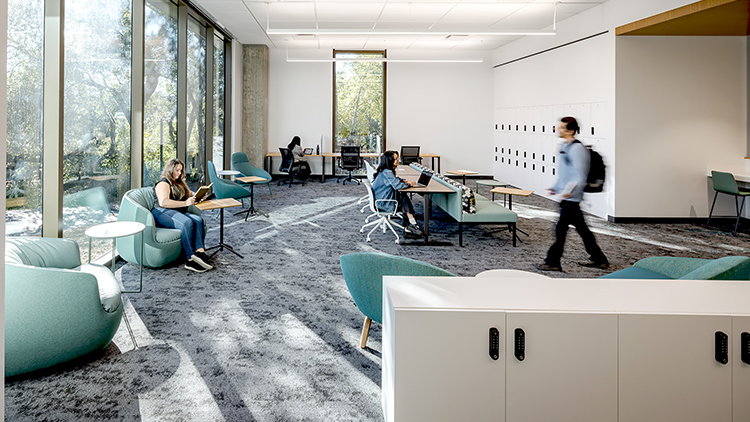
ABA Studios specified carpet tile from Mohawk Group for the West Valley College Learning Resource Center in Saratoga, California.
By Meg Scarbrough
There was a time when many college buildings seemed designed to do one thing well: hold students. Classrooms were classrooms. Dining halls were rows of tables. Residence halls were functional, and not exactly comforting. Flooring, in many cases, was chosen to disappear into the background—durable enough to survive traffic, but rarely asked to do much else.
That is no longer the brief.
Today, higher education interiors are being rethought through a far more complex lens. Colleges and universities are competing harder for students, paying closer attention to retention and increasingly designing for how students actually live, study, gather and decompress. Spaces are expected to be flexible, intuitive and welcoming. They also need to work harder, because budgets remain tight, renovation cycles are relentless, and facilities teams are under pressure to do more with less. Flooring sits right in the middle of those demands.
On one level, it is still about performance: maintenance, lifespan, acoustics, cleanability, safety and value over time. But designers and manufacturers say flooring is now part of a much broader conversation about experience, identity and wellbeing. It is helping define collaborative zones and quiet nooks. It is being used to support wayfinding without relying on excessive signage. It’s softening spaces that once felt institutional and helping campuses create environments that feel more residential and more personal.
That evolution is unfolding as higher ed continues to navigate a shifting enrollment picture. According to the National Student Clearinghouse Research Center, total postsecondary enrollment reached more than 19.4 million in fall 2025, up 1.0% from the previous year, driven by undergraduate gains. But the broader outlook is still shaped by demographic pressure: the Western Interstate Commission for Higher Education projects that the number of high school graduates will peak in 2025 and then decline steadily through 2041.
For institutions, that means facilities have become more than operational assets. They are recruiting tools, retention tools and, increasingly, signals of institutional priorities.
“I think overall, for higher ed, we’ve seen a shift from these one-size-fits-all spaces more toward environments that feel more human, more flexible and experience-driven,” says John Crews, director of design, education and porcelain studio for Shaw Contract. “These spaces really have to feel more human in order to engage students.”
That same theme surfaced repeatedly across conversations with manufacturers and designers. The terminology varied—wellness, belonging, sensory comfort, student experience—but the underlying idea was consistent: campuses are trying to create places where students want to be.
SHAPING THE STUDENT EXPERIENCE
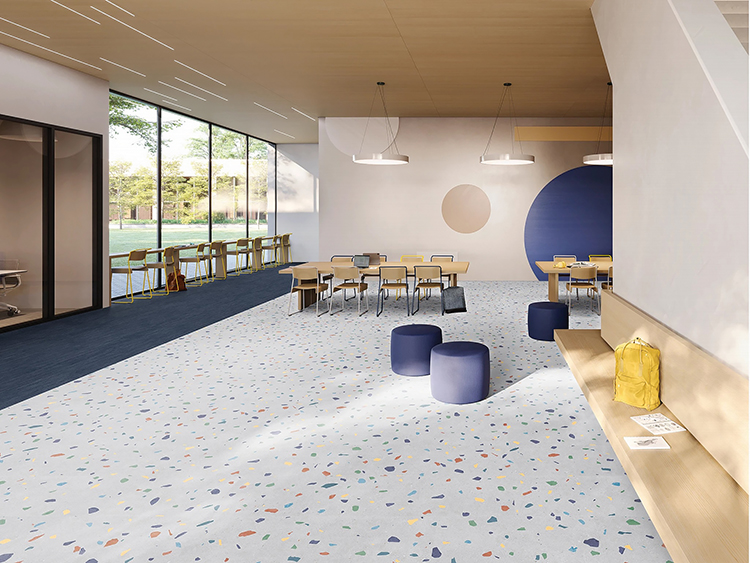
For Kalie Sheppard, an interior designer with MA+ Architecture, one of the clearest changes in higher education design is just how intentionally student-centered it has become.
On a recent pharmacy building project in Oklahoma, she says nearly every conversation came back to the same question: how will this decision affect the student?
The project included collaboration areas near faculty offices to encourage informal interaction, along with study spaces beyond the classroom and a stronger overall emphasis on places where students might actually want to linger. Compared to the older building it replaced—a 1960s-era structure—this new facility was much less about simply fitting a program into a box and much more about supporting how students learn and connect.
That shift resonates with what Mandy Woltjer, associate principal at architecture and design firm GBBN, describes as a growing willingness among higher-ed clients to “dial up the design opportunities,” she says. “They want to really create just moments of impact in their academic settings. That could be anything from just how they’re creatively leveraging technology, really thinking about different postures, creating moments of third spaces for focus and study, as well as group learning and collaborating.”
In other words, the goal is no longer just to provide classrooms or dining areas. It is to create a campus experience.
That matters, in part, because design has become a visible piece of the enrollment equation. Students are paying attention. Parents are paying attention. And universities know it.
Tracy Cook, senior director of business strategy for education and government at Mohawk Group, says that design is very much part of higher ed’s marketing strategy now. “Universities are investing in these facilities and these programs to recruit not just the students, but the parents,” she says. “The parents have to see that this is a pristine environment that’s going to meet all of their child’s needs.”
That can mean highly branded environments, but it can also mean something subtler: creating a campus that feels cared for, current and aligned with student expectations.
COMFORT MEANS INTENTION
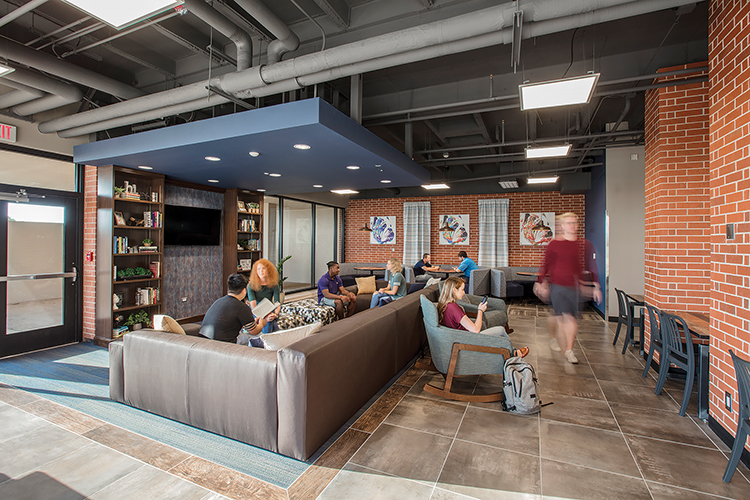
As colleges work to create spaces that feel more welcoming, the idea of comfort has broadened. Comfort can mean acoustical relief. It can mean warmer color palettes. It can mean tactile variation, softened edges, intuitive zoning or simply the ability to find a place that suits your mood and task.
Crews says comfort is inseparable from sensory experience. “The word ‘sensory’ comes up a lot—sensory, tactility,” he says. “We’re seeing elements of residential and hospitality start to make their way into education.”
He also points to a deeper understanding of how different spaces are navigated and occupied. A focus zone may call for one kind of finish language; a collaboration area may call for another. Flooring helps define that distinction.
That same balancing act is evident in the work GBBN is seeing across its higher-ed portfolio. Designers there describe flooring as a tool not just for intuitive wayfinding, but also for flexibility. In libraries, commons and student-centered spaces, furniture is constantly being moved and reconfigured. Meghan Mershmann, an associate at GBBN, jokes that higher-ed students are some of the biggest “space hackers” around, constantly rearranging environments to suit their needs. Flooring has to support that improvisation.
At the same time, designers are making deliberate choices about where softer materials can create quieter, more intimate moments. “In some of the more focus-centric spaces—computer labs, administrative spaces or little co-working zones—we’re definitely layering in more carpet and even area rugs,” Mershmann says. Harder, more utilitarian surfaces still dominate in labs, maker spaces and high-traffic circulation paths, but the all-hard-surface approach is no longer the only answer.
Sheppard sees a similar pattern. LVT remains a staple, especially because the market now offers more color and design flexibility. But soft surface still has a place—particularly where acoustics matter, or where the design is trying to create a more residential atmosphere. “Carpet can be clean, too,” she says, noting that in some lecture and student spaces, soft surface has become easier to justify as product technologies have improved.
That nuanced material mix may be one of the defining characteristics of the current higher-ed market: not a return to carpet everywhere, and not a hard-surface takeover either, but a much more strategic pairing of materials by zone, function and feel.
NO LONGER JUST A FINISH
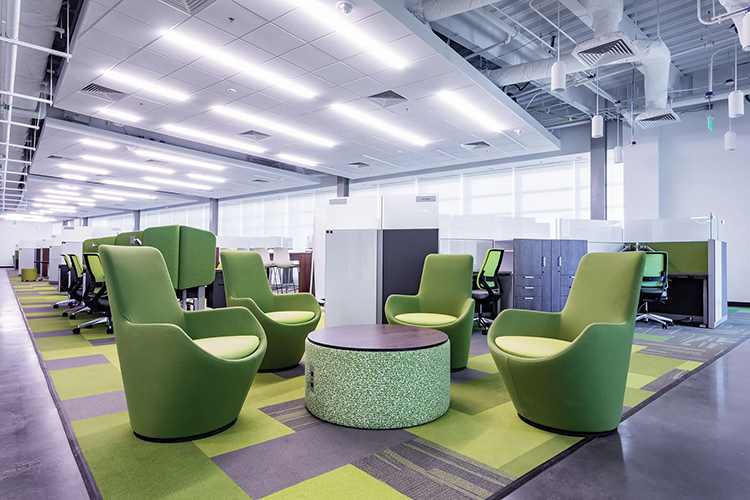
For Jonathan Stanley, director of education and government strategies for Tarkett North America, the biggest shift is that flooring is no longer being evaluated as a simple finish selection. It is being considered as part of overall building performance—and, increasingly, student performance.
“It’s all part of how we want to program the space,” he says. “We have four walls, a ceiling, and we have a floor. This is the largest space that has human connection to it. So, we have to make sure that what happens in the space has an outcome.”
That changes the evaluation criteria. Instead of asking only how long a product will last or how easy it is to maintain, universities and their facilities teams are increasingly asking what impact that material has on acoustics, indoor air quality and cognition.
Stanley, who was appointed to the board of LEARN (Learning Environments Action Research Network) in 2025, says those decisions are becoming more data-driven and more deliberate, particularly as institutions think through the unintended consequences of every design choice. Acoustics, in particular, have become more important as open and flexible spaces multiply. So has the relationship between flooring, sensory load and visual calm.
He also points to a major but less visible force shaping those decisions: maintenance labor. In total-cost-of-ownership research Stanley conducted with partners affiliated with APPA, an organization for educational facilities leaders, one striking figure emerged: a custodian spends 74% of daily activity time maintaining flooring. That means flooring decisions carry enormous operational weight, especially on campuses where maintenance budgets are under pressure.
That tension is becoming more pronounced as institutions put more money into capital renewal and modernization while, in many cases, struggling to fully fund ongoing maintenance. Stanley argues that in facilities-driven decisions—refreshes, renewals and updates led by campus operations teams—flooring remains a high priority precisely because it consumes so much maintenance time and so directly affects how spaces look and perform.
He also notes that higher education is now heavily driven by renovation. “There’s almost 70% modernization and capital renewal projects going on versus new construction in higher education,” he says. “And I really don’t see that changing much over the next several years.”
That observation lines up with what many designers are seeing on the ground, even if some firms currently have more new construction in their own pipelines than others.
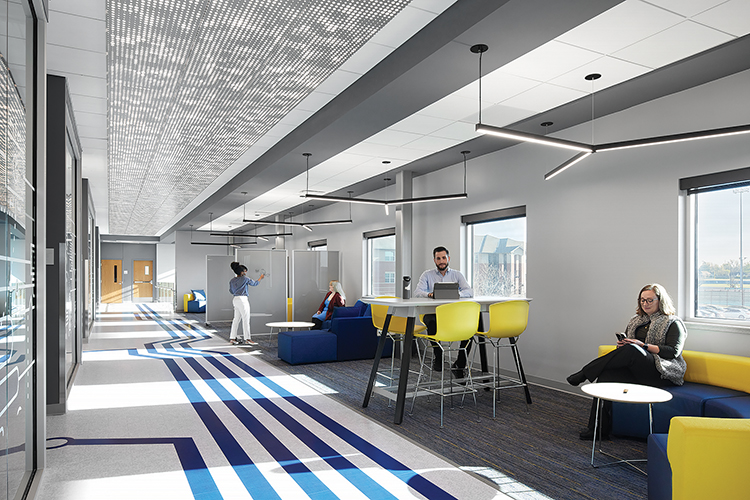
by MA+.
HOUSING AND DINING ARE EVOLVING
If there is one building type that most clearly reveals how campus expectations have changed, it is student housing.
Stanley points to research showing that residence halls can have an outsized effect on enrollment and re-enrollment decisions. What students and parents see in housing—and how clean, comfortable and well-maintained it feels—can influence whether a campus feels like a place they want to call home.
That has had a direct impact on flooring. In one example he provided, housing moved from VCT toward LVT and carpet in residential living spaces to create a more home-like feel. Maintenance remained critical, but so did appearance and comfort.
Crews sees that same shift through a student-housing lens that now feels increasingly multifamily. Private bedrooms, shared commons and amenity-rich living arrangements are changing both the aesthetic and performance demands placed on materials. Those spaces are warmer and more hospitality-driven, but they are also expected to stand up to heavy use and fast turnover.
Dining halls are evolving just as dramatically. Woltjer describes today’s campus dining spaces as centered on choice—food choice, seating choice, sensory choice. Some students want a quiet corner before a test; others want to arrive with a large group and claim a table together. That variability has reshaped layout, furniture planning and flooring.
In one University of Cincinnati project, GBBN was even able to uncover and restore the original terrazzo floor in a 1960s building, turning what could have been a hidden relic into both a sustainability win and a design story.
BRANDING IS GETTING SMARTER
School colors still matter, but higher-ed branding is becoming more sophisticated than simply washing a space in red, blue, orange or green.
Crews says designers are increasingly trying to tell a more local story—something rooted in place, legacy or regional character. “It’s much more complicated than just the school colors,” he says.
Katie Coulson, associate principal at GBBN, echoes that shift, noting that much of its recent higher-ed flooring work leans less on overt accent-striping and more on textural studies, warmer neutrals and subtle dialogue between materials like carpet and polished concrete. Strong repeat patterns and obviously tiled moments have given way to more monolithic looks.
Sheppard has seen branding come through more strongly in flooring because LVT and other categories now offer a wider range of colors making those applications easier to execute. But she also sees campuses balancing that visual identity with calmer spaces that allow students to focus.
That balance matters even more as neurodiversity and sensory experience become more common points of discussion. Stanley notes that the higher-ed conversation around designing for the neurodivergent is as strong as it has ever been. He argues that flooring and pattern can either support cognition or disrupt it, depending on how they are used.
His advice is not to eliminate color or branding, but to be more intentional about where bold pattern or color appears and where the rest of the building needs to quiet down.
STUDENTS DRIVING SUSTAINABILITY
If there is one vertical where sustainability pressure seems especially strong, designers say it is higher education.
Sometimes that pressure is baked into policy. Public institutions may have LEED or other standards built into project requirements. Sometimes it comes from institutional climate goals. And often, designers say, it comes from students themselves.
At GBBN, Woltjer notes that universities are among the most sustainability-forward clients in the firm’s Midwest work, often more engaged on the topic than clients in other verticals. They care about certifications, carbon, reuse and material health, and students are actively asking questions.
Cook says the next generation is especially tuned into sustainability and environmental issues, which makes institutional commitments in this area part of the broader attraction story.
At the same time, the market is still navigating tradeoffs. Sheppard notes that clients in her region are not always the ones pushing the sustainability conversation; in many cases, designers are the ones leading it. Crews pointed to the growing interest in the advantages of sustainable products and the popularity of Shaw’s EcoWorx Resilient platform. GBBN designers emphasize that when LVT is used, they are trying to make the most responsible choice possible, while also considering cost and durability realities.
That tension—between ideal material outcomes and real-world constraints—may define the next chapter of higher-ed flooring specification as much as any design trend does.
MORE FLEXIBLE, MORE SENSORY, MORE STRATEGIC
Taken together, these conversations suggest that higher education interiors are moving toward something more layered and adaptive than the sector has historically been known for.
There is more attention to student wellbeing, more emphasis on retention and belonging, more pressure to make spaces work harder and tell a stronger story, more scrutiny on lifecycle value, more pairing of soft and hard surfaces in deliberate ways, and more use of flooring as a spatial tool rather than a passive finish.
And there is also, increasingly, a sense that these spaces need to do emotional work, not just functional work.
That may mean a Zen room in a screen-heavy innovation center. It may mean a carpeted nook in a library. It may mean traction-rated porcelain in a café spill zone or LVT with acoustic backing in student housing. It may mean restoring terrazzo rather than burying it. Or it may simply mean understanding that a student walking into a building is making judgments—often instantly—about whether that place feels like somewhere they belong.
Higher education still has to deliver on the practicals: budgets are real, deferred maintenance is real, enrollment pressure is real. But for designers, manufacturers and facilities teams, the conversation has clearly moved beyond basic durability.
As Stanley puts it, the floor is the largest surface students physically connect with. The more intentional campuses become about the environments they create, the harder that surface has to work.
And increasingly, it is.


Join Our Newsletter
Get the latest flooring industry news delivered weekly.