Designer Forum - December 2010
By Tami Bopp
Over the past ten years, our architecture and interior design firm, Hahnfeld Hoffer Stanford, has seen marvelous growth. And during that growth period, we were fortunate to have our offices in one of Fort Worth’s most historic buildings—a converted church with spectacular architectural elements. Through the years, our office had become a defining part of who we were as an organization, while also serving as the home for our local American Institute of Architects (AIA) chapter. So it was bittersweet when our space requirements exceeded the building’s capacity.
At first, we worked through the space issues by leasing an adjacent building as an annex. However, this arrangement created numerous logistics issues, and by 2009 it proved to be an unworkable situation. The firm decided it would need to make a move to an office that could meet current needs, as well as accommodate future growth. Even in this soft commercial real estate market, finding a space that had the historic charm of the converted church proved elusive. So we concentrated on finding a space that would meet our needs, while providing a layout that our interior design team could work wonders with.
Within a few months, we found a suitable space, an office building designed in the 1980s that had been used as a showroom for an interior decorating firm. With steep angles and an open floor plan, it offered numerous architectural focal points, as well as providing a blank canvas for our interior design team’s vision.
Though we were creating a space for our firm, we took the same approach that we use with our clients. We examined what our space needs would be in the short and long term, and we analyzed the ways we could be more productive as a company—all the while encouraging creativity. Our discussions were thought provoking and brought us together as a firm. We developed goals for the project that we believed would ensure a seamless and positive transition for everyone, while also creating a more productive space to work in. In short, we wanted our new space to accomplish the following things: become a showcase for potential clients; reflect a certain image and culture to clients and employees; induce team collaboration and function efficiently; and work within our firm’s budget and an extremely tight timeframe.
Our clientele is diverse. We sought to provide a space that would be comfortable to both our faith-based and education clients, as well as corporate law firms and real estate brokers. We are a Fort Worth-based firm, but we also compete for projects throughout the Southwest. As an architecture and interior design firm, it is important for us to have a space that shows off not only the firm’s culture, but our talent as well.
Since budget was important, we needed to create a dynamic space with minimal costs. This is where the angled walls and open floor plan would come into play. We could use these angles in creative ways to enhance the floor plan. The cost would be minimal, the impact extraordinary. Another aspect of our “showcase” would be to include the different products that we might specify in our clients’ projects—essentially creating an interior design showroom within our office that included textured accent walls, lighting, stone material, laminates, and a multitude of flooring materials.
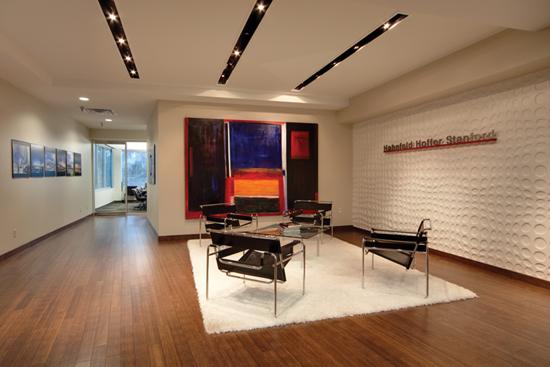
We have a variety of zones in our new space that require different flooring materials. In our multipurpose room, we selected Teknoflor Series Two Natural Wood Collection, a no-wax sheet vinyl which we use a lot in high-traffic areas for faith based work and healthcare projects. We selected bamboo flooring in our main lobby space to showcase a warm, inviting look and emphasize our commitment to renewable products. Multiple carpet selections were used to define different activities for meeting areas, private work zones and open office work zones. This is often the look we develop for our clients as well.
It was important to us that the new space be a working office, not a museum or cold environment. Our previous office had a lot of warmth and character. The new space is more of a typical office, its strongest benefit being that its wrap-around windows provide a lot of natural light, something we did not previously have.
We decided that it would be important to allow every employee access to the vast window area that surrounded the entire space. It was determined this could become a theme to our layout. Though it might be a culture shock at first, over the long-term it would foster productivity and personal interaction among the staff, in addition to our clients. One of our challenges with an open plan was to divide up the flooring. We selected two carpet tiles for the open office area that were companion pieces but on different scales. This helped to define the traffic pattern and scale of the space.
In our previous space, we were segregated due to the lack of space and the type of building we were occupying. Going forward, it was important for us to emphasize the project team. The layout of the space allowed us to design team “pods” of four people with a meeting table in the center. Against the backdrop of the natural light, this encourages spontaneous meetings and staff interaction. Using lower workstation panels provides workspace privacy, while allowing employees to view the surrounding exterior when standing up. The new layout also requires a different storage solution. Each workstation is provided with a tower that allows garment storage and additional filing.
Due to the lease arrangement, we had approximately six weeks to complete our build-out process. That meant that we needed to use as much in-stock product as possible, since we didn’t have time to special order. Where this issue affected us the most was in flooring. The challenge was finding carpet that fulfilled our design aesthetics, budget and time requirements without reselecting all of our other materials.
In the end, we used carpet tiles, which included Bolyu’s Dhurrie Remix, for our meeting spaces, Lees Carpets’ Parkway and Mast in our open office area, and J+J/Invision’s Edge II broadloom for our private office spaces. We started with three different carpets, but due to the speed with which we needed to complete the project, we ended up with four. Teragren Signature Bamboo Flooring was installed throughout the space at an angle, to create more dynamic energy. Using existing furniture and creating an accent wall from preformed panels also helped add dynamic impact to the space. The result is a seamless transition that blends all of the design elements together.
Finally, like many architecture firms, we have several professionals who are also accomplished artists. By showcasing their artwork, we created focal points throughout the office, which also serve as conversation pieces with clients and visitors. These finishing touches completed the look we were after.
Since the space we selected was a second-generation office space that had been occupied by a tenant who moved upstairs, we definitely needed to change the look and create an identity all our own. At the end of the day, we feel that we transformed the space into something special that epitomizes the “form and function” aesthetic. Most importantly, we succeeded in designing a floor plan that our employees can be proud of, bringing out the spirit of our firm, both in terms of who we are today and who we aspire to be in the future.
Interior design is a balancing act. To ensure each project’s success, a designer’s plan for the space must reflect the personality of the organization or client, while enabling multiple tasks, like maximizing functionality and efficiency of the space. Creating the perfect environment for a client is always a challenge, but creating the perfect space for your own firm is the ultimate challenge.
Copyright 2010 Floor Focus
Related Topics:Mohawk Industries, HMTX, The American Institute of Architects