Ceramic Tile's Game Changing Transition - A/S 2011
By Bill Griese
While there are plenty of arguments for ceramic tile’s sustainability—its primary ingredients (sand, clay and feldspar) are readily available, it emits no VOCs, and it has a lifecycle that can span centuries—demand in the marketplace for product transparency means that changes are in store for the tile industry.
Using ASTM International’s definition of sustainability, a sustainable product is one that “meets the needs of the present without compromising the ability of future generations to meet their own needs.” In recent years, these needs were straightforward and dependent upon specific social or environmental priorities. However, additions to Leadership in Energy and Environmental Design (LEED), the in-process Green Squared standard and the development of environmental product declarations are paving the way for more comprehensive evaluations of products. These developments will be valuable in helping the industry and end-users measure the overall sustainability of ceramic tile as a flooring surface.
NEW METHODS OF SPECIFYING SUSTAINABLE PRODUCTS
The U.S. Green Building Council (USGBC) recently announced the addition of a new pilot credit for the Materials and Resources chapter of LEED. This credit, numbered 43 and titled “Certified Products,” awards a point to a building project that uses products with single or multi-attribute sustainability certifications, lifecycle assessments, and/or standardized environmental product declarations that in total contribute a weighted value of at least 10% of the total value of all non-structural materials and products on the project. The intent of this credit is “to increase the use of products and materials with lifecycles, ingredients, and attributes understood and optimized to improve overall environmental, economic, and social performance.” As stated by USGBC on its website, “We want LEED buildings to have more products that we know more about, and fewer products that we don’t know very much about.”
In the past decade LEED had a significant influence in establishing certain social and environmental sustainability priorities. This resulted in marketplace demands focused on specific single attributes. As products meeting each (and sometimes all) of these demands became more readily available, consumers began needing more information and guidance on which products to choose. Third-party product certification programs were created, multi-attribute sustainability demands increased, consumers began considering lifecycle sustainability impacts of products, and there was a general increase in the demand for standardized environmental reporting.
Today, all-inclusive sustainability demands are more prevalent than ever. In LEED pilot credit 43, partial credit is given to products with single attribute or self-declared sustainability achievements, full credit is given to products with industry-recognized achievements (multi-attribute sustainability or industry-wide declarations), and exemplary credit is given to products that declare everything, including sustainability achievements and shortcomings (product specific reporting).
Leed Pilot Credit 43 Compliance Pathways
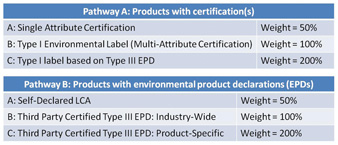
Why is this a game-changer for the ceramic tile and flooring industries? As shown in the table above, LEED pilot credit 43 is moving away from the old system of single attribute criteria and towards two important new ways of thinking about sustainability: one that requires compliance with multi-attribute lifecycle-based criteria and another that requires standardized sustainability reporting as an environmental product declaration (EPD). Ceramic tile industry initiatives aligned with both approaches are already underway.
In fact, the Tile Council of North America is participating in the first joint flooring industry initiative to develop PCRs specifically for the U.S. market, under the leadership of NSF International. The process should be completed by the end of the year.
GREEN SQUARED: A NEW STANDARD FOR CERAMIC TILE PRODUCT SUSTAINABILITY
To establish a set of multi-attribute lifecycle-based sustainability criteria for its products, the North American ceramic tile industry is writing a multi-attribute standard, ANSI A138.1, named Green Squared. Led by the Tile Council of North America (TCNA), its members and members of the greater green building community, this effort is modeled after other well-respected multi-attribute standards. Once in place, the products certified to the Green Squared standard could be considered for contribution to LEED and would receive even greater acceptance in the sustainable product marketplace.
Green Squared will introduce sustainability criteria for porcelain, pressed floor, mosaic and quarry tile. Additionally, mortar, grout, membranes, backerboards and many other products needed to tile floors will be standardized. Once completed, it will be the very first sustainable building material standard to encompass a full range of products within an industry.
Products Covered By Green Squared
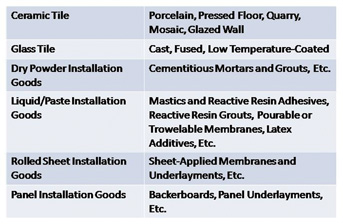
The sustainability criteria for each product category in Green Squared will be in accordance with the North American green building industry’s practices, expectations, and leading initiatives. The standard will establish a consistent approach to the evaluation and determination of sustainable products, and it will include relevant criteria through the product lifecycle, from raw material extraction through manufacturing, use, and end of life management.
Green Squared will consist of the following sections: General Environmental Characteristics (product characteristics), Environmental Product Manufacturing including raw material extraction, End of Product Life Management, Progressive Corporate Governance, and Innovation.
Green Squared Areas Of Standardization As A Percentage Of Total Sustainability Criteria
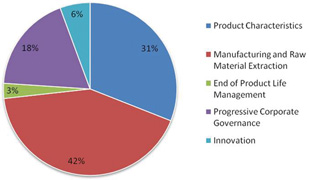
Reflecting the latest environmental thinking and to meet today’s multi-attribute sustainability expectations, the first section of Green Squared, General Environmental Characteristics, includes the following environmental criteria: recycled content/reclaimed content, indigenous raw goods, environmental packaging, durability, low emissions, environmental maintenance, solar reflectance index (SRI), light reflectance value (LRV), sound abatement, third party LCA and EPD, and participation in LCA database initiatives.
The second section of Green Squared, Environmental Product Manufacturing and Raw Material Extraction, lays the foundation for environmental manufacturing. It covers these subjects: particulate emissions, combustion and fuel usage, raw goods sourcing and extraction, outsourced packaging and manufacturing services, environmental management plans and systems, utility usage, renewable energy, manufacturer waste diversion/minimization and shipping material waste minimization.
The third section of Green Squared, End of Product Life Management, reflects that tile products are durable, inert and intended to last as long as the buildings in which they are installed. Tile and related installation materials are engineered to serve as permanent finishes capable of outliving several generations of building occupants. Because end of life management is most pertinent to building demolition waste and waste generated during construction, the following areas are evaluated: availability of manufacturer guidelines on clean fill usage and the eligibility of their products, and availability of end of product life collection options by manufacturers.
The fourth section of Green Squared, Progressive Corporate Governance, sets corporate social responsibility criteria for the workplace and for community involvement. The following areas are covered: social responsibility strategy, baseline labor law compliance, baseline environmental regulation compliance, baseline health and safety regulation compliance, participation in voluntary health and safety programs, baseline FTC Green Guides compliance, continuous community involvement, public disclosure, sustainability reports, and certified “green” facilities.
The final section of Green Squared, Innovation, gives manufacturers the opportunity to achieve product sustainability recognition through exceptional performance beyond the requirements set forth in the standard and/or for innovative performance in categories not specifically addressed. The following areas are evaluated: “Above and Beyond” standardized criteria (exemplary conformance), innovative technologies and carbon footprint awareness, and greenhouse gas reduction strategies.
Green Squared is currently being considered by the ANSI A108 Committee, which represents a diverse cross-section of tile industry and green building community stakeholders. Once approved, it will serve as a valuable tool and clear standard for assessing the overall sustainability of tile and installation materials in today’s green building world.
The demands related to ceramic tile product sustainability are constantly evolving. Accelerated by recent additions to LEED, the era of single attribute promotion and self-declared sustainability is ending and a new era of prescribed multi-attribute requirements and standardized environmental reporting begins.
Copyright 2011 Floor Focus
Related Topics:RD Weis